. 2025 Feb:112:105537.
doi: 10.1016/j.ebiom.2024.105537. Epub 2025 Jan 2.

Genetic factors shaping the plasma lipidome and the relations to cardiometabolic risk in children and adolescents

Affiliations

Genetic factors shaping the plasma lipidome and the relations to cardiometabolic risk in children and adolescents

Yun Huang et al. EBioMedicine. 2025 Feb.

Abstract

Background: Lipid species are emerging as biomarkers for cardiometabolic risk in both adults and children. The genetic regulation of lipid species and their impact on cardiometabolic risk during early life remain unexplored.

Methods: Using mass spectrometry-based lipidomics, we measured 227 plasma lipid species in 1149 children and adolescents (44.8% boys) with a median age of 11.2 years. We performed genome-wide association analyses to identify genetic variants influencing lipid species. Colocalisation and Mendelian randomisation (MR) analyses were performed to infer causality between lipid species and cardiometabolic outcomes.

Findings: We identified 37 genome-wide significant loci for 52 lipid species, nine of which are previously unreported. Colocalisation analyses revealed that seven lipid loci shared genetic variants associated with adult cardiometabolic outcomes. One-sample MR analysis identified positive causal associations between ceramides and liver enzymes, sphingomyelins and hemoglobin A1c (HbA1c), and phosphatidylethanolamines and high-sensitivity C-reactive protein in children and adolescents. Two-sample MR using adult-based summary statistics showed consistent direction of associations and indicated additional causal links, specifically between ceramides and elevated HbA1c levels, and phosphatidylinositols with elevated liver enzymes.

Interpretation: These findings highlight the potential long-term implications of plasma lipid genetic determinants on cardiometabolic risk.

Funding: Novo Nordisk Foundation, The Innovation Fund Denmark, The Danish Heart Foundation, EU Horizon, and LundbeckFonden.

Keywords: Cardiometabolic risk; Children; Genome-wide association study; Lipidomics; Mendelian randomisation.


Conflict of interest statement

Declaration of interests C.E.F. has received speaker honoria from Nestlé, Siemens, Novo Nordisk, and the organisation of Danish General Practitioners. T.H. has stocks in Novo Nordisk and Genmab. A.K. receives grants from EU Horizon 2020 (grant numbers 668031, 847989, 825694, 964590), Novo Nordisk Foundation (NNF15OC0016692), Innovationfund Denmark—Innoexplorer, Danish National Research Foundation, Region of Southern Denmark (Elite Research Centre), AstraZeneca and Innovative Health Initiative (IHI). A.K. receives royalties from Gyldendal, payment for lectures from Norgine, Siemens, and Novo Nordisk. A.K. has two patents planned/pending from Region of Southern Denmark and University of Southern Denmark, participates on an advisory board for Norgine, Siemens, Novo Nordisk, Boehringer Ingelheim. A.K. has a leadership role as the Secretary General European Association for the Study of The Liver 2023–2025. A.K. has received equipment, materials, and drugs from Norgine (Rifaximin), Siemens (ELF test), Echosence (FibroScan), and Nordic Bioscience (ECM markers). A.K. has financial interest as the Board member and co-founder Evido. M.T. has received consulting fees from Boehringer Ingelheim, Astra Zeneca, Novo Nordisk, and GSK. M.T. received speaker's fee from Siemens Healthcare, Echosens, Norgine, Madrigal, Takeda and Tillotts Pharma as well as advisory fee from Boehringer Ingelheim, Astra Zeneca, Novo Nordisk and GSK. M.T. is the vice-chair for the board of Alcohol & Society (non-governmental organisation) and board member for Evido. P.R. received study drugs provided by Bayer, Novo Nordisk, and Lexicon. P.R. received grants from Bayer, Astra Zeneca and Novo Nordisk to the institution, as well as receives consulting fees from Astra Zeneca, Bayer, Boehringer Ingelheim, Novo Nordisk, Daichii Sankyo and Gilead. C.L.-Q. has received consultancy fees from Pfizer. She has received honoraria, travel or speakers' fees from Biogen. She is the director of the company BrainLogia. J-C.H. has received honoria from Novo Nordisk and Rhythm Pharma. J-C.H. provides training and treatment of obesity at Dr Holm Clinic. The remaining coauthors declare no competing interests.

Figures

Fig. 1
Fig. 1
Schematic study design. We conducted GWAS for 227 lipid species in 1149 children and adolescents to identify loci independently associated with lipid species. Following this, we performed colocalisation analysis to identify variants that colocalise with 16 cardiometabolic outcomes. To further explore these associations, we carried out Mendelian Randomisation (MR) analysis, assessing the relationship between genetically predicted lipid levels and cardiometabolic outcomes. This was done using both individual-level data from children and adolescents, and publicly available GWAS summary statistics from adult studies. Created with BioRender.com.
Fig. 2
Fig. 2
Genome-wide associations of plasma lipid species. a, Manhattan plot displaying chromosomal positions (x-axis) of significant associations. Genetic loci that pass the study-wide significant threshold (P < 2.2 × 10−10; P from GWAS analysis using linear mixed models with the Wald test) were labelled on the bottom (red points). b, Associations of 37 lead SNPs at independent genetic loci with 52 lipid species. Red points indicate positive associations, and blue points indicate negative associations. Point size reflects genome-wide significance (P < 5 × 10−8) or study-wide significance (P < 2.2 × 10−10).
Fig. 3
Fig. 3
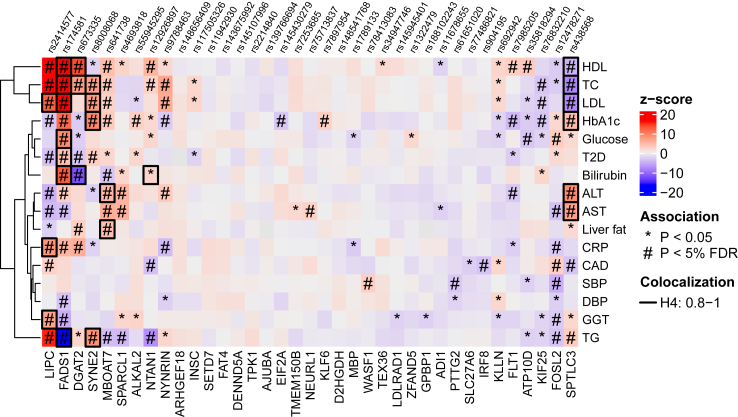
Lipid loci associations and colocalisation with T2D, CAD, and 14 cardiometabolic traits. For the lead SNP at each lipid locus, z-scores (aligned to lipid-increasing allele) were obtained from available GWAS summary statistics (red indicates a positive and blue a negative association between the lipid-increasing allele and the outcome). ∗denotes P < 0.05, and #indicates FDR-adjusted P < 0.05 (P from GWAS summary statistics of outcomes). Colocalisation evidence was found in 26 lipid-outcome pairs. Squares with a black solid line border indicate high support for colocalisation (H4 > 0.8). Abbreviations: HDL, high-density lipoprotein cholesterol; TC, total cholesterol; LDL, low-density lipoprotein cholesterol; HbA1c, haemoglobin A1c; T2D, type 2 diabetes; ALT, alanine aminotransferase; AST, aspartate transaminase; CRP, C-reactive protein; CAD, coronary artery disease; SBP, systolic blood pressure; DBP, diastolic blood pressure; GGT, gamma glutamyl transferase; TG, total triglycerides.
Fig. 4
Fig. 4
MR estimates for the association between genetically predicted lipid levels and cardiometabolic outcomes. a, One-sample MR (1SMR) using two-stage least squares method in 1117 children and adolescents. In stage 1, lipids were regressed on the genetic instrument, adjusting for age, sex, BMI SDS, cohort, the year of blood sample collection, genotype batch, and the first four genetic principal components which explained 61.39% of the genetic variance. In stage 2, the predicted lipid levels were used to estimate their association with the outcome, adjusting for age, sex, BMI SDS, cohort, and the year of blood sample collection. β coefficients and 95% confidence intervals (CI) represent the association of per standard deviation increase in genetically predicted lipids on cardiometabolic outcomes. Four nominally significant associations were shown. b, MR estimates from two-sample MR (2SMR) for 10 lipid-outcome combinations with colocalisation evidence, using publicly available summary statistics of outcomes (P < 5% FDR, red indicates positive estimates, blue indicates negative estimates). Abbreviations: ALT, alanine aminotransferase; AST, aspartate transaminase; HbA1c, haemoglobin A1c; GGT, gamma glutamyl transferase; CRP, C-reactive protein.

References

    1. Bhargava S., La Puente-Secades S de, Schurgers L., Jankowski J. Lipids and lipoproteins in cardiovascular diseases: a classification. Trends Endocrinol Metab. 2022;33:409–423. doi: 10.1016/j.tem.2022.02.001. - DOI - PubMed
    1. Tabassum R., Ripatti S. Integrating lipidomics and genomics: emerging tools to understand cardiovascular diseases. Cell Mol Life Sci. 2021;78:2565–2584. doi: 10.1007/s00018-020-03715-4. - DOI - PMC - PubMed
    1. Han X. Lipidomics for studying metabolism. Nat Rev Endocrinol. 2016;12:668–679. doi: 10.1038/nrendo.2016.98. - DOI - PubMed
    1. Choi R.H., Tatum S.M., Symons J.D., Summers S.A., Holland W.L. Ceramides and other sphingolipids as drivers of cardiovascular disease. Nat Rev Cardiol. 2021;18:701–711. doi: 10.1038/s41569-021-00536-1. - DOI - PMC - PubMed
    1. Jensen P.N., Fretts A.M., Hoofnagle A.N., et al. Circulating ceramides and sphingomyelins and the risk of incident cardiovascular disease among people with diabetes: the strong heart study. Cardiovasc Diabetol. 2022;21:167. doi: 10.1186/s12933-022-01596-4. - DOI - PMC - PubMed