


Accelerometry-assessed sleep clusters and obesity in adolescents and young adults: a longitudinal analysis in GINIplus/LISA birth cohorts
- PMID: 39754701
- PMCID: PMC11813820
- DOI: 10.1007/s12519-024-00872-5
Accelerometry-assessed sleep clusters and obesity in adolescents and young adults: a longitudinal analysis in GINIplus/LISA birth cohorts
Abstract
Background: Some studies have revealed various sleep patterns in adolescents and adults using multidimensional objective sleep parameters. However, it remains unknown whether these patterns are consistent from adolescence to young adulthood and how they relate to long-term obesity.
Methods: Seven-day accelerometry was conducted in German Infant Study on the influence of Nutrition Intervention PLUS environmental and genetic influences on allergy development (GINIplus) and Influence of Lifestyle factors on the development of the Immune System and Allergies in East and West Germany (LISA) birth cohorts during the 15-year and 20-year follow-ups, respectively. Five sleep clusters were identified by k-means cluster analysis using 12 sleep characteristics at each follow-up. Adjusted linear and logistic regression models using generalized estimating equations were examined. Further, the interaction effects with time of follow-ups and polygenic risk scores (PRS) for body mass index (BMI) were tested.
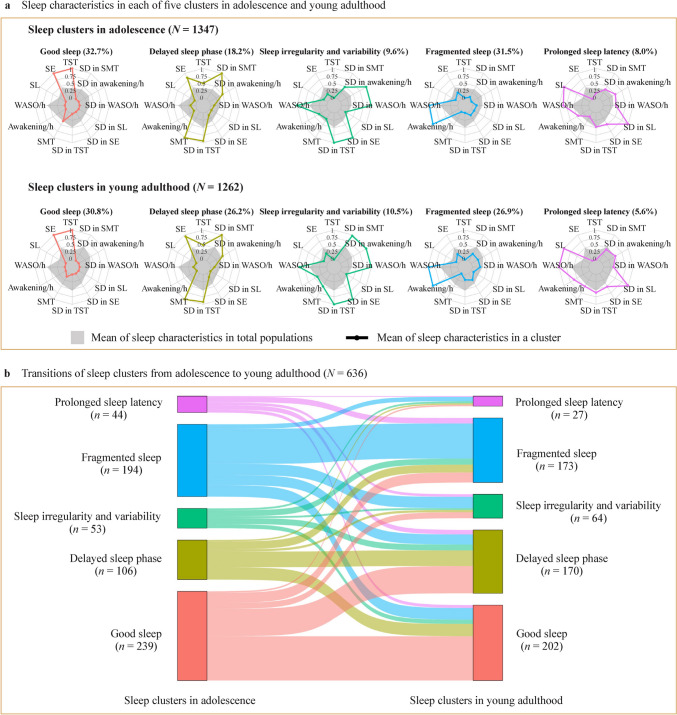
Results: Five sleep clusters were classified consistently in both adolescence (n = 1347, aged 14.3-16.4 years) and young adulthood (n = 1262, aged 19.5-22.4 years). Adolescents in the "good sleep", "delayed sleep phase", and "fragmented sleep" clusters displayed greater stability transitioning into young adulthood, while those in the "sleep irregularity and variability", and "prolonged sleep latency" clusters showed lower stability (n = 636). Compared to the "good sleep" cluster, the "prolonged sleep latency" cluster exhibited associations with higher BMI [β = 0.56, 95% confidence interval (CI) = (0.06, 1.05)] and increased odds of overweight/obesity [Odds ratio = 1.55, 95% CI = (1.02, 2.34)]. No significant PRS-sleep cluster interaction was found for BMI or overweight/obesity. Among males only, the "delayed sleep phase", "sleep irregularity and variability" and "fragmented sleep" clusters showed stronger associations with overweight/obesity as age increased.
Conclusion: Adolescents and young adults shared five consistent sleep patterns, with the "prolonged sleep latency" pattern linked to higher BMI and overweight/obesity.
Keywords: Accelerometry; Adolescents; Obesity; Sleep clusters; Young adults.
© 2024. The Author(s).
Conflict of interest statement
Declarations. Conflict of interest: No financial or non-financial benefits have been received or will be received from any party related directly or indirectly to the subject of this article. Ethical approval: The GINIplus and LISA studies were approved by the local ethics committees, and all participants and their parents gave written informed consents.
Figures


References
-
- Sun J, Wang M, Yang L, Zhao M, Bovet P, Xi B. Sleep duration and cardiovascular risk factors in children and adolescents: a systematic review. Sleep Med Rev. 2020;53:101338. - PubMed
-
- Tobaldini E, Fiorelli EM, Solbiati M, Costantino G, Nobili L, Montano N. Short sleep duration and cardiometabolic risk: from pathophysiology to clinical evidence. Nat Rev Cardiol. 2019;16:213–24. - PubMed
-
- Martinez-Gomez J, Fernandez-Alvira JM, de Cos-Gandoy A, Bodega P, de Miguel M, Tresserra-Rimbau A, et al. Sleep duration and its association with adiposity markers in adolescence: a cross-sectional and longitudinal study. Eur J Prev Cardiol. 2023;30:1236–44. - PubMed
Publication types
MeSH terms
Grants and funding
LinkOut - more resources
Full Text Sources
Medical
