


Brain activity patterns reflecting security perceptions of female cyclists in virtual reality experiments
- PMID: 39755730
- PMCID: PMC11700102
- DOI: 10.1038/s41598-024-81271-8
Brain activity patterns reflecting security perceptions of female cyclists in virtual reality experiments
Abstract
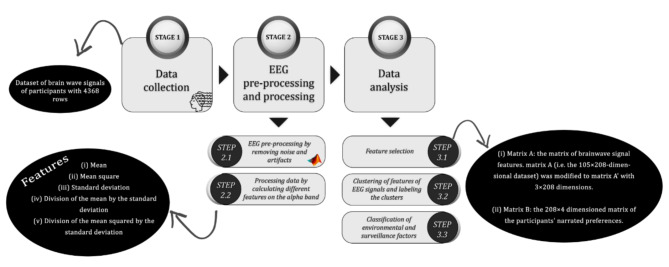
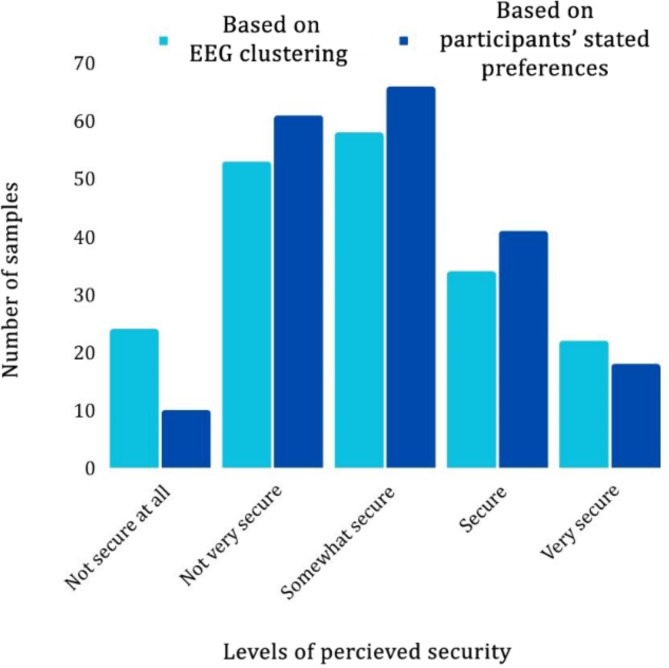
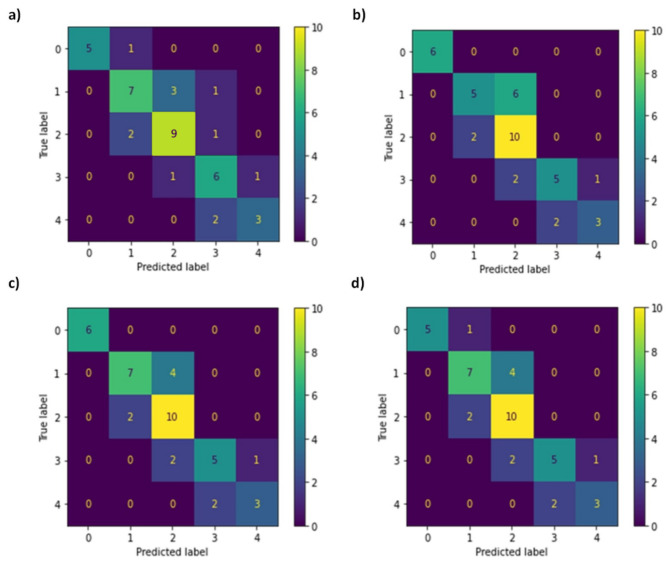
Active transportation, such as cycling, improves mobility and general health. However, statistics reveal that in low- and middle-income countries, male and female cycling participation rates differ significantly. Existing literature highlights that women's willingness to use bicycles is significantly influenced by their perception of security. This study employs virtual reality (VR) cycling simulation and electroencephalography (EEG) analysis to investigate factors influencing female cyclists' perceptions of security in Tehran. A total of 52 female participants took part in four scenarios within a VR bicycle simulator, which simulates various environmental settings. In this experiment, participants' brainwave signals are gathered through an EEG device, and a questionnaire with their stated preferences is filled out. The Gaussian mixture approach is used to cluster brainwave patterns based on security perception from EEG data. Subsequently, four supervised machine learning methods, random forest, support vector machine, logistic regression, and multilayer perceptron, are utilized to classify influential factors on security perception using clustered EEG data. Consequently, the support vector machine model, with an F1 score of 0.74, appears to be the most effective technique for the classification of environmental and surveillance factors. Furthermore, the SelectKBest algorithm determines that factors such as the presence of obstacles like kiosks, cycling routes passing through tunnels and underpasses, the level of incivility in the urban cycling environment, and the presence of informal surveillance have the biggest impact on female cyclists' security perception.
© 2024. The Author(s).
Conflict of interest statement
Declarations. Competing interests: The authors declare no competing interests.
Figures





References
-
- da Silva, C., da Silva, D. R. & Nélson, A. Sustainable modes and violence: Perceived safety and exposure to crimes on trips to and from a Brazilian university campus. J. Transp. Health. 16, 100817 (2020).
-
- Firoozi Yeganeh, S., Khademi, N., Farahani, H. & Besharat, M. A. A qualitative exploration of factors influencing women’s intention to use shared taxis: a study on the characteristics of urban commuting behavior in Iran. Transp. Policy. 129, 90–104 (2022).
-
- Hsu, H. P. How does fear of sexual harassment on transit affect women’s use of transit? In Women’s Issues in Transportation, Summary of the 4th International Conference, vol. 2, 85–94 (2009).
-
- Dunckel-Graglia, A. & Women-Only, T. How pink public transportation changes public perception of women’s mobility. J. Public. Transp.16, 85–105 (2013).
-
- Gardner, N., Cui, J. & Coiacetto, E. Harassment on public transport and its impacts on women’s travel behaviour. Aust. Plan.54, 8–15 (2017).
Publication types
MeSH terms
LinkOut - more resources
Full Text Sources
