. 2025 Jan 4;15(1):820.
doi: 10.1038/s41598-024-84422-z.

Feasibility study of hyperspectral colposcopy as a novel tool for detecting precancerous cervical lesions

Affiliations

Feasibility study of hyperspectral colposcopy as a novel tool for detecting precancerous cervical lesions

Carlos Vega et al. Sci Rep. .

Abstract

Cervical cancer remains a major global health concern, with a specially alarming incidence in younger women. Traditional detection techniques such as the Pap smear and colposcopy often lack sensitivity and specificity and are highly dependent on the experience of the gynaecologist. In response, this study proposes the use of Hyperspectral Imaging, a pioneering technology that combines traditional imaging with spectroscopy to provide detailed spatial and spectral information. Over a period of six-months, our custom-designed hyperspectral colposcope was used on 62 patients. The gathered data underwent a specialized preprocessing workflow using a PCA-based strategy for unsupervised segmentation of the cervical region. This process extracted spectral signatures from various tissue types, and our subsequent statistical analysis highlighted its ability to detect differences and alterations in the cervical tissue. This offers a promising avenue for improving the precision of cervical lesion diagnosis.


Conflict of interest statement

Declarations. Competing interests: The authors declare no competing interests.

Figures
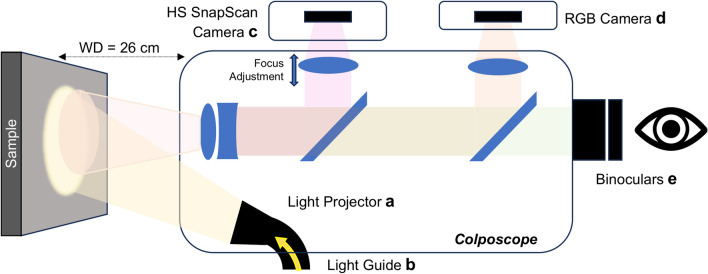
Fig. 1
Fig. 1
Schematic of the HS Colposcope optics. (a) Light projector over the sample. (b) Light guide from the light source. (c) HS camera. (d) RGB camera. (e) Binoculars for gynaecologist vision.
Fig. 2
Fig. 2
Results of the HS colposcope characterisation. (a) Reflectance profile from the ruler and its first derivative (green and red crosses meaning local maxima and minima, respectively). (b) Contrast with respect to frequency for different wavelengths. (c) Distortion values with respect to the wavelength, showing the characterised function of the graph. (d) Light distribution on the sensor and maximum light spot. (e) Mean spectra from two different radial profiles and a certified reference. (f) Contrast at different working distances, showing optimal DoF at MTF50. (g) Summary of characterization parameters.
Fig. 3
Fig. 3
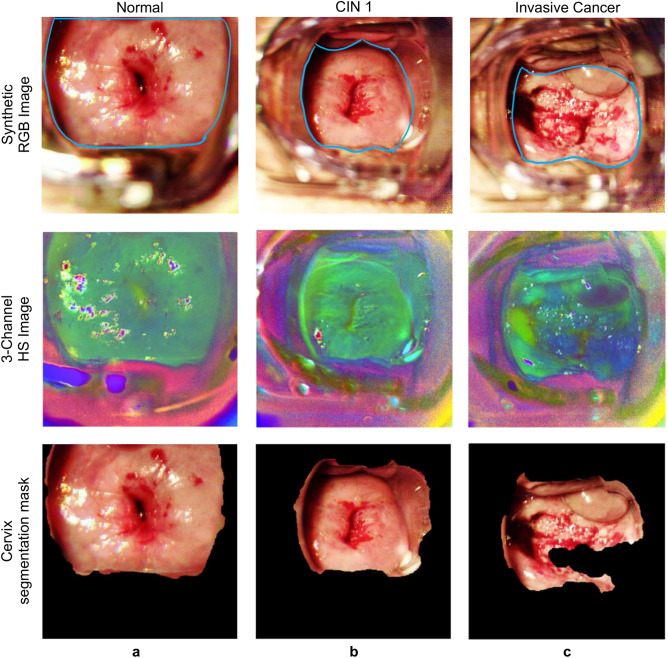
Result of the PCA-based cervix segmentation approach in different tissue and lesion types. (a) Normal cervix. (b) CIN 1. (c) Invasive cervical cancer. Blue line represents cervix area.
Fig. 4
Fig. 4
Results of the unsupervised segmentation of the cervical tissue into exocervix (blue), endocervix (green), outliers (black) and spectral signatures for different lesions grades. (a) Normal cervix. (b) CIN 1. (c) CIN 3.
Fig. 5
Fig. 5
Spectral comparison of the different cervical tissue types. Mean (a) reflectance and (b) absorption spectra for each of the different classes. Statistical analysis performed to evaluate the differences between the different tissue types for (c) reflectance and (d) absorption spectra. The darker grey areas represent the wavelengths related to the most relevant absorption peaks of haemoglobin in 546, 576 and 750 nm. The magenta arrow highlights the 610 nm wavelength where cancer and exocervix tissue present equivalent distribution.
Fig. 6
Fig. 6
Methodology followed to develop and study the feasibility of the HS colposcope for gynaecology workflows. (a) HS colposcope hardware and software design (1: Front lenses; 2: Main body; 3: Image splitter and bracket; 4: HS camera; 5: Binoculars; 6: Essential system actions of the custom GUI; 7: Central live view for image focus; 8: Textboxes for patient identifiers). (b) Spatial and spectral HS colposcope characterisation targets. (c) Data collection. (d) Data processing and analysis. HW: Hardware; SW: Software; EHR: Electronic Health Records; HS: Hyperspectral; HPV: Human Papillomavirus.
Fig. 7
Fig. 7
Generation process of the 3-channel image. (a) Calibrated HS image, (b) 3 most relevant PCA components, (c) channels in 1 to 0 range, (d) 3-channel image, and (e) cervix area segmentation.

References

    1. Sung, H. et al. Global cancer statistics 2020: GLOBOCAN estimates of incidence and mortality worldwide for 36 cancers in 185 countries. CA Cancer J. Clin.71, 209–249 (2021). - DOI - PubMed
    1. Bray, F. et al. Global cancer statistics 2018: GLOBOCAN estimates of incidence and mortality worldwide for 36 cancers in 185 countries. CA Cancer J. Clin.68, 394–424 (2018). - DOI - PubMed
    1. World Health Organization. Cervical Cancer Spain 2021 Country Profile. (2021).
    1. Herrera, A. et al. Estimaciones de La Incidencia de Cáncer En Canarias 2018. (2018).

    1. Walboomers, J. M. et al. Human papillomavirus is a necessary cause of invasive cervical cancer worldwide. J. Pathol.189, 12–19 (1999). - DOI - PubMed

Publication types

MeSH terms