


Exploring Chronic Pain in Hemodialysis Patients: An Observational Study Based on the New IASP Classification for ICD-11
- PMID: 39755882
- PMCID: PMC11751259
- DOI: 10.1007/s40122-024-00698-z
Exploring Chronic Pain in Hemodialysis Patients: An Observational Study Based on the New IASP Classification for ICD-11
Abstract
Introduction: Pain is one of the most frequently reported symptoms in hemodialyzed (HD) patients, with prevalence rates between 33% and 82%. Risk factors for chronic pain in HD patients are older age, long-lasting dialysis history, several concomitant diseases, malnutrition, and others. However, chronic pain assessment in HD patients is rarely performed by specialists in pain medicine, with relevant consequences in terms of diagnostic and treatment accuracy. Furthermore, no study has used the recently introduced International Association for the Study of Pain (IASP) pathophysiological classification.
Methods: In this observational, cross-sectional study in a tertiary HD center in Northern Italy, we analyzed data regarding HD patients, evaluated for 5 months in 2021 by specialists in pain medicine and aimed to identify and characterize chronic pain according to the IASP definition and the last 2019 classification of chronic pain for ICD-11. Pain severity was evaluated by the pain severity score of the brief pain inventory tool.
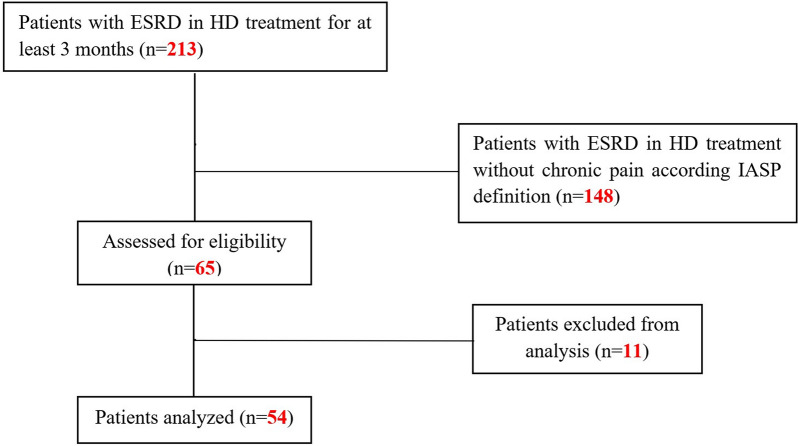
Results: Among 213 patients, 65 (31%) suffered from chronic pain. The average age was 73.1 years; 55.5% of the patients were male; 53.7% had diabetes, and 39.2% had arterial hypertension. Of the 54 patients subjected to an in-depth evaluation, data regarding 113 pain diagnoses were extracted, particularly related to osteoarthritis, obliterating arterial disease, and low back pain with or without radiculopathy. On the basis of these diagnoses, the pain classification according to the IASP pathophysiological definition highlighted a predominant nociceptive pain type (53.9% of all the diagnoses), followed by neuropathic (22.1%), mixed (22.1%), nociplastic (2.6%), and idiopathic (2.6%) pain. According to the IASP classification for ICD-11, the clinical diagnosis of chronic pain secondary to obliterating arterial disease and diabetes-related foot ulcers could not be assigned to any diagnostic category as a result of the lack of a specific item in the aforementioned classification.
Conclusion: This study confirmed that chronic pain is a common, burdening issue in hemodialysis patients and that it is of a prevalent nociceptive nature. Our study highlights some limitations of the last IASP ICD-11 classification, especially the lack of specific items for some pain features that are very frequent in hemodialysis patients, and not only in that population. Finally, this study underlines the importance of mutual collaboration between pain physicians and nephrologists for the well-being of patients of high clinical complexity, such as those undergoing chronic hemodialysis.
Keywords: Chronic pain; End-stage renal disease; Hemodialysis; IASP classification; Observational studies.
© 2025. The Author(s).
Conflict of interest statement
Declarations. Conflict of Interest: Vittorio Schweiger, Martina Cacciapuoti, Marta Nizzero, Salvatore Simari, Gianmarco Lombardi, Leonardo Gottin, Lisa Stefani, Alvise Martini, Gabriele Finco, Enrico Polati and Giovanni Gambaro have nothing to disclose. Giustino Varrassi is an Editorial Board member of Pain and Therapy. Giustino Varrassi was not involved in the selection of peer reviewers for the manuscript nor any of the subsequent editorial decisions. Ethical Approval: All the study procedures were found to be in accordance with the Helsinki Declaration of 1975/83. The study was approved by the ethics committee of the Azienda Ospedaliera Universitaria Integrata of Verona (RED Register, 1751CESC). Informed consent was obtained from all patients included in the study.
References
-
- Murtagh FEM, Addington-Hall J, Higginson IJ. The prevalence of symptoms in end-stage renal disease: a systematic review. Adv Chronic Kidney Dis. 2007;14:82–99. 10.1053/j.ackd.2006.10.001. - PubMed
-
- Breivik H, Collett B, Ventafridda V, et al. Survey of chronic pain in Europe: prevalence, impact on daily life, and treatment. Eur J Pain. 2006;10:287–333. 10.1016/j.ejpain.2005.06.009. - PubMed
-
- Fortina F, Agliata S, Ragazzoni E, et al. Chronic pain during dialysis. Pharmacologic therapy and its costs. Ital J Urol Nephrol. 1999;51:85–7. - PubMed
-
- Mercadante S, Ferrantelli A, Tortorici C, et al. Incidence of chronic pain in patients with end-stage renal disease on dialysis. J Pain Symptom Manag. 2005;30:302–4. 10.1016/j.jpainsymman.2005.08.010. - PubMed
LinkOut - more resources
Full Text Sources
