


Sentiment analysis of tweets employing convolutional neural network optimized by enhanced gorilla troops optimization algorithm
- PMID: 39755914
- PMCID: PMC11700156
- DOI: 10.1038/s41598-025-85392-6
Sentiment analysis of tweets employing convolutional neural network optimized by enhanced gorilla troops optimization algorithm
Abstract
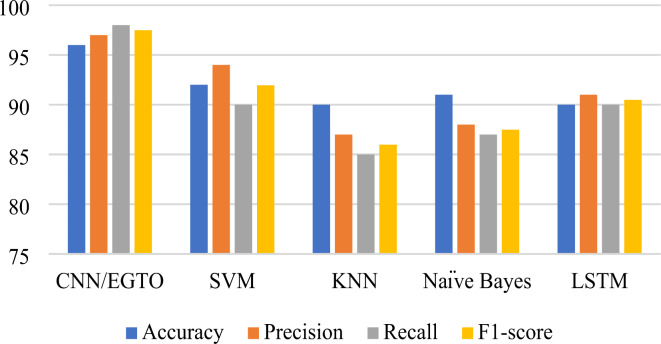
Sentiment analysis has become a difficult and important task in the current world. Because of several features of data, including abbreviations, length of tweet, and spelling error, there should be some other non-conventional methods to achieve the accurate results and overcome the current issue. In other words, because of those issues, conventional approaches cannot perform well and accomplish results with high efficiency. Emotional feelings, such as fear, anxiety, or traumas, often stem from many psychological issues experienced during childhood that can persist throughout life. In addition, people discuss and share their ideas on social media, often unconsciously representing their hidden emotions in the comments. This study is about sentiment analysis of tweets shared by several people. In fact, sentiment analysis can determine whether the shared comments and tweets are positive or negative. The paper introduces the use of a Convolutional Neural Network (CNN), a kind of neural network, optimized by the Enhanced Gorilla Troops Optimization Algorithm (CNN-EGTO). Two datasets provided by the SemEval-2016 are used to evaluate the system, while the polarity of tweets were manually determined. It was determined by the findings of the present study that the suggested model could approximately achieve the values of 98%, 95%, 98%, and 96.47% for accuracy, precision, recall, and F1-score, respectively, for positive polarity. In addition, the suggested model could gain the values of 97, 96, 98, and 97.49 for precision, recall, accuracy, and F1-score, respectively, for negative polarity. Consequently, it was found that the suggested model could outperform the other models by considering their performance and efficiency. These values of performance metrics represent that the suggested model could determine the polarity of sentence, positive or negative, with great efficiency.
Keywords: Convolutional neural network; Enhanced gorilla optimization algorithm; Sentiment analysis; Supervised learning; Twitter.
© 2025. The Author(s).
Conflict of interest statement
Declarations. Competing interests: The authors declare no competing interests.
Figures

References
-
- Acheampong, F. A., Wenyu, C. & Nunoo-Mensah, H. Text‐based emotion detection: advances, challenges, and opportunities. Eng. Rep.2, e12189 (2020). - DOI
-
- Lo, S. L., Chiong, R. & Cornforth, D. Ranking of high-value social audiences on Twitter. Decis. Support Syst.85, 34–48 (2016). - DOI
-
- He, B., Macdonald, C., He, J. & Ounis, I. in Proceedings of the 17th ACM conference on Information and knowledge management. 1063–1072.
Publication types
MeSH terms
LinkOut - more resources
Full Text Sources
