Acute kidney injury recovery status predicts mortality and cardiorenal outcomes in patients admitted with acute decompensated heart failure
- PMID: 39756821
- PMCID: PMC11751981
- DOI: 10.1136/openhrt-2024-002928
Acute kidney injury recovery status predicts mortality and cardiorenal outcomes in patients admitted with acute decompensated heart failure
Abstract
Background: Acute kidney injury (AKI) in the context of acute decompensated heart failure (ADHF) encompasses a broad spectrum of phenotypes with associated disparate outcomes. We evaluate the impact of 'ongoing AKI' on prognosis and cardiorenal outcomes and describe predictors of 'ongoing AKI'.
Methods: A prospective multicentre observational study of patients admitted with ADHF requiring intravenous furosemide was completed, with urinary angiotensinogen (uAGT) measured at baseline. AKI was defined using Kidney Disease Improving Global Outcomes (KDIGO) AKI criteria. AKI recovery status was defined as 'no AKI', 'recovered AKI' or 'ongoing AKI' based on renal function at hospital discharge. Event-free survival analysis was performed to predict death and cardiorenal outcomes at hospital discharge and 6-month follow-up. Multinomial logistic regression was performed to identify predictors of ongoing AKI. Multiclass receiver operator curve analysis was performed to evaluate the relationship between renin-angiotensin system (RAS) blockers and uAGT in predicting ongoing AKI.
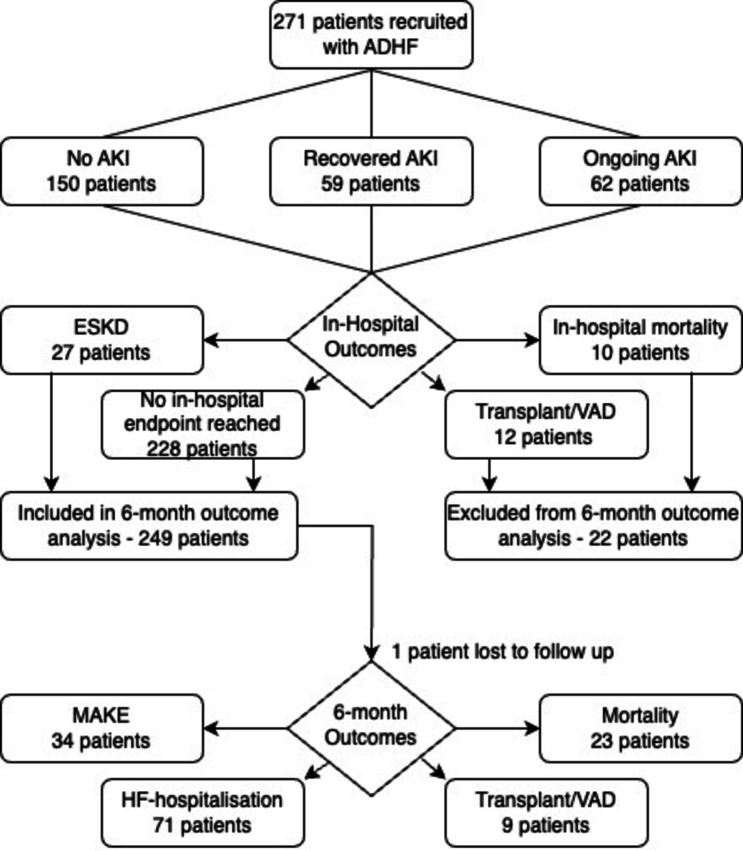
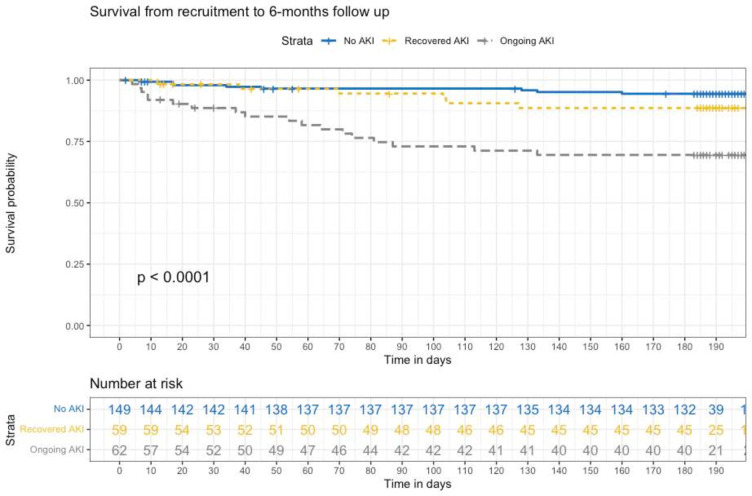
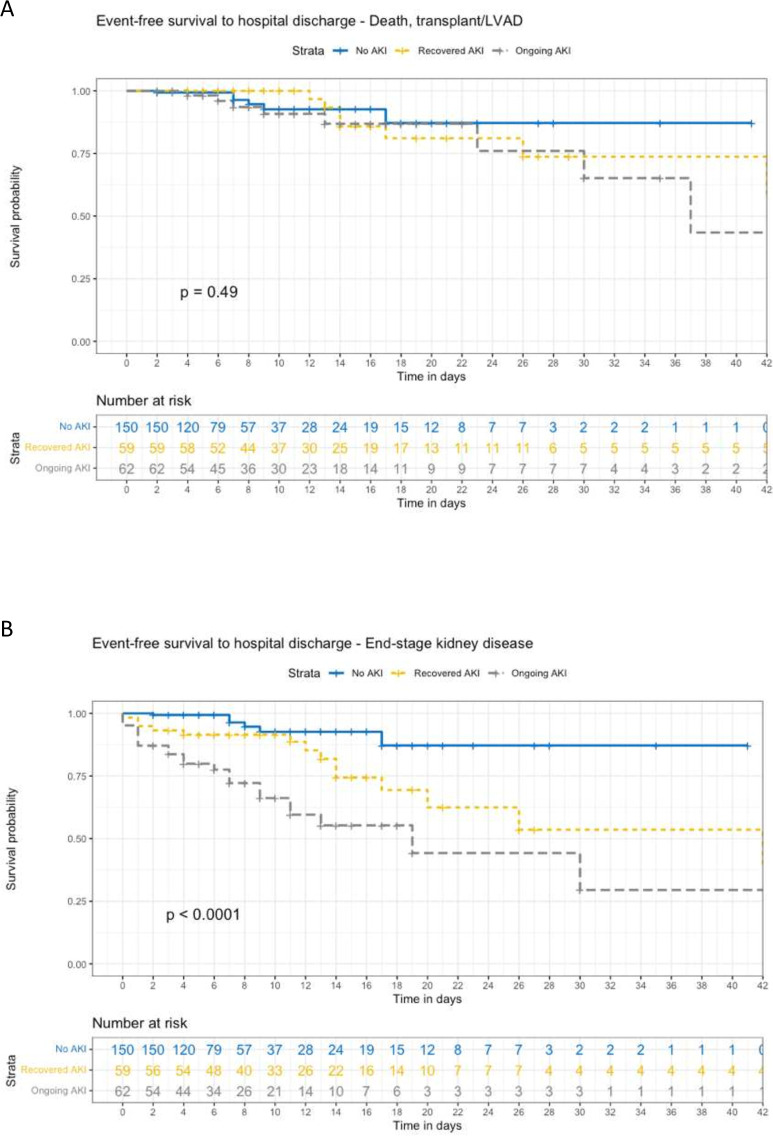
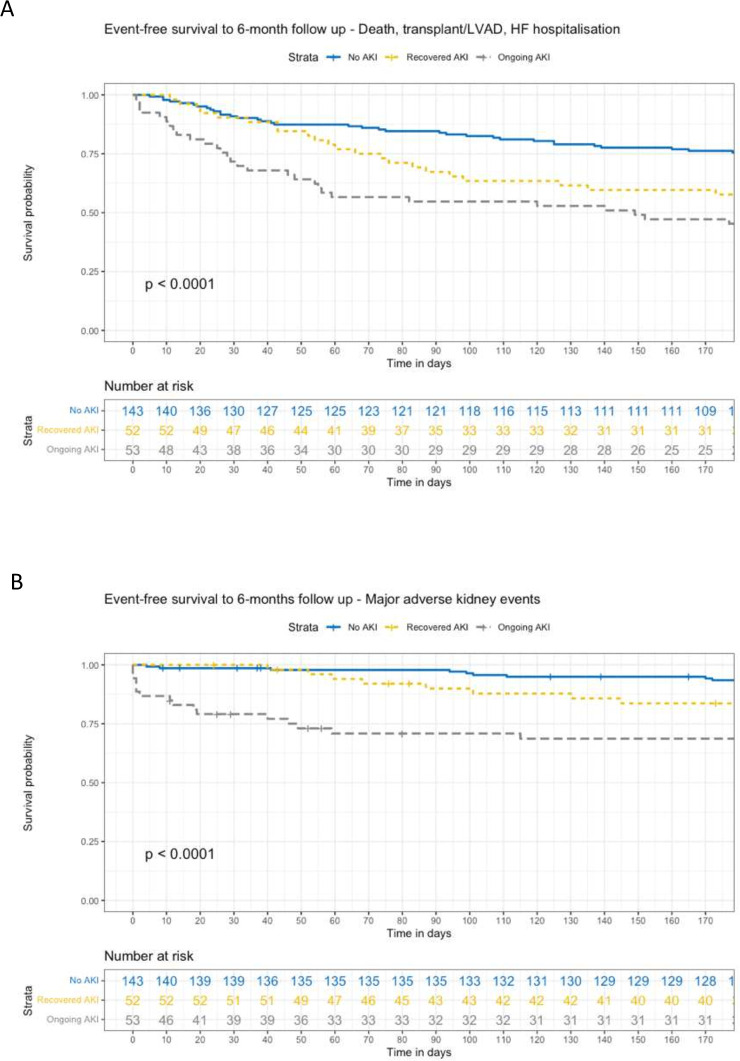
Results: Among 271 enrolled patients, 121 (44.6%) patients developed AKI, of whom 62 patients had ongoing AKI. Ongoing AKI was associated with increased risk of death (HR 6.89, p<0.001), in-hospital end-stage kidney disease (HR 44.39, p<0.001), 6-month composite of death, transplant, left ventricular assist device and heart failure hospitalisation (HR 3.09, p<0.001), and 6-month composite major adverse kidney events (HR 5.71, p<0.001). Elevated baseline uAGT levels, chronic beta-blocker and thiazide diuretic therapy, and lack of RAS blocker prescription at recruitment were associated with ongoing AKI. While uAGT levels were lower with RAS blocker prescription, in patients with ongoing AKI, uAGT levels were elevated regardless of RAS blocker status.
Conclusion: Patients experiencing ongoing AKI during ADHF admission were at increased risk of death and other adverse cardiorenal outcomes. Differential uAGT response in patients receiving RAS blockers with ongoing AKI suggests biomarkers may be helpful in predicting treatment responses and cardiorenal outcomes.
Keywords: Biomarkers; HEART FAILURE; Heart Transplantation; Heart-Assist Devices.
© Author(s) (or their employer(s)) 2025. Re-use permitted under CC BY-NC. No commercial re-use. See rights and permissions. Published by BMJ Group.
Conflict of interest statement
Competing interests: None declared.
Figures
Similar articles
-
Urinary Angiotensinogen Level Predicts AKI in Acute Decompensated Heart Failure: A Prospective, Two-Stage Study.J Am Soc Nephrol. 2015 Aug;26(8):2032-41. doi: 10.1681/ASN.2014040408. Epub 2015 Feb 26. J Am Soc Nephrol. 2015. PMID: 25722365 Free PMC article.
-
Urinary Biomarkers at the Time of AKI Diagnosis as Predictors of Progression of AKI among Patients with Acute Cardiorenal Syndrome.Clin J Am Soc Nephrol. 2016 Sep 7;11(9):1536-1544. doi: 10.2215/CJN.00910116. Epub 2016 Aug 18. Clin J Am Soc Nephrol. 2016. PMID: 27538426 Free PMC article.
-
Urinary angiotensinogen predicts progressive chronic kidney disease after an episode of experimental acute kidney injury.Clin Sci (Lond). 2018 Oct 5;132(19):2121-2133. doi: 10.1042/CS20180758. Print 2018 Oct 15. Clin Sci (Lond). 2018. PMID: 30224346
-
Left Ventricular Assist Devices and the Kidney.Clin J Am Soc Nephrol. 2018 Feb 7;13(2):348-355. doi: 10.2215/CJN.04670417. Epub 2017 Oct 25. Clin J Am Soc Nephrol. 2018. PMID: 29070522 Free PMC article. Review.
-
Heart-Kidney Interactions in Cardiorenal Syndrome Type 1.Adv Chronic Kidney Dis. 2018 Sep;25(5):408-417. doi: 10.1053/j.ackd.2018.08.013. Adv Chronic Kidney Dis. 2018. PMID: 30309458 Review.
References
Publication types
MeSH terms
Substances
LinkOut - more resources
Full Text Sources
Medical