


Retinoblastoma with and without Extraocular Tumor Extension: A Global Comparative Study of 3435 Patients
- PMID: 39758129
- PMCID: PMC11696820
- DOI: 10.1016/j.xops.2024.100637
Retinoblastoma with and without Extraocular Tumor Extension: A Global Comparative Study of 3435 Patients
Abstract
Purpose: To study the treatment and outcomes of children with retinoblastoma (RB) with extraocular tumor extension (RB-EOE) and compare them with RB without extraocular tumor extension (RB-w/o-EOE).
Design: Multicenter intercontinental collaborative prospective study from 2017 to 2020. RB-EOE cases included those with overt orbital tumor extension in treatment-naive patients. Cases with microscopic orbital extension detected postenucleation were excluded from the study.
Participants: A total of 319 children with RB-EOE and 3116 children with RB-w/o-EOE.
Intervention: Chemotherapy, enucleation, exenteration, radiotherapy.
Main outcome measures: Systemic metastasis and death.
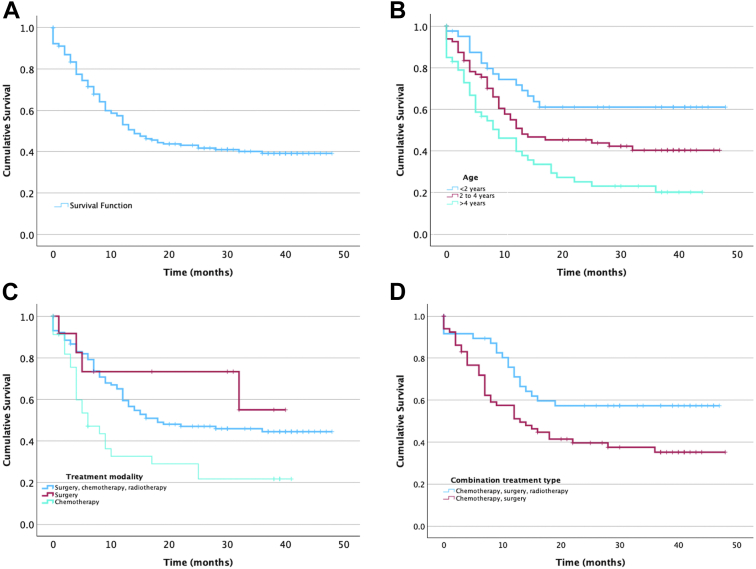
Results: Of the 3435 RB patients included in this study, 309 (9%) were from low-income countries (LIC), 1448 (42%) from lower-middle income, 1012 (29%) from upper-middle income, and 666 (19%) patients from high-income countries. There was an inverse relationship between the percentage of RB-EOE and national income level, with 96 (31%) patients from LIC, 197 (6%) lower-middle income, 20 (2%) upper-middle income, and 6 (1%) patients from high-income countries (P = 0.0001). The outcomes were statistically significant for RB-EOE compared with RB-w/o-EOE: systemic metastasis (32% vs. 4% respectively; P = 0.0001) and metastasis-related death (63% vs. 6% respectively; P = 0.0001). Multimodal treatment was the most common form of treatment (n = 177; 54%) for RB-EOE, with most cases undergoing a combination of intravenous chemotherapy and enucleation (n = 97; 30%). Adjuvant external beam radiotherapy (EBRT) after surgery (enucleation/orbital exenteration) was given in only 68 (21%) cases. Kaplan-Meier analysis for systemic metastasis and metastasis-related death in RB-EOE was 28% and 57% at 1 year, 29% and 60% at 2 years, and 29% and 61% at 3 years, respectively. Cox regression analysis revealed that the risk of death from RB-EOE was greater in patients aged >4 years than <2 years (hazard ratio, 2.912; P < 0.001) and for unimodal (surgery or intravenous chemotherapy) and bimodal (surgery and intravenous chemotherapy) treatment than trimodal treatment (surgery, intravenous chemotherapy, and EBRT) (hazard ratio, 2.023; P = 0.004 and hazard ratio, 1.819; P = 0.027, respectively).
Conclusions: Retinoblastoma with extraocular tumor extension is associated with a higher risk of metastasis and death. Patients with RB-EOE are likely to benefit from trimodal treatment (intravenous chemotherapy, surgery, and EBRT) rather than treatment protocols excluding EBRT.
Financial disclosures: The authors have no proprietary or commercial interest in any materials discussed in this article.
Keywords: External beam radiotherapy; Extraocular extension; Multimodal treatment; Retinoblastoma; Tumor.
© 2024 by the American Academy of Ophthalmology.
Figures
References
-
- Wong E.S., Choy R.W., Zhang Y., et al. Global retinoblastoma survival and globe preservation: a systematic review and meta-analysis of associations with socioeconomic and health-care factors. Lancet Glob Health. 2022;10:e380–e389. - PubMed
-
- Vempuluru V.S., Maniar A., Kaliki S. Global retinoblastoma studies: a review. Clin Exp Ophthalmol. 2024;52:334–354. - PubMed
-
- Finger P.T., Tomar A.S. Retinoblastoma outcomes: a global perspective. Lancet Glob Health. 2022;10:e307–e308. - PubMed
LinkOut - more resources
Full Text Sources
