


Utilizing Martian samples for future planetary exploration-Characterizing hazards and resources
- PMID: 39761405
- PMCID: PMC11745335
- DOI: 10.1073/pnas.2404251121
Utilizing Martian samples for future planetary exploration-Characterizing hazards and resources
Abstract
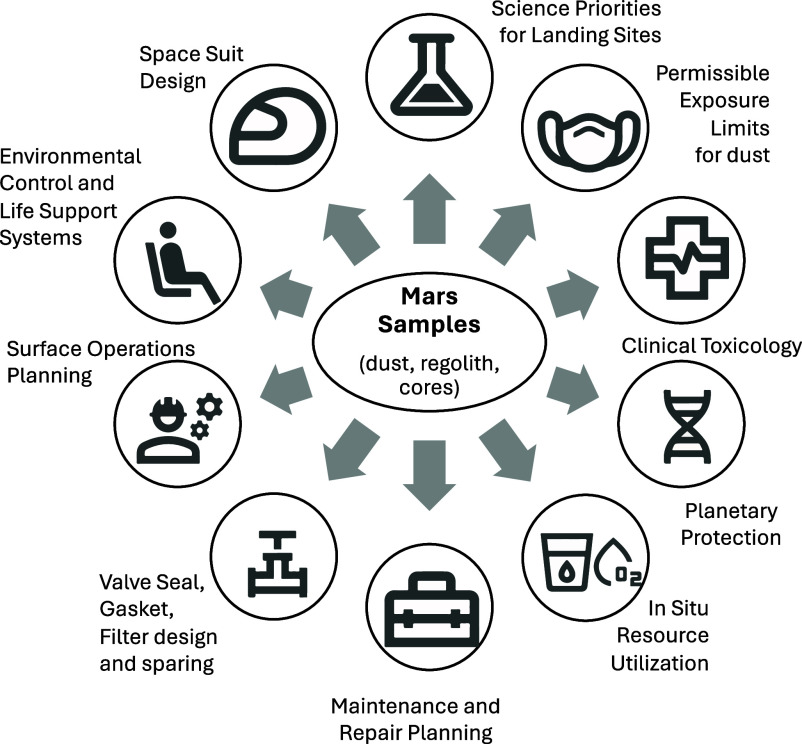
One of the most surprising and important findings of the first human landings on the Moon was the discovery of a very fine layer of lunar dust covering the entire surface of Moon along with the negative impacts of this dust on the well-being and operational effectiveness of the astronauts, their equipment, and instrumentation. The United States is now planning for human missions to Mars, a planet where dust can also be expected to be ubiquitous for many or most landing sites. For these missions, the design and operations of key hardware systems must take this dust into account, especially when related to crew health and safety. Improved understanding of Martian dust characteristics can inform its potential to also perform transport of microorganisms, both those inadvertently brought to Mars by the astronauts, or, if Martian microorganisms exist, the potential for their inadvertent return to Earth with the astronauts. Careful planning and design are needed to assure that future missions do not violate the United Nations Outer Space Treaty (1967) signed by all spacefaring nations. In this paper, we review the impact of lunar dust on the Apollo missions and identify several questions about dust in the atmosphere of Mars that may be answered by the curated samples that would be returned by the planned Mars Sample Return (MSR) Campaign. These answers would not only provide an opportunity to better understand the history of Mars but could also reduce uncertainty in charting the future of humanity's exploration of the planet.
Keywords: Mars; exploration; spaceflight.
Conflict of interest statement
Competing interests statement:The authors declare no competing interest.
Figures
References
-
- Carrier W. D. III, Olhoeft G., Mendell W., “Physical properties of the lunar surface” in Lunar Sourcebook: A User’s Guide to the Moon, Heiken G. H., Vaniman D. T., French B.M., et al. (Cambridge University Press, 1991), pp. 475–567.
-
- NASA, “Apollo 17 technical crew debriefing”, (Tech. Rep. MSC-07631, Johnson Space Center, NASA STI Archives, 1973).
-
- Levine J. S., “Lunar dust and its impact on human exploration: Identifying the problems” in The Impact of Lunar Dust on Human Exploration, Levine J. S., Ed. (Cambridge Scholars Publishing, 2021), pp. 41–54.
-
- Gaier J. R., The effects of lunar dust on EVA systems during the Apollo Missions. NASA/TM-2005-213610/REV1. (2007). https://ntrs.nasa.gov/citations/20070021819. Accessed 19 February 2024.
-
- Gaier J. R., “The impacts of dust on lunar sample equipment during Apollo” in The Impact of Lunar Dust on Human Exploration, Levine J. S., Ed. (Cambridge Scholars Publishing, 2021), pp. 67–87.
Publication types
MeSH terms
Substances
LinkOut - more resources
Full Text Sources
Miscellaneous
