


Psychological factors associated with Long COVID: a systematic review and meta-analysis
- PMID: 39764180
- PMCID: PMC11701445
- DOI: 10.1016/j.eclinm.2024.102756
Psychological factors associated with Long COVID: a systematic review and meta-analysis
Abstract
Background: Despite the immense impact of Long COVID on public health and those affected, its aetiology remains poorly understood. Findings suggest that psychological factors such as depression contribute to symptom persistence alongside pathophysiological mechanisms, but knowledge of their relative importance is limited. This study aimed to synthesise the current evidence on psychological factors potentially associated with Long COVID and condition-relevant outcomes like quality of life.
Methods: In this systematic review and meta-analysis, MEDLINE, PsycINFO, and the Cochrane Database of Systematic Reviews were searched for peer-reviewed studies published in English from 2019 to January 2, 2024. Studies providing cross-sectional or longitudinal data on the association between at least one psychological variable and the presence of Long COVID (primary outcome) or condition-relevant secondary outcomes (symptom severity, impairment, quality of life, and healthcare utilisation) were included. Psychological constructs with at least five comparisons were pooled as odds ratio (OR) for categorical data and standardised mean difference (SMD) for continuous data in random-effects meta-analyses of cross-sectional studies with control groups. This review is registered with PROSPERO, CRD42023408320.
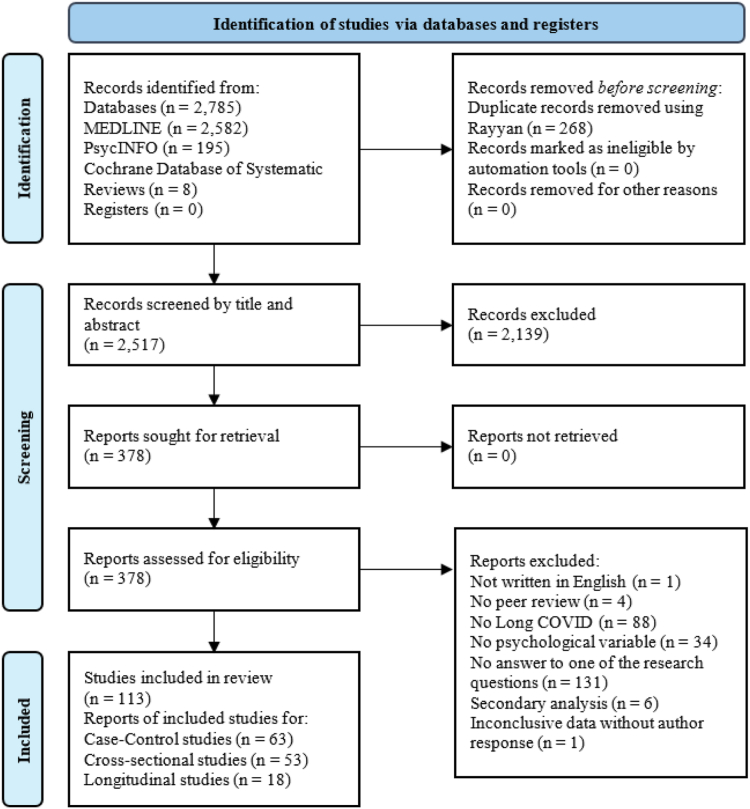
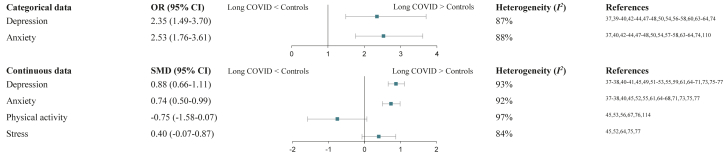
Findings: 113 studies (n = 312,831 patients with Long COVID) provided data on at least one psychological variable, 63 in cross-sectional group comparisons, 53 in cross-sectional associations, and 18 longitudinal. Most reported findings related to depression and anxiety, and - less frequently - to physical activity, posttraumatic stress disorder, stress, and history of mental illness. Depression (OR 2.35; 95% CI, 1.49-3.70) and anxiety (OR 2.53; 95% CI, 1.76-3.61) were significantly associated with Long COVID and higher in affected patients than controls (depression: SMD 0.88; 95% CI, 0.66-1.11; anxiety: SMD 0.74; 95% CI, 0.50-0.99), while results for physical activity and stress were non-significant. In most prospective studies, the investigated psychological constructs significantly predicted Long COVID.
Interpretation: Evidence suggests depression and anxiety to be co-occurring phenomena and predictive factors of Long COVID. Future studies should prospectively investigate psychological constructs such as emotion regulation or dysfunctional symptom expectations, which are well-known risk factors and therapeutic targets of persistent somatic symptoms in other medical conditions, but are so far understudied in Long COVID.
Funding: None.
Keywords: Biopsychosocial model; Long COVID; Persistent somatic symptoms; Post COVID-19 condition; Psychological factors.
© 2024 The Author(s).
Conflict of interest statement
PE reports research funding (no personal honoraria) from the German Research Foundation. SS reports research funding (no personal honoraria) from the German Research Foundation and the German Heart Foundation/German Foundation of Heart Research. BL reports research funding (no personal honoraria) from the German Research Foundation, the German Federal Ministry of Education and Research, the German Innovation Committee at the Joint Federal Committee, the European Commission's Horizon 2020 Framework Programme, the European Joint Programme for Rare Diseases (EJP), the Ministry of Science, Research and Equality of the Free and Hanseatic City of Hamburg, Germany, and the Foundation Psychosomatics of Spinal Diseases, Stuttgart, Germany. He received remunerations for several scientific book articles from various book publishers, from the Norddeutscher Rundfunk (NDR) for interviews in medical knowledge programmes on public television, and as a committee member from Aarhus University, Denmark. He received travel expenses from the European Association of Psychosomatic Medicine (EAPM), and accommodation and meals from the Societatea de Medicina Biopsyhosociala, Romania, for a presentation at the EAPM Academy at the Conferința Națională de Psihosomatică, Cluj-Napoca, Romania, October 2023. He received remuneration and travel expenses for lecture at the Lindauer Psychotherapiewochen, April 2024. He is President of the German College of Psychosomatic Medicine (DKPM) (unpaid) since March 2024 and was a member of the Board of the European Association of Psychosomatic Medicine (EAPM) (unpaid) until 2022. He is member of the EIFFEL Study Oversight Committee (unpaid). AT reports research funding (no personal honoraria) from the German Research Foundation. She received remunerations for scientific book articles. MSM reports research funding (no personal honoraria) from the German Research Foundation and the German Academic Research Service. She received remunerations for scientific book articles, from the Norddeutscher Rundfunk (NDR) for interviews in medical knowledge programmes on public television, for post graduate training for psychotherapy, and for the review of a grant proposal at the University of Toledo, USA. She is member of the Scientific Advisory Board of PKD Cure e.V. (unpaid). She is Executive Board Member and Vice-Treasurer of the European Association of Psychosomatic Medicine (EAPM) (unpaid).
Figures
References
LinkOut - more resources
Full Text Sources
