. 2024 Dec 23:15:1504528.
doi: 10.3389/fpls.2024.1504528. eCollection 2024.

Enhancement on selenium volatilization for phytoremediation: role of plant and soil microbe interaction

Affiliations

Enhancement on selenium volatilization for phytoremediation: role of plant and soil microbe interaction

Ranju R Karna et al. Front Plant Sci. .

Abstract

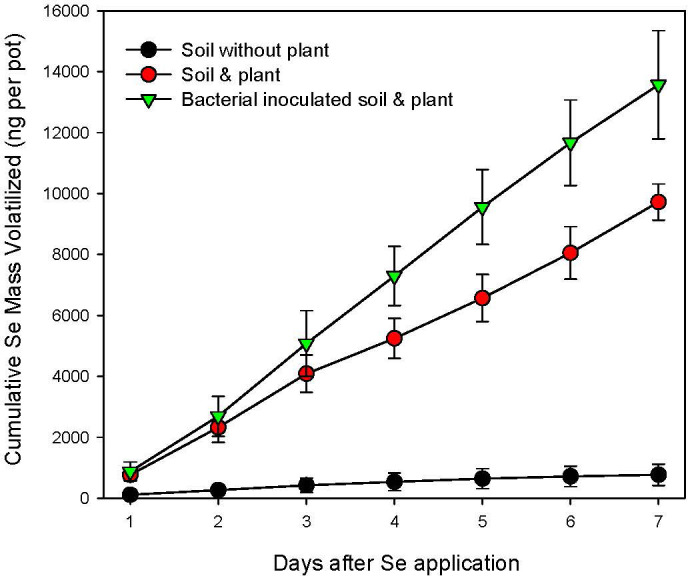
This study aimed at quantifying the potential effects of plant and soil microbial interaction on selenium (Se) volatilization, with the specific objectives of identifying soil bacteria associated with rabbitfoot grass (Polypogon monspeliensis) and demonstrating the enhancement of Se volatilization in the soil-Indian mustard (Brassica juncea) system through inoculation of the soil with the identified best Se-volatilizing bacterial strain. Soil bacteria were isolated from topsoil and rhizosphere soils of rabbitfoot grass, and the bacterial colonies were characterized via PCR-DGGE and DGGE band analysis prior to their identification using 16S rDNA sequencing technique. Bacillus cereus produced over 500-fold more volatile Se in a culture medium treated with 15 µg Se/mL (equal mixture of SeO4 2-, SeO3 2- and selenomethionine) than any of the other eight identified bacterial strains. Inoculation of Indian mustard vegetated soil with the best Se volatilizing bacterial strain B. cereus resulted in a significant (p<0.05) increase in Se volatilization during a 7-day time period, compared to the soil-plant system without inoculation of B. cereus. Thus, inoculation of the soil with B. cereus substantially enhanced Se removal via biogenic volatilization in the soil-Indian mustard system. This study evaluated the role of B. cereus in enhancing Se volatilization in soil-plant systems, and demonstrated the importance of plant and soil microbial interaction for Se phytoremediation.

Keywords: Bacillus cereus; Indian mustard; phytoremediation; plant and microbial interaction; rabbitfoot grass; selenium; volatilization.


Conflict of interest statement

The authors declare that the research was conducted in the absence of any commercial or financial relationships that could be construed as a potential conflict of interest.

Figures
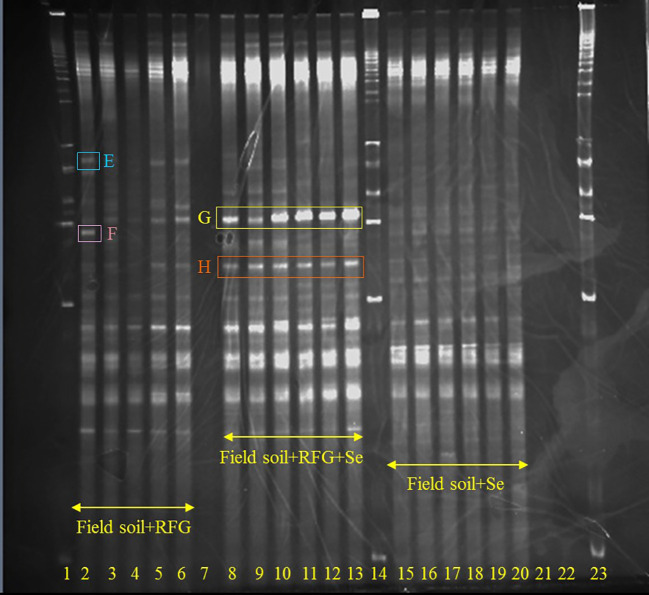
Figure 1
Figure 1
Effects of Se on the microbial community in the rhizosphere of a soil-rabbitfoot grass system. DGGE analysis of 16S rDNA fragments amplified from rhizosphere DNA taken from the rabbitfoot grass soil without Se treatment (lanes 2 to 6), the rabbitfoot grass soil with Se treatment (lanes 8 to 13), and Se-contaminated soil (lanes 15-20). Lanes 1, 14 and 23: 1 kb ladders. Bands excised, cloned, sequenced and identified as: E, Niastella sp., F, Uncultured Bacterium Clone; G, Xanthomonadales; H, Uncultured Alphaproteobacterium Clone.
Figure 2
Figure 2
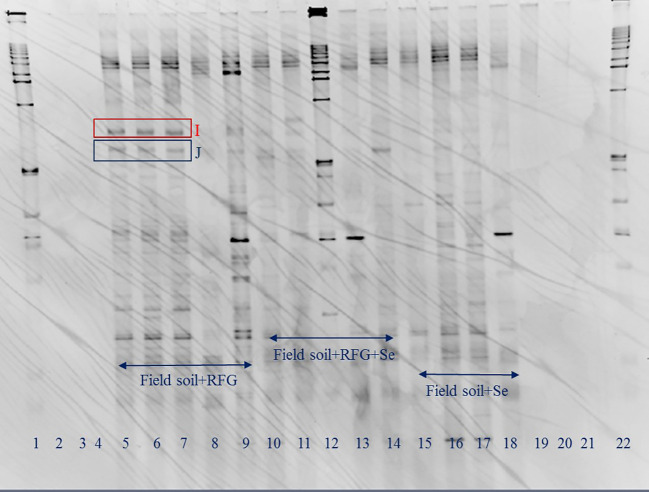
Effects of Se on microbial community in topsoil of a soil-rabbitfoot grass system. DGGE analysis of 16S rDNA fragments amplified from rhizosphere DNA taken from the rabbitfoot grass soil without Se treatment (lanes 5 to 9), the rabbitfoot grass soil with Se treatment (lanes 10 to 14), and the unvegetated soil with Se treatment (lanes 15 to 18). Lanes 1, 12 and 22: 1 kb ladders. Bands excised, cloned, sequenced and identified as: I: Uncultured Alphaproteobacterium Clone, J: Uncultured Bacterium Clone.
Figure 3
Figure 3
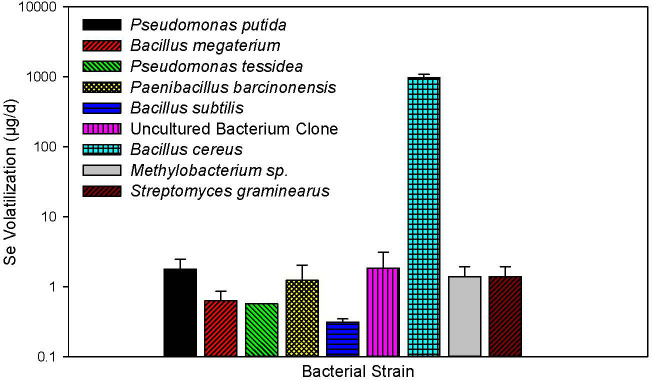
Selenium volatilization rates among bacterial strains isolated from the soil-rabbitfoot grass system. Microbial volatilization measurements conducted over 24 hours demonstrated B. cereus as the best Se volatilizing species at p < 0.05. The data in the figure are means and standard deviation (n=3).
Figure 4
Figure 4
Cumulative selenium mass volatilized from the soil-Indian mustard (B. juncea). The data are means and standard deviations (n=4).

Similar articles

Cited by

References

    1. Ackerman J. T., Eagles-Smith C. A. (2009). Selenium bioaccumulation and body condition in shorebirds and terns breeding in San Francisco Bay, California, USA. Environ. Toxicol. Chem. 28, 2134–2141. doi: 10.1897/09-101.1 - DOI - PubMed
    1. Alcántara-Hernández R., Valenzuela-Encinas C., Marsch R., Dendooven L. (2009). Respiratory and dissimilatory nitrate-reducing communities from an extreme saline alkaline soil of the former lake Texcoco (Mexico). Extremophiles. 13, 169–178. doi: 10.1007/s00792-008-0207-1 - DOI - PubMed
    1. Altschul S. F., Gish W., Miller W., Myers E. W., Lipman D. J. (1990). Basic local alignment search tool. J. Mol. Biol. 215, 403–410. doi: 10.1016/S0022-2836(05)80360-2 - DOI - PubMed
    1. Bañuelos G. S., Lin Z. Q., Arroyo I., Terry N. (2005. a). Selenium volatilization in vegetated agricultural drainage sediment from the San Luis Drain, Central California. Chemosphere. 60, 1203–1213. doi: 10.1016/j.chemosphere.2005.02.033 - DOI - PubMed
    1. Bañuelos G., Terry N., Leduc D. L., Pilon-Smits E. A., Mackey B. (2005. b). Field trial of transgenic Indian mustard plants shows enhanced phytoremediation of selenium-contaminated sediment. Environ. Sci. Technol. 39, 1771–1777. doi: 10.1021/es049035f - DOI - PubMed

LinkOut - more resources