


The systemic inflammation response index as a significant predictor of short-term adverse outcomes in acute decompensated heart failure patients: a cohort study from Southern China
- PMID: 39764249
- PMCID: PMC11700808
- DOI: 10.3389/fendo.2024.1444663
The systemic inflammation response index as a significant predictor of short-term adverse outcomes in acute decompensated heart failure patients: a cohort study from Southern China
Abstract
Objective: The deterioration of acute decompensated heart failure (ADHF) is associated with abnormal activation of inflammatory pathways. This study aims to evaluate the impact and predictive value of a novel inflammatory marker, the systemic inflammation response index (SIRI), on short-term adverse outcomes in ADHF patients.
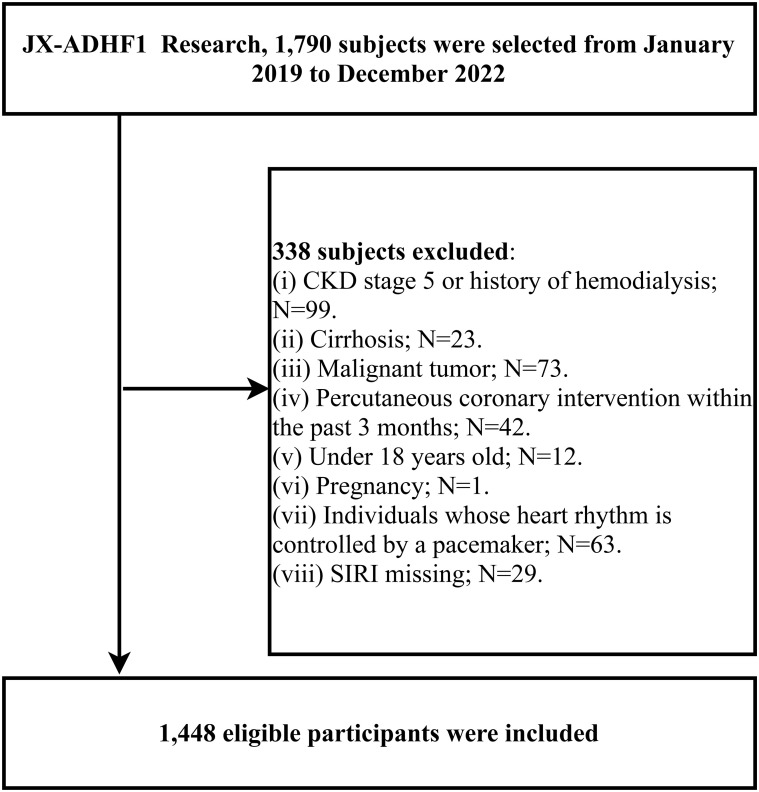
Methods: This retrospective cohort study included 1,448 ADHF patients from Jiangxi Provincial People's Hospital between 2019-2022. SIRI was calculated using the formula: (neutrophil count × monocyte count)/lymphocyte count. In the correlation analysis, the study outcome was the 30-day mortality in patients with ADHF. Cox regression analysis and receiver operating characteristic curves were employed to investigate the risk assessment and predictive value of the SIRI for 30-day mortality in ADHF patients. Finally, we also exploratively assessed the mediation effect of nutritional factors (albumin: Alb, total cholesterol: TC, and lymphocyte count) on the association between SIRI and 30-day mortality in ADHF patients.
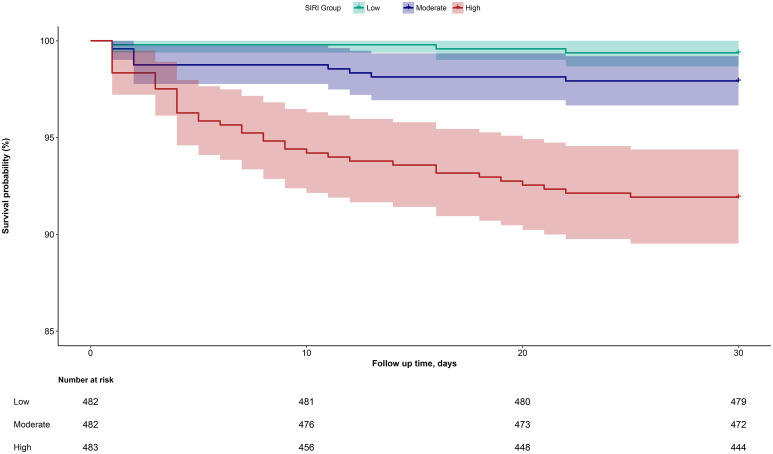
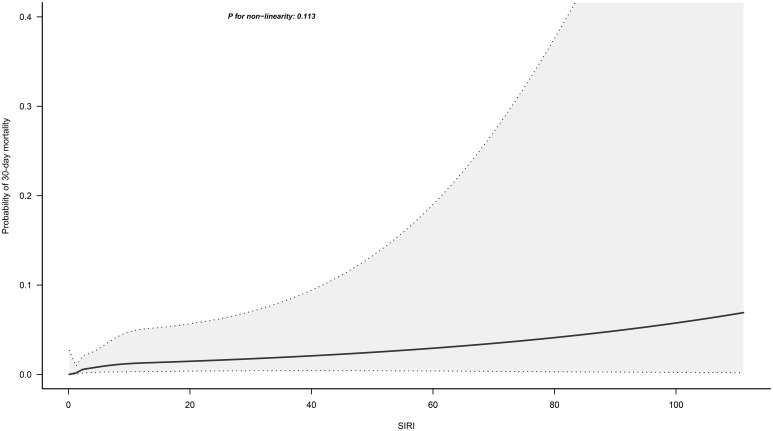
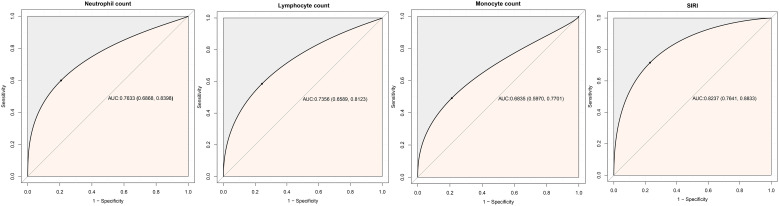
Results: During the 30-day follow-up, 53 deaths were recorded. Mortality rates across SIRI tertiles were 0.62%, 2.07%, and 8.28%, respectively. There was a significant linear positive correlation between SIRI and 30-day mortality in ADHF patients (HR: 1.21; P for non-linearity = 0.113). Additionally, compared to ADHF patients with low SIRI, those with high SIRI had a 685% increased risk of 30-day mortality (HR: 7.85). Furthermore, receiver operating characteristic curve analysis demonstrated that SIRI significantly improved the predictive value for 30-day mortality in ADHF patients compared to neutrophil count, monocyte count, and lymphocyte count alone (AUC: neutrophil count 0.7633, monocyte count 0.6835, lymphocyte count 0.7356, SIRI 0.8237; all DeLong P<0.05). Mediation analyses indicated that, except for lymphocyte count, both Alb and TC had significant indirect effects on the SIRI-related 30-day mortality in ADHF patients; Specifically, Alb accounted for approximately 24.46% of the mediation effect, while TC accounted for approximately 13.35%.
Conclusion: This cohort study based on a Southern Chinese population demonstrates a significant linear positive correlation between SIRI and 30-day mortality in ADHF patients, highlighting its substantial predictive value. Incorporating SIRI into the monitoring regimen of ADHF patients may be crucial for preventing further disease progression.
Keywords: ADHF; SIRI; acute decompensated heart failure; inflammatory marker; systemic inflammation response index.
Copyright © 2024 Xie, Wang, Lu, Kuang, He, Xie, Sheng, Zhang, Wang and Zou.
Conflict of interest statement
The authors declare that the research was conducted in the absence of any commercial or financial relationships that could be construed as a potential conflict of interest.
Figures
References
-
- Hollenberg SM, Warner Stevenson L, Ahmad T, Amin VJ, Bozkurt B, Butler J, et al. . 2019 ACC expert consensus decision pathway on risk assessment, management, and clinical trajectory of patients hospitalized with heart failure: A report of the American college of cardiology solution set oversight committee. J Am Coll Cardiol. (2019) 74:1966–2011. doi: 10.1016/j.jacc.2019.08.001 - DOI - PubMed
-
- Yancy CW, Jessup M, Bozkurt B, Butler J, Casey DE, Jr, Colvin MM, et al. . 2017 ACC/AHA/HFSA focused update of the 2013 ACCF/AHA guideline for the management of heart failure: A report of the American college of cardiology/American heart association task force on clinical practice guidelines and the heart failure society of America. Circulation. (2017) 136:e137–61. doi: 10.1161/CIR.0000000000000509 - DOI - PubMed
MeSH terms
Substances
LinkOut - more resources
Full Text Sources
Medical
Miscellaneous
