


Enhanced Expression of N-Cadherin, but Not of E-Cadherin, in Cutaneous Squamous Cell Carcinoma in Comparison to Basal Cell Carcinoma
- PMID: 39766148
- PMCID: PMC11674879
- DOI: 10.3390/cancers16244247
Enhanced Expression of N-Cadherin, but Not of E-Cadherin, in Cutaneous Squamous Cell Carcinoma in Comparison to Basal Cell Carcinoma
Abstract
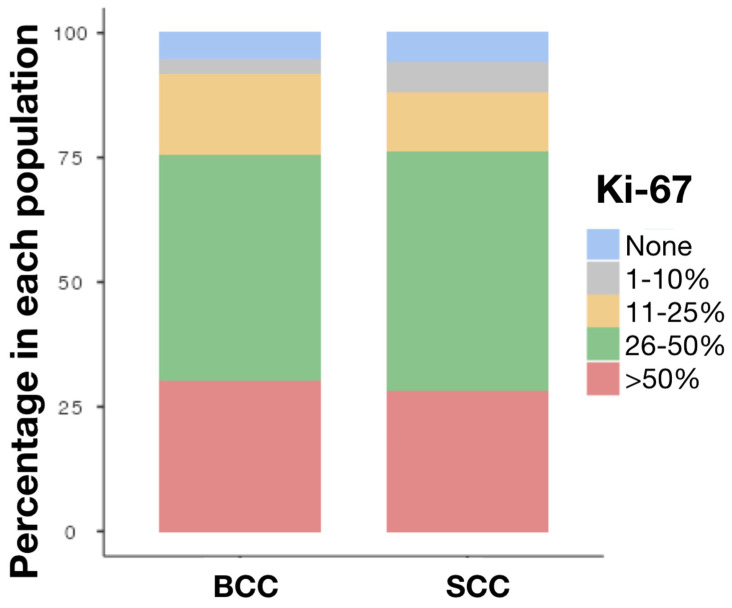
Background: Adhesion molecules including E-cadherin and N-cadherin have been proven to contribute to the carcinogenesis process. It has been demonstrated that an increased expression or appearance of N-cadherin, as well as a reduction in the expression of E-cadherin, are documented in many cancers, often leading to the loss of intercellular adhesion and acquisition of a more invasive or even metastatic mesenchymal phenotype. The aim of this study was to assess the expression of E-cadherin and N-cadherin, as well as markers of proliferation Ki67 in basal cell carcinoma (BCC) and squamous cell carcinoma (SCC).
Methods: A total of 123 tumor paraffin specimens, including 73 BCC and 50 SCC cases, were obtained from multiple anatomical locations. The expression of E-Cadherin and N-Cadherin, including the percentage of stained cells, was assessed using a four-grade scale, with Ki-67 assessed on the five-grade scale.
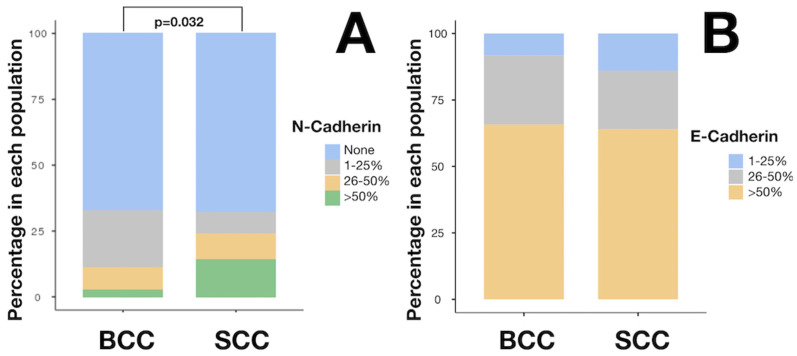
Results: A significantly higher expression of N-cadherin was observed in SCC compared to BCC, with 14% of SCC cases having a more than 50% expression of N-cadherin, and 10% with 26-50% expression, in comparison with 2.7% and 8.2% in BCC, respectively (p < 0.001). No significant differences were observed with regard to E-cadherin expression between SCC and BCC.
Conclusions: Our results suggest that N-cadherin expression might contribute to the acquisition of the mesenchymal phenotype, SCC, when compared with BCC, with a high expression of E-cadherin in both tumors explaining their overall low rate of metastases; however, further research on the role of adhesion molecules in these tumors is needed.
Keywords: BCC; E-cadherin; Ki67; N-cadherin; SCC.
Conflict of interest statement
The authors declare no conflicts of interest.
Figures
References
-
- Cebolla-Verdugo M., Llamas-Segura C., Velasco-Amador J.P., Almazán-Fernández F.M., Ruiz-Villaverde R. Understanding and managing locally advanced basal cell carcinoma: Insights into pathogenesis, therapeutic strategies, and the role of hedgehog pathway inhibitors. Ital. J. Dermatol. Venerol. 2024;159:530–542. doi: 10.23736/S2784-8671.24.07993-3. - DOI - PubMed
LinkOut - more resources
Full Text Sources
Research Materials
