


Enhanced Effect of Patient Room Disinfection Against Carbapenem-Resistant Enterobacter cloacae and Methicillin-Resistant Staphylococcus aureus Using UV-C Irradiation in Conjunction with UV-C Containment Unit
- PMID: 39766504
- PMCID: PMC11672435
- DOI: 10.3390/antibiotics13121115
Enhanced Effect of Patient Room Disinfection Against Carbapenem-Resistant Enterobacter cloacae and Methicillin-Resistant Staphylococcus aureus Using UV-C Irradiation in Conjunction with UV-C Containment Unit
Abstract
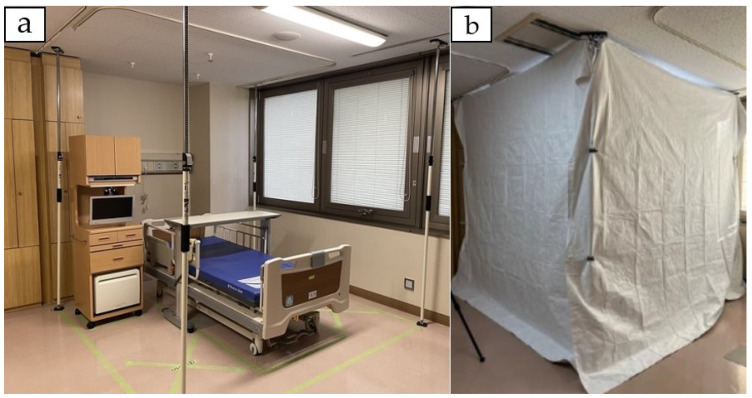
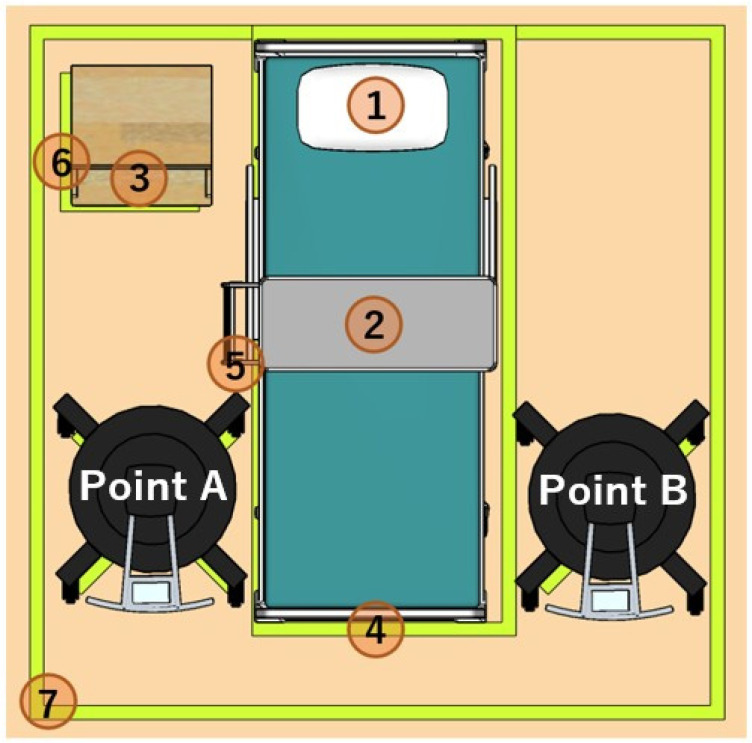
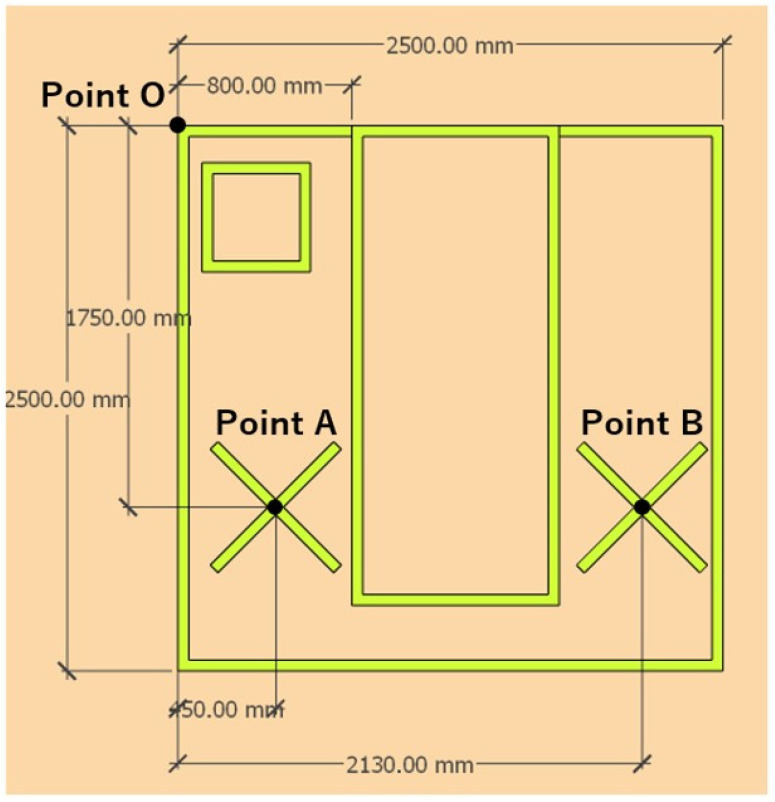
Background/Objectives: In environments with high-frequency contact surfaces, drug-resistant bacteria, such as carbapenem-resistant Enterobacterales and methicillin-resistant Staphylococcus aureus (MRSA), can survive for extended periods, contributing to healthcare-associated infections. Ultraviolet (UV)-C irradiation often fails to adequately disinfect shadowed areas, leading to a persistent contamination risk. We evaluated the effectiveness of using a UV-C containment unit (UVCCU) in conjunction with UV-C irradiation to improve the sterilization effects on both direct and indirect surfaces, including shadowed areas, and to assess the leakage of UV radiation to the surroundings. Methods: In a model patient room, agar media inoculated with carbapenem-resistant Enterobacter cloacae and MRSA were placed at multiple locations on direct and indirect surfaces around the bed. We used the UV-C irradiation system, UVDI-360, to irradiate the bedroom-environment surfaces with and without a UVCCU. The reduction in bacterial colony counts with and without the UVCCU was measured by counting colony-forming units and calculating the log reduction values, and the UV radiation leakage outside the UVCCU was measured. Results: The use of the UVCCU led to a significant reduction in MRSA colony counts, even in shadowed areas that had previously been inadequately disinfected (with the UVCCU: 2.7 [2.7-2.8]; without the UVCCU: 0.6 [0.5-0.7]; p < 0.01). Additionally, the use of the UVCCU kept the UV radiation leakage to the surrounding environment within regulated limits. Conclusions: These findings suggest that a UVCCU can enhance the disinfection efficacy for multidrug-resistant organisms on healthcare environmental surfaces. The portability and ease of use of the UVCCU indicate its promise as an auxiliary device for UV-C disinfection in healthcare settings.
Keywords: UV-C containment unit; carbapenem-resistant Enterobacter cloacae; environmental transmission; methicillin-resistant Staphylococcus aureus; ultraviolet-C.
Conflict of interest statement
Y.H. is an employee of Moraine Corporation and is responsible for operating the UVDI-360, setting up the UVCCU, measuring UV leakage outside the UVCCU, and positioning the plates prepared by Japan Biosciences Co., Ltd. The counting of bacterial colonies before and after UV irradiation is conducted by Japan Biosciences Co., Ltd.
Figures
References
-
- Jinadatha C., Villamaria F.C., Ganachari-Mallappa N., Brown D.S., Liao I.C., Stock E.M., Copeland L.A., Zeber J.E. Can pulsed xenon ultraviolet light systems disinfect aerobic bacteria in the absence of manual disinfection? Am. J. Infect. Control. 2015;43:415–417. doi: 10.1016/j.ajic.2014.12.012. - DOI - PubMed
-
- Sukhum K.V., Newcomer E.P., Cass C., Wallace M.A., Johnson C., Fine J., Sax S., Barlet M.H., Burnham C.A.D., Dantas G., et al. Antibiotic-resistant organisms establish reservoirs in new hospital built environments and are related to patient blood infection isolates. Commun. Med. 2022;2:62. doi: 10.1038/s43856-022-00124-5. - DOI - PMC - PubMed
-
- Mashigo B., Parker A., Lalla U., Allwood B.W., Moolla M.S., Lovelock T., Koegelenberg C.F.N. An outbreak within an outbreak: The impact of Infection Prevention and Control strategies on hospital-acquired infections and the occurrence of multi-drug resistant organisms during the COVID-19 pandemic. S. Afr. Med. J. 2023;113:42. doi: 10.7196/SAMJ.2023.v113i12.971. - DOI - PubMed
-
- Otter J.A., Yezli S., Salkeld J.A.G., French G.L. Evidence that contaminated surfaces contribute to the transmission of hospital pathogens and an overview of strategies to address contaminated surfaces in hospital settings. Am. J. Infect. Control. 2013;41:S6–S11. doi: 10.1016/j.ajic.2012.12.004. - DOI - PubMed
Grants and funding
LinkOut - more resources
Full Text Sources
