


The Effect of Medium-Chain Triglycerides Oil on Candida albicans and Streptococcus mutans in Planktonic and Mucosal Models
- PMID: 39766621
- PMCID: PMC11727019
- DOI: 10.3390/antibiotics13121231
The Effect of Medium-Chain Triglycerides Oil on Candida albicans and Streptococcus mutans in Planktonic and Mucosal Models
Abstract
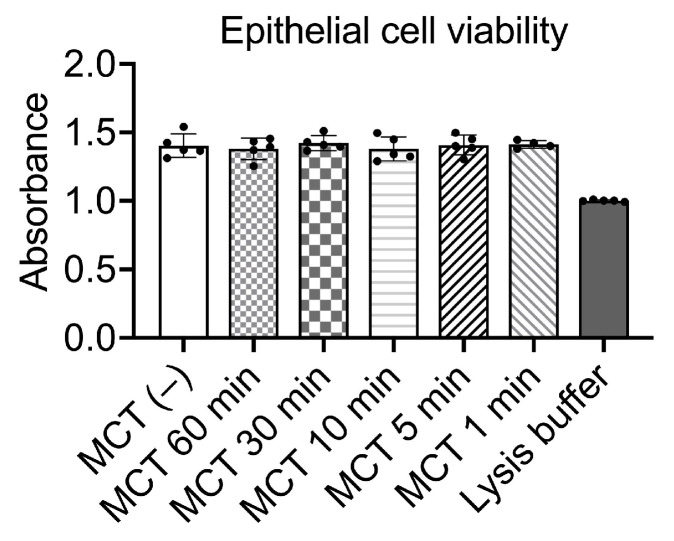
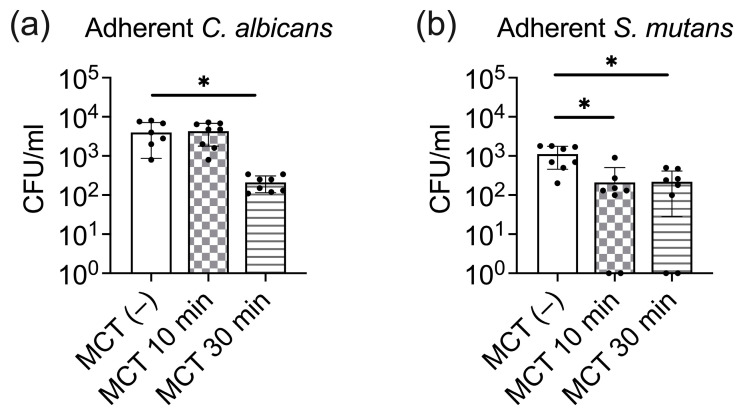
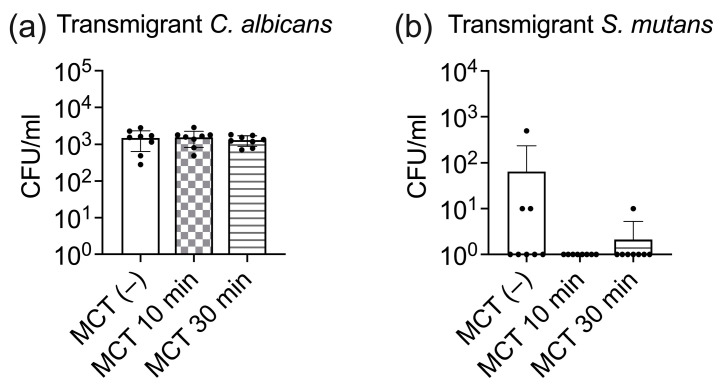
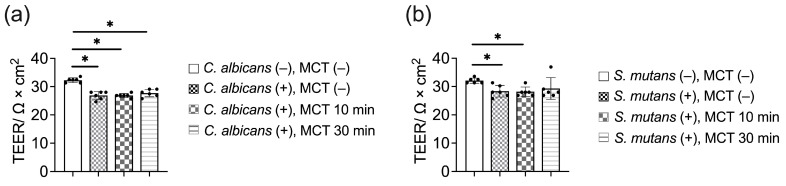
Despite MCT oil's potential antimicrobial benefits for gastrointestinal health, its effects on disrupting cariogenic pathogens on oral mucosal surfaces remain underexplored. This study evaluated the impact of MCT oil on the adhesion and invasion of Candida albicans and Streptoccocus mutans using planktonic and mucosal models. First, a planktonic model was used to assess the impact of various concentrations of MCT on the growth of S. mutans and C. albicans. Subsequently, a mucosal model was established by seeding TR-146 human buccal mucosal epithelial cells on a 3 µm porous transwell membrane, forming an epithelial barrier. MCT oil was then applied to the epithelial barriers in different durations (10, 30, and 60 min). Subsequently, C. albicans and S. mutans were introduced in the transwell and their adherence to the epithelial cells and their transmigration through the barriers was assessed using colony-forming unit counts and the barrier integrity was assessed by trans epithelial electrical resistance (TEER). Furthermore, cytotoxicity of MCT oil on mucosal cells was assessed by AlamarBlue assay. We found that higher MCT concentrations (90% and 100%) significantly inhibited C. albicans and S. mutans growth in planktonic conditions. Additionally, MCT oil reduced S. mutans adhesion to epithelial cells, highlighting its potential to interfere with bacterial attachment and colonization to oral mucosa. However, the oil had limited effects on C. albicans adhesion and transmigration. MCT demonstrated no cytotoxic effects on the viability of epithelial cells. The study findings highlight the potential benefits of MCT oil, particularly in oral bacterial inhibition, for oral health applications.
Keywords: C. albicans; MCT oil; S. mutans; adherence; epithelial barrier; transmigration.
Conflict of interest statement
The authors declare no conflicts of interest.
Figures

References
-
- Krishna A. Coconut Oil: Chemistry, Production and Its Applications—A Review. Indian Coconut J. 2010;53:15–27.
-
- Subroto A., Pangawikan A., Yarlina V., Ramadhani A.V. The Extraction, Purification, and the Recent Applications of Coconut Oil in Food Products—A Review. Int. J. Emerg. Technol. Learn. 2020;11:234–240.
-
- Saher F., Hosein M.M., Ahmed J.T. Role of Coconut Oil Pulling on Oral Health—An Overview. J. Pak. Dent. Assoc. 2018;27:94–99. doi: 10.25301/JPDA.273.94. - DOI
-
- Yin J., Huang H., Jiang X., Guo X.-Y., Pan B., Gao P., Zhong W., Hu C., He D. Coconut oil research: Past, present, and future directions. Food Health. 2024;6:5. doi: 10.53388/FH2024005. - DOI
Grants and funding
LinkOut - more resources
Full Text Sources
