


Skin and Induced Pluripotent Stem Cells as Biomarkers for Neurodegenerative Diseases
- PMID: 39766775
- PMCID: PMC11675334
- DOI: 10.3390/genes15121507
Skin and Induced Pluripotent Stem Cells as Biomarkers for Neurodegenerative Diseases
Abstract
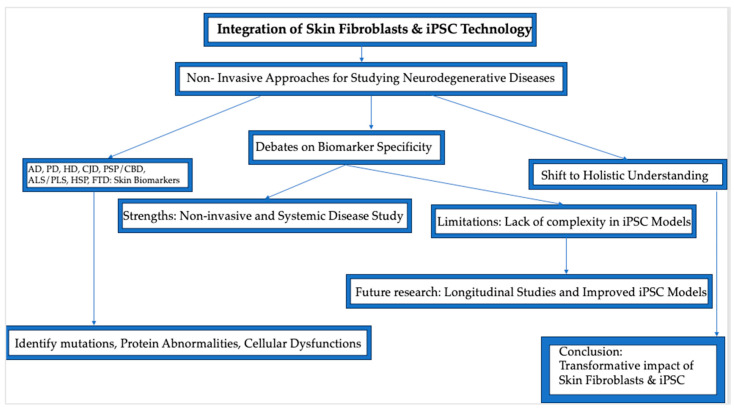
As the global population ages, the rising prevalence of neurodegenerative diseases, characterized by abnormal protein aggregates, presents significant challenges for early diagnosis and disease monitoring. Identifying accessible tissue biomarkers is crucial for advancing our ability to detect and track the progression of these diseases. Among the most promising biomarkers is the skin, which shares a common embryological origin with the brain and central nervous system (CNS). This biological connection positions the skin as a potential reflection of CNS pathology. Over the past decades, gene expression studies have demonstrated that key genes involved in neurodegenerative diseases are also expressed in skin tissues. Genes such as APP, PSEN1, PPA2, PINK1, LRRK2, PLCB4, MAPT, SPAST, and SPG7 are prominent in this regard. Beyond gene expression, proteins related to neurodegenerative diseases-such as α-synuclein, TAU, PARKIN, and prion protein (PrP)-have been isolated from the skin of affected individuals, underscoring the skin's capacity to mirror neural degeneration. This non-invasive window into neurodegenerative processes is further enhanced by advances in stem cell technology, which have allowed for the generation of human-induced pluripotent stem cells (iPSCs) from patient-derived fibroblasts. These iPSCs offer a valuable model for studying disease mechanisms and developing therapeutic approaches. This review conducts a comprehensive analysis of the literature from databases such as PubMed, Google Scholar, and ResearchGate, emphasizing the unique potential of the skin as a non-invasive biomarker for neurodegenerative diseases. It explores how the skin serves as a bridge between gene expression and disease pathology in both the skin and the CNS. By leveraging this biological connection, the skin emerges as a promising model for enhancing our understanding of neurodegenerative disorders and developing innovative strategies for early detection and treatment. However, significant limitations remain, requiring further validation to establish the specificity and sensitivity of these biomarkers.
Keywords: fibroblasts; genes; iPSc; neurodegenerative diseases; proteins; skin.
Conflict of interest statement
No conflicts of interest to declare.
Figures
References
-
- Nagasaka Y., Dillner K., Ebise H., Teramoto R., Nakagawa H., Lilius L., Axelman K., Forsell C., Ito A., Winblad B., et al. A unique gene expression signature discriminates familial Alzheimer’s disease mutation carriers from their wild-type siblings. Proc. Natl. Acad. Sci. USA. 2005;102:14854–14859. doi: 10.1073/pnas.0504178102. - DOI - PMC - PubMed
-
- Azkona G., López de Maturana R., Del Rio P., Sousa A., Vazquez N., Zubiarrain A., Jimenez-Blasco D., Bolaños J.P., Morales B., Auburger G., et al. LRRK2 Expression Is Deregulated in Fibroblasts and Neurons from Parkinson Patients with Mutations in PINK1. Mol. Neurobiol. 2018;55:506–516. doi: 10.1007/s12035-016-0303-7. - DOI - PMC - PubMed
Publication types
MeSH terms
Substances
LinkOut - more resources
Full Text Sources
Medical
Research Materials
Miscellaneous
