


Characterization of the Mitochondrial Genome of Cambaroides schrenckii (Astacidea: Cambaridae) and Its Phylogenetic Implications
- PMID: 39766845
- PMCID: PMC11675430
- DOI: 10.3390/genes15121578
Characterization of the Mitochondrial Genome of Cambaroides schrenckii (Astacidea: Cambaridae) and Its Phylogenetic Implications
Abstract
Background: Cambaroides schrenckii is an endangered freshwater crayfish in China, belonging to the genus Cambaroides, that can act as a complementary host for paragonimus. The objective of this study was to examine the complete mitochondrial genome characteristics and their evolutionary relationships within the Astacidea.
Methods: The analysis of gene rearrangements and evolutionary relationships was conducted through the sequencing of the mitochondrial genome of C. schrenckii.
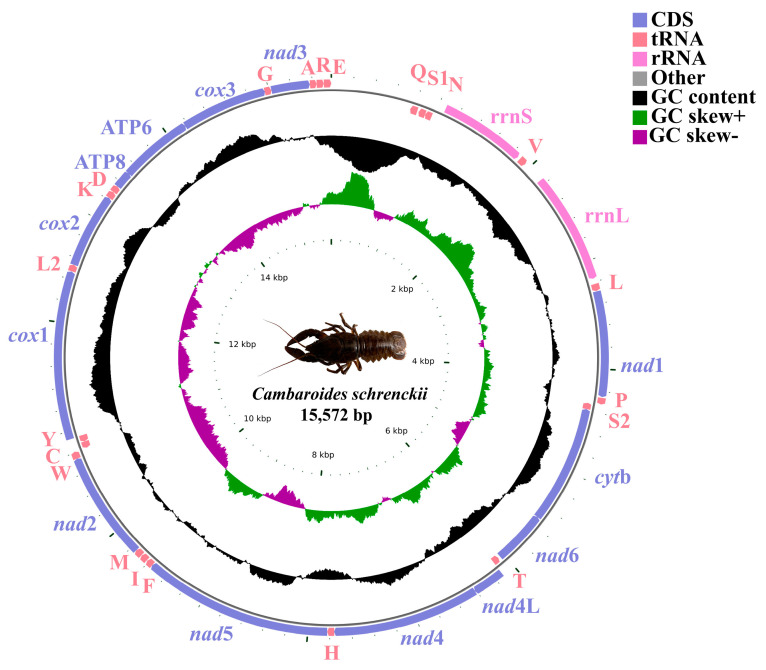
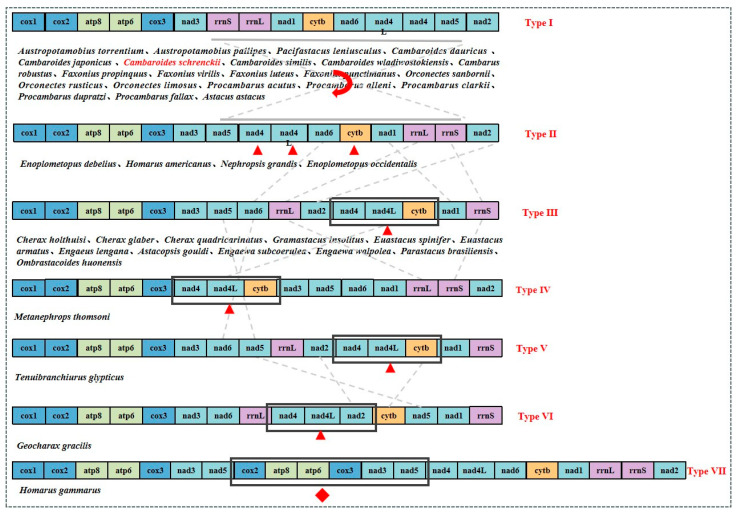
Results: C. schrenckii mitochondrial genome length was 15,572, comprising thirteen PCGs, two rRNAs, 22 tRNAs, and one d-loop region of C. schrenckii. The mitochondrial genome of C. schrenckii exhibits an A + T content of 69.61% and a G + C content of 30.39%. Among the thirteen PCGs, cytb, nad3, and nad6 have a start codon of ATT, while the other ten PCGs have ATC, ATA, and ATG start codons. All 22 tRNA genes displayed a typical cloverleaf secondary structure. Gene rearrangement analysis showed that seven gene arrangements were identified based on PCGs in the infraorder Astacidea, with type I being the most common.
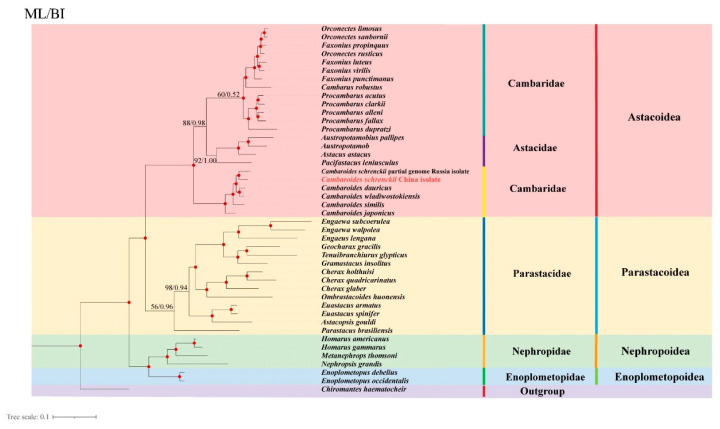
Conclusions: The relationship between the American Cambaridae is closer to Astacidae than the Asian Cambaridae. The present study provides a theoretical basis for further discussions of developmental relationships in the infraorder Astacidea.
Keywords: Astacidea; Cambaroides schrenckii; mitochondrial genome; phylogenetic analysis.
Conflict of interest statement
The authors declare no conflicts of interest.
Figures
References
-
- Su C.C., Tin Y.C., Ahyong S.T. Two New Species of the Rare Lobster Genus Thaumastocheles Wood-Mason, 1874 (Reptantia: Nephropidae) Discovered from Recent Deep-Sea Expeditions in the Indo-West Pacific. J. Crustac. Biol. 2014;34:107–122.
-
- Mantelatto F.L., Tamburus A.F., Carvalho-Batista A. Checklist of decapod crustaceans from the coast of the So Paulo state (Brazil) supported by integrative molecular and morphological data: V. Dendrobranchiata and Pleocyemata [Achelata, Astacidea, Axiidea, Caridea (Alpheoidea and Processoidea excluded), Gebiidea, Stenopodidea] Zootaxa. 2022;5121:1–74. - PubMed
-
- Richman N.I., Böhm M., Adams S.B., Alvarez F., Bergey E.A., Bunn J.J., Burnham Q., Cordeiro J., Coughran J., Crandall K.A., et al. Multiple drivers of decline in the global status of freshwater crayfish (Decapoda: Astacidea) Philos. Trans. R. Soc. Lond. B Biol. Sci. 2015;370:20140060. doi: 10.1098/rstb.2014.0060. - DOI - PMC - PubMed
-
- Chai J.Y., Jung B.K. Epidemiology of trematode infections: An update. Adv. Exp. Med. Biol. 2019;1154:359–409. - PubMed
MeSH terms
Substances
Grants and funding
- 32172886/National Natural Science Foundation of China
- 31972703/National Natural Science Foundation of China
- ZD2022C006/Heilongjiang Provincial Natural Science Foundation of China
- NPRC-2019-194-30/National Parasitic Resource Center of China and Ministry of Science and Technology
- ZRCQC202204/Heilongjiang Bayi Agricultural University support Program for San Heng San Zong
LinkOut - more resources
Full Text Sources
Research Materials
