


Polymorphism of Genes Potentially Affecting Growth and Body Size Suggests Genetic Divergence in Wild and Domestic Reindeer (Rangifer tarandus) Populations
- PMID: 39766896
- PMCID: PMC11675441
- DOI: 10.3390/genes15121629
Polymorphism of Genes Potentially Affecting Growth and Body Size Suggests Genetic Divergence in Wild and Domestic Reindeer (Rangifer tarandus) Populations
Abstract
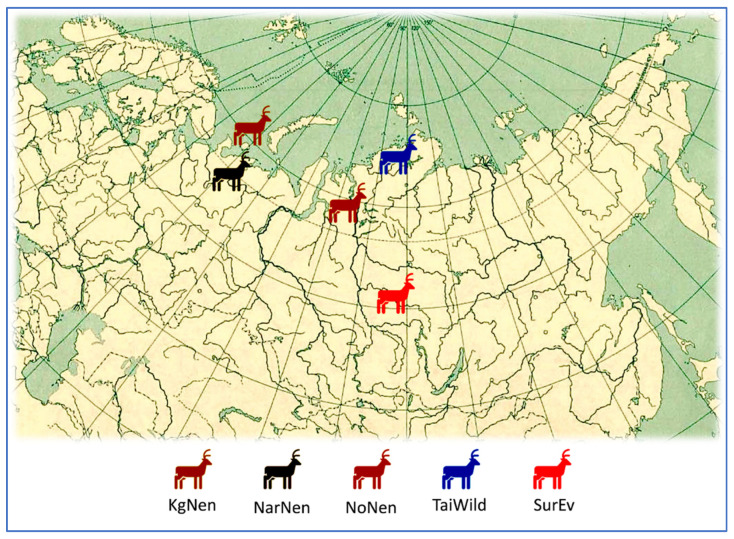
Background/Objectives: A combination of increased human presence in the Arctic zone alongside climate change has led to a decrease in the number of wild reindeer (Rangifer tarandus). Studying the genetic potential of this species will aid in conservation efforts, while simultaneously promoting improved meat productivity in domestic reindeer. Alongside reducing feed costs, increasing disease resistance, etc., acquiring genetic variation information is a crucial task for domestic reindeer husbandry. This study thus identified highly informative molecular genetic markers usable for assessing genetic diversity and breeding purposes in reindeer. Methods: We analyzed gene polymorphism that may potentially affect animal growth and development in populations of wild (Taimyr Peninsula) and domestic reindeer, including Nenets and Evenk breeds. We screened these populations for polymorphisms by sequencing the GH, GHR, LCORL and BMP2 genes. Results: Following generation of gene sequences, we compared the alleles frequency in the surveyed populations and their genetic divergence. Some loci lacked polymorphism in wild reindeer, unlike domestic breeds. This could suggest a selection-driven microevolutionary divergence in domestic reindeer populations. An isolated domestic population from Kolguyev Island appeared to be genetically remote from continental reindeer. Conclusions: Molecular genetic markers associated with economically important traits in reindeer can be further developed using the data obtained. Monitoring wild reindeer populations and better utilizing the genetic potential of domestic animals will depend on a panel of these marker genes. By using this marker panel, the amount of time spent on selection efforts will be greatly reduced to enhance meat performance during reindeer breeding.
Keywords: BMP2; GH; GHR; LCORL; body size; genes; genetic divergence; growth; polymorphism; reindeer Rangifer tarandus.
Conflict of interest statement
The authors declare no conflicts of interest. The funders had no role in the design of the study; in the collection, analyses, or interpretation of data; in the writing of the manuscript; or in the decision to publish the results.
Figures


References
-
- Gunn A., Russell D. Update on the global status of wild reindeer and caribou. [(accessed on 27 November 2024)];Deer Spec. Group Newsl. 2022 33:14–29. Available online: https://www.deerspecialistgroup.org/wp-content/uploads/2022/04/DSGNews33....
-
- Tryland M., Ravolainen V., Pedersen Å.Ø. Climate change: Potential impacts on pasture resources, health and diseases of reindeer and caribou. In: Tryland M., Kutz S., editors. Reindeer and Caribou. CRC Press; Boca Raton, FL, USA: 2018. pp. 493–514. - DOI
-
- Dance M. Ph.D. Dissertation. University of Oxford; Oxford, UK: 2023. [(accessed on 27 November 2024)]. Genetic Legacies of Past Climate Change on Arctic Species: How Past Responses Shape Future Impacts. Available online: https://ora.ox.ac.uk/objects/uuid:7e2e2273-73d8-4b2e-bc5a-72430830ebf6.
-
- Mallory C.D., Boyce M.S. Observed and predicted effects of climate change on Arctic caribou and reindeer. Environ. Rev. 2018;26:13–25. doi: 10.1139/er-2017-0032. - DOI
-
- Tahmin K.K. Master’s Thesis. Norwegian University of Life Sciences; Ås, Norway: 2023. [(accessed on 27 November 2024)]. Parasitic Infection Risk for the Svalbard Reindeer (Rangifer tarandus platyrhynchus) in Relation to Temperature, Host Density, and Grazing Behaviors. Available online: https://nmbu.brage.unit.no/nmbu-xmlui/handle/11250/3148260.
MeSH terms
Substances
Grants and funding
LinkOut - more resources
Full Text Sources
