


Federated Learning: Breaking Down Barriers in Global Genomic Research
- PMID: 39766917
- PMCID: PMC11728131
- DOI: 10.3390/genes15121650
Federated Learning: Breaking Down Barriers in Global Genomic Research
Abstract
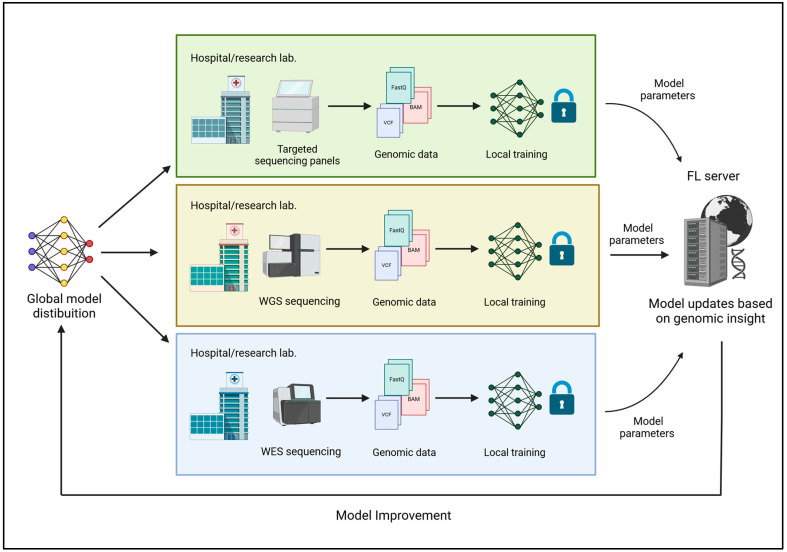
Recent advancements in Next-Generation Sequencing (NGS) technologies have revolutionized genomic research, presenting unprecedented opportunities for personalized medicine and population genetics. However, issues such as data silos, privacy concerns, and regulatory challenges hinder large-scale data integration and collaboration. Federated Learning (FL) has emerged as a transformative solution, enabling decentralized data analysis while preserving privacy and complying with regulations such as the General Data Protection Regulation (GDPR). This review explores the potential use of FL in genomics, detailing its methodology, including local model training, secure aggregation, and iterative improvement. Key challenges, such as heterogeneous data integration and cybersecurity risks, are examined alongside regulations like GDPR. In conclusion, successful implementations of FL in global and national initiatives demonstrate its scalability and role in supporting collaborative research. Finally, we discuss future directions, including AI integration and the necessity of education and training, to fully harness the potential of FL in advancing precision medicine and global health initiatives.
Keywords: NGS sequencing; artificial intelligence; federated learning; genomic data privacy; machine learning; precision medicine.
Conflict of interest statement
The authors declare no conflicts of interest.
Figures
References
-
- Hudson M., Garrison N.A., Sterling R., Caron N.R., Fox K., Yracheta J., Anderson J., Wilcox P., Arbour L., Brown A., et al. Rights, interests and expectations: Indigenous perspectives on unrestricted access to genomic data. Nat. Rev. Genet. 2020;21:377–384. doi: 10.1038/s41576-020-0228-x. - DOI - PubMed
Publication types
MeSH terms
Grants and funding
LinkOut - more resources
Full Text Sources
