


Epigenetic Regulation and Neurodevelopmental Disorders: From MeCP2 to the TCF20/PHF14 Complex
- PMID: 39766920
- PMCID: PMC11728296
- DOI: 10.3390/genes15121653
Epigenetic Regulation and Neurodevelopmental Disorders: From MeCP2 to the TCF20/PHF14 Complex
Abstract
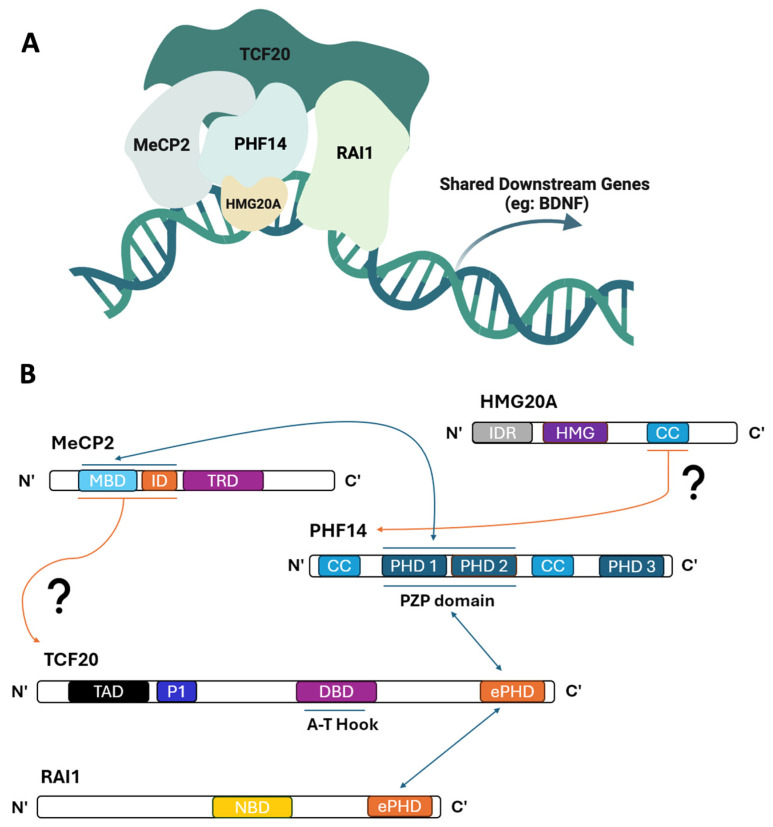
Background: Neurodevelopmental disorders (NDDs) affect approximately 15% of children and adolescents worldwide. This group of disorders is often polygenic with varying risk factors, with many associated genes converging on shared molecular pathways, including chromatin regulation and transcriptional control. Understanding how NDD-associated chromatin regulators and protein complexes orchestrate these regulatory pathways is crucial for elucidating NDD pathogenesis and developing targeted therapeutic strategies. Recently, the TCF20/PHF14 chromatin complex was identified in the mammalian brain, expanding the list of chromatin regulatory remodelers implicated in NDDs. This complex-which includes MeCP2, RAI1, TCF20, PHF14, and HMG20A-plays a vital role in epigenetic and transcriptional regulation.
Methods: We review and summarize current research and clinical reports pertaining to the different components of the MeCP2-interacting TCF20/PHF14 complex. We examine the NDDs associated with the TCF20/PHF14 complex, explore the molecular and neuronal functions of its components, and discuss emerging therapeutic strategies targeting this complex to mitigate symptoms, with broader applicability to other NDDs.
Results: Mutations in the genes encoding the components of the MeCP2-interacting TCF20/PHF14 complex have been linked to various NDDs, underscoring its critical contribution to brain development and NDD pathogenesis.
Conclusions: The MeCP2-interacting TCF20/PHF14 complex and its associated NDDs could serve as a model system to provide insight into the interplay between epigenetic regulation and NDD pathogenesis.
Keywords: HMG20A; MeCP2; PHF14; RAI1; Rett syndrome; TCF20; chromatin regulators; neurodevelopmental disorders; neuronal activity; transcription.
Conflict of interest statement
The authors declare no conflicts of interest.
Figures
References
-
- Gidziela A., Ahmadzadeh Y.I., Michelini G., Allegrini A.G., Agnew-Blais J., Lau L.Y., Duret M., Procopio F., Daly E., Ronald A., et al. A meta-analysis of genetic effects associated with neurodevelopmental disorders and co-occurring conditions. Nat. Hum. Behav. 2023;7:642–656. doi: 10.1038/s41562-023-01530-y. - DOI - PMC - PubMed
-
- Moffitt T.E., Houts R., Asherson P., Belsky D.W., Corcoran D.L., Hammerle M., Harrington H., Hogan S., Meier M.H., Polanczyk G.V., et al. Is Adult ADHD a Childhood-Onset Neurodevelopmental Disorder? Evidence from a Four-Decade Longitudinal Cohort Study. Am. J. Psychiatry. 2015;172:967–977. doi: 10.1176/appi.ajp.2015.14101266. - DOI - PMC - PubMed
-
- Liah M., Andrew L., Mark M., Tim F., Eavan M., Lisa C. Adult onset neurodevelopmental disorder with regression, abnormal movement, loss of speech and seizures (NEDAMSS); Proceedings of the Association of British Neurologists: Annual Meeting Abstracts; Belfast, UK. 20 May 2023; p. A79.
Publication types
MeSH terms
Substances
Grants and funding
LinkOut - more resources
Full Text Sources
Miscellaneous
