


Population Studies and Molecular Mechanisms of Human Radioadaptive Capabilities: Is It Time to Rethink Radiation Safety Standards?
- PMID: 39769306
- PMCID: PMC11676322
- DOI: 10.3390/ijms252413543
Population Studies and Molecular Mechanisms of Human Radioadaptive Capabilities: Is It Time to Rethink Radiation Safety Standards?
Abstract
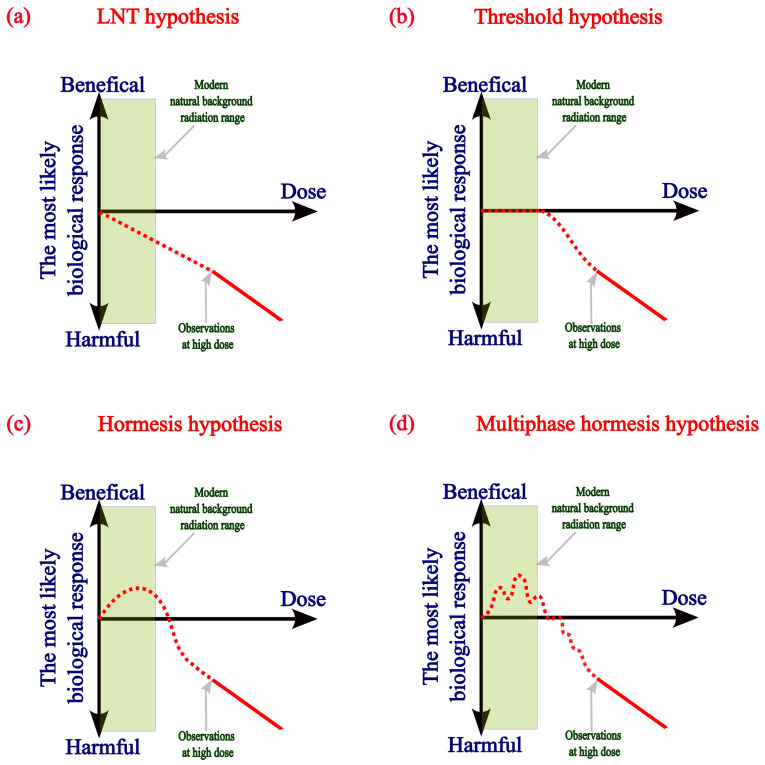
The evolution of man on Earth took place under conditions of constant exposure to background ionizing radiation (IR). From this point of view, it would be reasonable to hypothesize the existence of adaptive mechanisms that enable the human organism to safely interact with IR at levels approximating long-term natural background levels. In some situations, the successful operation of molecular mechanisms of protection against IR is observed at values significantly exceeding the natural background level, for example, in cancer cells. In 15-25% of cancer patients, cancer cells develop a phenotype that is resistant to high doses of IR. While further investigations are warranted, the current evidence suggests a strong probability of observing positive health effects, including an increased lifespan, a reduced cancer risk, and a decreased incidence of congenital pathologies, precisely at low doses of ionizing radiation. This review offers arguments primarily based on a phenomenological approach and critically reconsidering existing methodologies for assessing the biological risks of IR to human health. Currently, in the most economically developed countries, there are radiation safety rules that interpret low-dose radiation as a clearly negative environmental factor. Nowadays, this approach may pose significant challenges to the advancement of radiomedicine and introduce complexities in the regulation of IR sources. The review also examines molecular mechanisms that may play a key role in the formation of the positive effects of low-dose IR on human radioadaptive capabilities.
Keywords: carcinogenesis; hormesis; ionizing radiation; low-dose radiation; radiation safety; radioadaptive response; radioresistance.
Conflict of interest statement
The authors declare no conflicts of interest.
Figures
References
-
- Li Q., Zhao G., Han W., Xu S., Wu L. Radiation Target: Moving from Theory to Practice. Nucl. Anal. 2022;1:100024. doi: 10.1016/j.nucana.2022.100024. - DOI
-
- ICRP 1990 Recommendations of the International Commission on Radiological Protection. Ann. ICRP. 1991;21:1–201. - PubMed
-
- Takahashi K., Yugi K., Hashimoto K., Yamada Y., Pickett C.J.F., Tomita M. Computational Challenges in Cell Simulation: A Software Engineering Approach. IEEE Intell. Syst. 2002;17:64–71. doi: 10.1109/MIS.2002.1039834. - DOI
Publication types
MeSH terms
LinkOut - more resources
Full Text Sources
