


Randomized Clinical Evaluation of the Healing Activity of Green Propolis Ointment in Individuals with Lower Limb Ulcers Resulting from Leprosy: Preliminary Results of a Pilot Study
- PMID: 39770464
- PMCID: PMC11679340
- DOI: 10.3390/ph17121622
Randomized Clinical Evaluation of the Healing Activity of Green Propolis Ointment in Individuals with Lower Limb Ulcers Resulting from Leprosy: Preliminary Results of a Pilot Study
Abstract
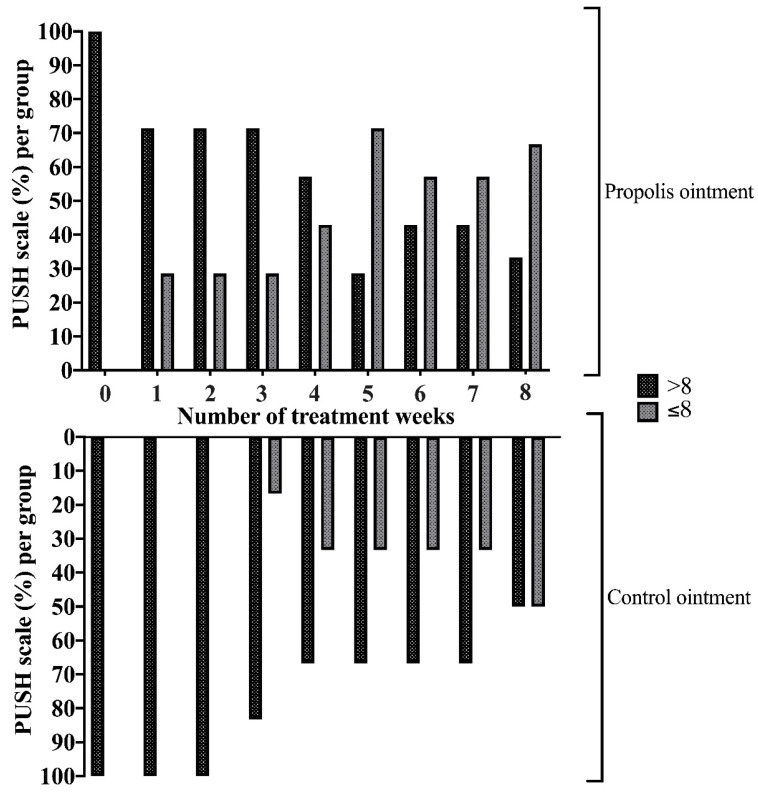
Background/Objectives: Treating chronic wounds incurs substantial costs for Brazil's Unified Health System. Natural compounds, particularly propolis, are increasingly explored as low-cost alternatives due to their healing properties. Brazilian green propolis, distinct in its chemical composition, has garnered scientific interest. This study aimed to assess the healing effects of green propolis ointment on lower-limb ulcers from leprosy. Methods: A blinded, randomized clinical trial included 18 wounds in two groups: propolis ointment (G1) and control (G2), with evaluations conducted weekly for 61 days. Wound progress was monitored using morphometry and the Pressure Ulcer Scale for Healing (PUSH). Results: No participants exhibited sensitivity to the propolis. G1 showed significant initial healing: average wound area reduction (%) for G1 vs. G2 included 56.38 vs. 6.13-p < 0.001 (week 1); 79.51 vs. 24.16-p = 0.022 (week 4); and 84.33 vs. 39.73-p = 0.051 (week 7). In G1, the PUSH scores decreased from the beginning, whereas in G2, reductions were observed after three weeks. By week 5, 71.4% of G1 wounds scored below eight points, versus 33.3% in G2. G1 wounds exhibited a reduced area and exudate, as well as revitalized granulation tissue without adverse effects. Conclusions: The findings suggest that green propolis ointment is safe, supports tissue repair and may offer cost-effective treatment benefits. Standard wound dressings are selected to support all healing stages, with an emphasis on antimicrobial action, hemostasis to reduce exudate, and pain-reducing and non-irritant properties. Green propolis ointment meets these criteria, offering a cost-effective treatment that accelerates lesion reduction and encouraging leprosy patients to follow the therapeutic regimen.
Keywords: Brazilian green propolis; clinical study; healing; leprosy; ulcer.
Conflict of interest statement
The authors declare that they have no conflicts of interest. The sponsors had no role in the design of the study, data collection, analysis, interpretation, manuscript writing, or decision to publish the results.
Figures


References
-
- Bernardo C.L.E., Souza I.A.F., Colavitti C., Garcia C. Propolis: Healing and natural antibiotic. Rev. Braz. Enferm. 1990;43:101–106. doi: 10.1590/S0034-71671990000100016. - DOI
-
- Peruchi C.M.S., Silva E.B., Andrade R.A., Franco S.L., Ramatho L.T.O. Effect del propoleos in there healing of subcutaneous wounds induced in el dorso de ratones: Histological study. Rev. Fac. Odontol. Univ. Chile. 2001;19:23–24.
-
- Vargas A.C., Loguercio A.P., Witt N.M., Costa M.M., Silva M.S., Viana L.R. Antimicrobial activity “in vitro” of alcoholic extract of propolis. Rural. Sci. 2004;34:159–163.
-
- Fernandes A., Jr., Lopes M.M.R., Colombari V., Monteiro A.C.M., Vieira E.P. Antimicrobial activity of Apis propolis mellifera obtained in three regions of Brazil. Rural. Sci. 2006;36:294–297.
Grants and funding
LinkOut - more resources
Full Text Sources
