


Resistant Rhodococcus for Biodegradation of Diesel Fuel at High Concentration and Low Temperature
- PMID: 39770807
- PMCID: PMC11676119
- DOI: 10.3390/microorganisms12122605
Resistant Rhodococcus for Biodegradation of Diesel Fuel at High Concentration and Low Temperature
Abstract
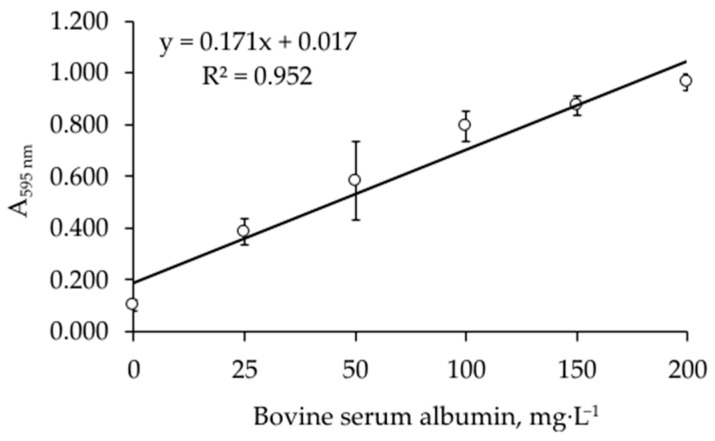
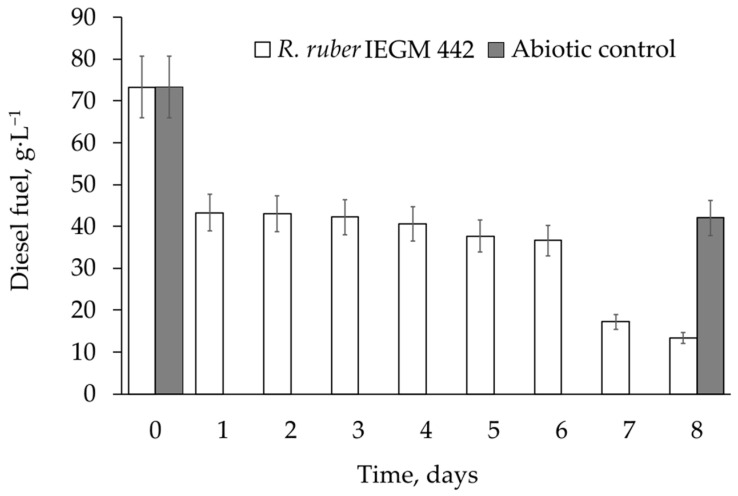
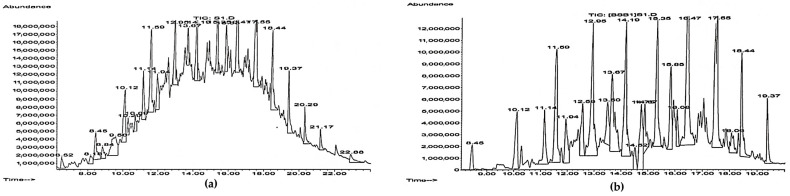
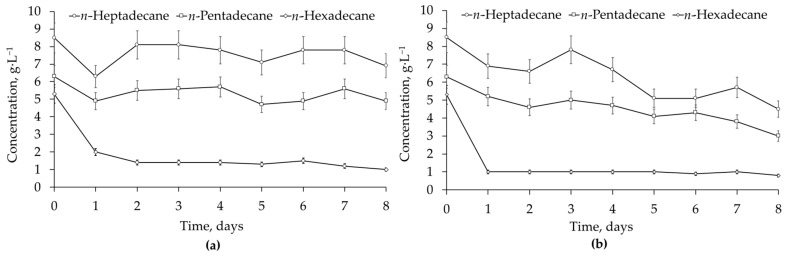
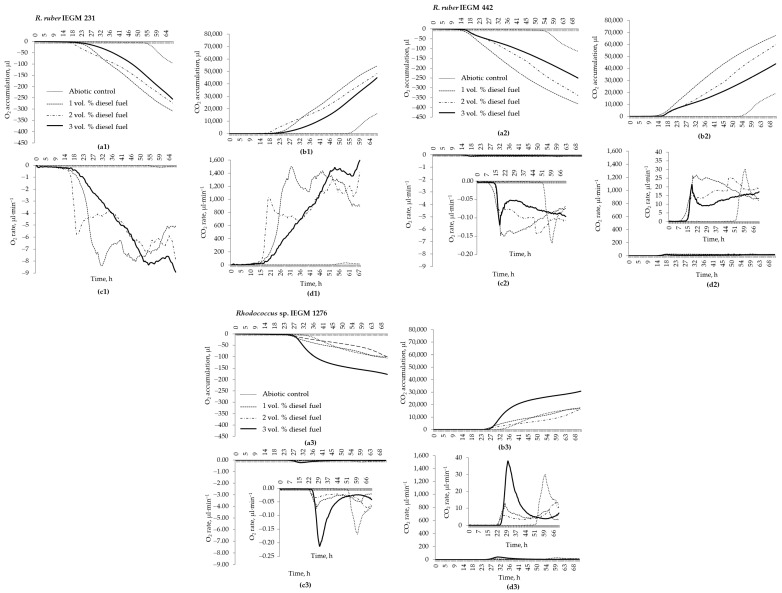
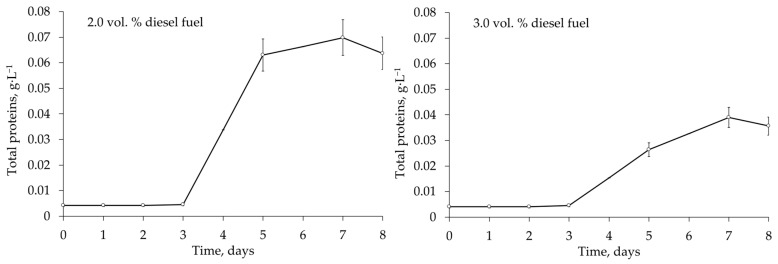
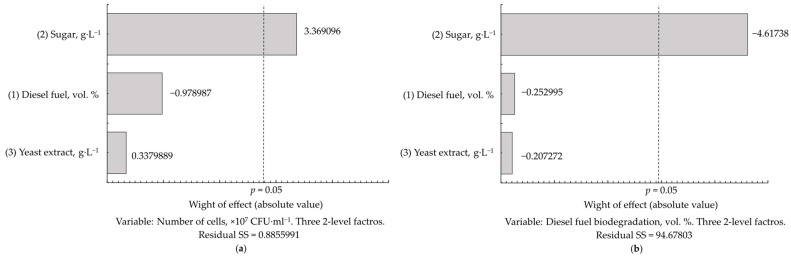
The resistance of 16 Rhodococcus strains to diesel fuel was studied. The minimal inhibitory concentrations of diesel fuel against Rhodococcus were 4.0-64.0 vol. % and 0.5-16.0 vol. % after 7 days of incubation in Luria-Bertani broth and a mineral "Rhodococcus-surfactant" medium, respectively. The three most resistant strains (R. ruber IEGM 231, IEGM 442 and Rhodococcus sp. IEGM 1276) capable of overcoming the toxicity of diesel fuel at a high (8.0 vol. %) concentration and at a low (4 °C) temperature were selected. Respiration activities, growth kinetics, and changes in the diesel fuel composition during the biodegradation process were elucidated using gas chromatography with mass spectrometry, respirometry, and Bradford analysis. Growth conditions were optimised for the improved biodegradation of diesel fuel by Rhodococcus cells using multifactor analysis. They included the simultaneous addition of 1.3 g·L-1 of granular sugar and 0.25 g·L-1 of yeast extract. The twofold stimulation of the biodegradation of individual hydrocarbons in diesel fuel (n-pentadecane, n-hexadecane and n-heptadecane) was demonstrated when glycolipid Rhodococcus-biosurfactants were added at a concentration of 1.4 g·L-1. A total removal of 71-91% of diesel fuel was achieved in this work.
Keywords: Rhodococcus; biodegradation; biosurfactants; diesel fuel; growth kinetics; heavy contamination; low temperatures; no catabolite repression; resistance; respirometry.
Conflict of interest statement
The authors declare no conflicts of interest. The funders had no role in the design of the study; in the collection, analyses, or interpretation of data; in the writing of the manuscript; or in the decision to publish the results.
Figures
References
-
- Brown K.E., King C.K., Kotzakoulakis K., George S.C., Harrison P.L. Assessing fuel spill risks in polar waters: Temporal dynamics and behaviour of hydrocarbons from Antarctic diesel, marine gas oil and residual fuel oil. Mar. Pollut. Bull. 2016;110:343–353. doi: 10.1016/j.marpolbul.2016.06.042. - DOI - PubMed
-
- Gao P., Zhang Y., Zhao L. Synthetic zeolites derived from fly ash as effective mineral sorbents for diesel fuel spill remediation. Clays Clay Miner. 2016;64:552–559. doi: 10.1346/CCMN.2016.064035. - DOI
-
- Glyaznetsova Y.S., Nemirovskaya I.A., Flint M.V. Study of the effects of an accidental diesel fuel spill in Norilsk. Dokl. Earth Sci. 2021;501:994–999. doi: 10.1134/S1028334X21110052. - DOI
-
- Muthohharoh T., Latumahina L.J., Suyanta S., Suherman S. Analysis of petroleum products spill potential impact (gasoline and diesel fuels) on soil fertility quality around Pertamina Rewulu-Cilacap pipeline Bantul-Yogyakarta. Molekul. 2023;18:170–177. doi: 10.20884/1.jm.2023.18.2.5402. - DOI
-
- Imbery J.J., Buday C., Miliano R.C., Shang D., Kwok H., Helbing C.C. Salmonid smolt caudal fin and liver transcriptome responses to low sulfur marine diesel and high sulfur fuel oil water accommodated fractions for assessing oil spill effects in marine environments. Ecotoxicol. Environ. Saf. 2024;279:116463. doi: 10.1016/j.ecoenv.2024.116463. - DOI - PubMed
Grants and funding
LinkOut - more resources
Full Text Sources
