


Dietary N-6 Polyunsaturated Fatty Acid Intake and Brain Health in Middle-Aged and Elderly Adults
- PMID: 39770894
- PMCID: PMC11680004
- DOI: 10.3390/nu16244272
Dietary N-6 Polyunsaturated Fatty Acid Intake and Brain Health in Middle-Aged and Elderly Adults
Abstract
Background: Dietary intake of polyunsaturated fatty acids (PUFA) plays a significant role in the onset and progression of neurodegenerative diseases. Since the neuroprotective effects of n-3 PUFA have been widely validated, the role of n-6 PUFA remains debated, with their underlying mechanisms still not fully understood.
Methods: In this study, 169,295 participants from the UK Biobank were included to analyze the associations between dietary n-6 PUFA intake and neurodegenerative diseases using Cox regression models with full adjustments for potential confounders. In addition, multiple linear regression models were utilized to estimate the impact of n-6 PUFA intake on brain imaging phenotypes.
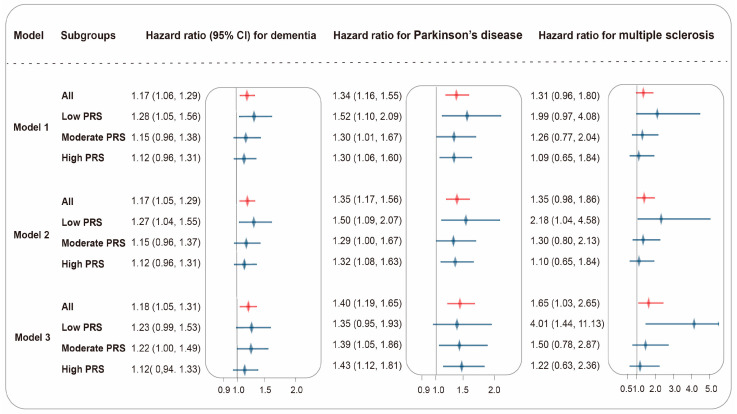
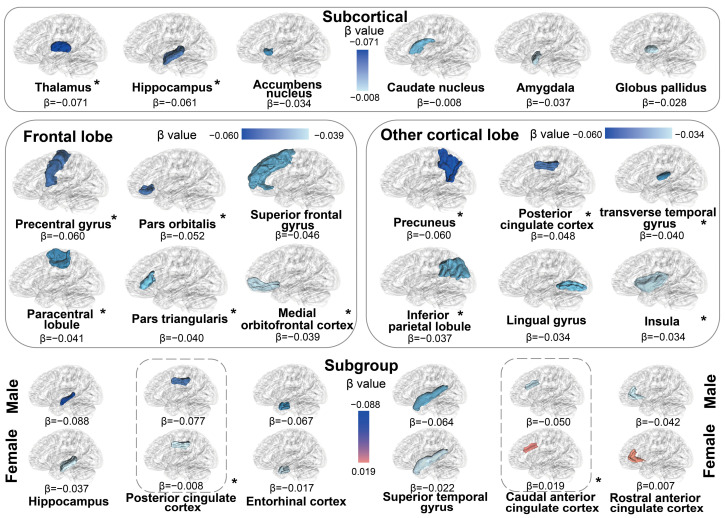
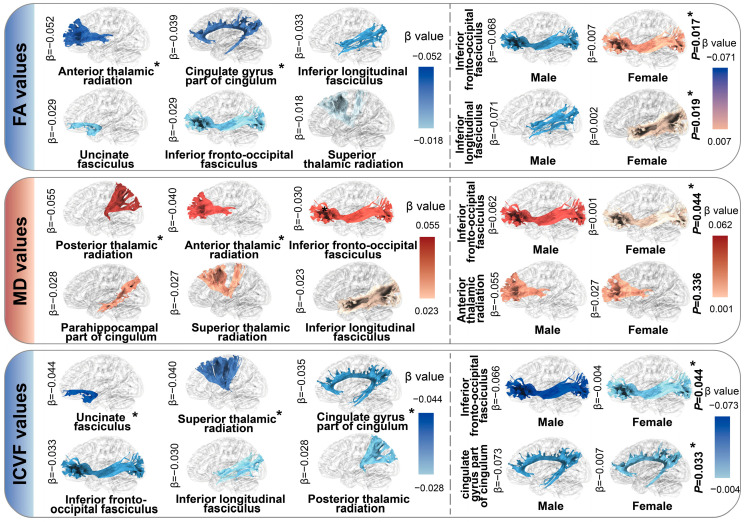
Results: Results indicated that low dietary n-6 PUFA intake was associated with increased risks of incident dementia (hazard ratio [95% confidence interval] = 1.30 [1.13, 1.49]), Parkinson's disease (1.42 [1.16, 1.74]), and multiple sclerosis (1.65 [1.03, 2.65]). Moreover, the low intake was linked to diminished volumes of various brain structures, including the hippocampus (β [95% confidence interval] = -0.061 [-0.098, -0.025]), thalamus (-0.071 [-0.105, -0.037]), and others. White matter integrity was also found to be compromised in individuals with low n-6 PUFA intake.
Conclusions: These findings enhanced our understanding of how dietary n-6 PUFA intake might affect neurological health, thereby providing epidemiological evidence for future clinical and public health interventions.
Keywords: dietary factors; genetic risk; gray matter; n-6 polyunsaturated fatty acids; neurodegenerative disease; white matter.
Conflict of interest statement
The authors declare no conflicts of interest.
Figures

References
-
- Feigin V.L., Stark B.A., Johnson C.O., Roth G.A., Bisignano C., Abady G.G., Abbasifard M., Abbasi-Kangevari M., Abd-Allah F., Abedi V., et al. Global, regional, and national burden of stroke and its risk factors, 1990–2019: A systematic analysis for the Global Burden of Disease Study 2019. Lancet Neurol. 2021;20:795–820. doi: 10.1016/S1474-4422(21)00252-0. - DOI - PMC - PubMed
-
- Bazan N.G., Molina M.F., Gordon W.C. Docosahexaenoic acid signalolipidomics in nutrition: Significance in aging, neuroinflammation, macular degeneration, Alzheimer’s, and other neurodegenerative diseases. Annu. Rev. Nutr. 2011;31:321–351. doi: 10.1146/annurev.nutr.012809.104635. - DOI - PMC - PubMed
MeSH terms
Substances
Grants and funding
LinkOut - more resources
Full Text Sources
