


Heterogeneity in Health Outcomes in the Strong Hearts, Healthy Communities-2.0 Multilevel Intervention in a Community-Randomized Trial: An Exploratory Study of Moderators
- PMID: 39770974
- PMCID: PMC11678296
- DOI: 10.3390/nu16244353
Heterogeneity in Health Outcomes in the Strong Hearts, Healthy Communities-2.0 Multilevel Intervention in a Community-Randomized Trial: An Exploratory Study of Moderators
Abstract
Background/objectives: Multilevel interventions have demonstrated efficacy in improving obesity and other related health outcomes. However, heterogeneity in individual responses indicates the need to identify the factors associated with responses and non-responses to multilevel interventions. The objective of this report is to identify the potential sources of heterogeneity through the exploration of the moderation effects of participant characteristics (sociodemographic and baseline physical/mental health) in the Strong Hearts, Healthy Communities-2.0 (SHHC-2.0) intervention.
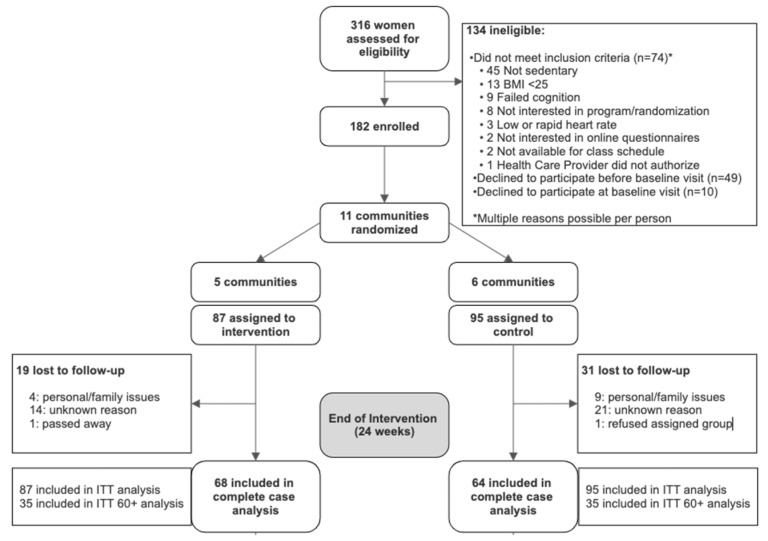
Methods: SHHC-2.0 is a 24-week multilevel intervention to improve people's diet and physical activity evaluated using a cluster-randomized, controlled trial design conducted with women aged 40 and older living in rural communities with an elevated risk of cardiovascular disease, defined as having a BMI > 30, or a BMI 25-30 plus < 1 weekly occurrence of 30 min of physical activity during leisure time. Linear mixed models were used to compare the between-group changes in the outcomes (weight, systolic blood pressure, hemoglobin A1c [HbA1c], and triglycerides), with an interaction term included for each potential moderator.
Results: Within the sociodemographic characteristics, there were no differences in effectiveness by age, income, or baseline BMI status, but the participants with a high school education or less experienced less weight loss. Among their health history, only a history of hypertension was associated with differential outcomes; those with a history of hypertension demonstrated a greater reduction in systolic blood pressure. The participants with elevated depressive symptoms demonstrated greater weight loss and a greater reduction in the HbA1c level.
Conclusions: SHHC-2.0 was effective across a wide range of participants. The identified moderators (i.e., education level) may inform the future tailoring of the SHHC intervention to optimize the outcomes among participant subgroups, while more broadly, our findings can serve to inform the development and dissemination of multilevel interventions.
Keywords: cardiovascular disease; diet; mental health; moderation analysis; multilevel intervention; nutrition; obesity; physical activity.
Conflict of interest statement
Rebecca A. Seguin-Fowler is a co-founder of strongpeopleprogram.org. No other authors have conflicts of interest to declare. The funders had no role in the design and conduct of this study; collection, management, analysis, and interpretation of the data; preparation, review, or approval of the manuscript; or decision to submit the manuscript for publication.
Figures
References
Publication types
MeSH terms
Substances
Grants and funding
LinkOut - more resources
Full Text Sources
Medical
