


Development and Pragmatic Randomized Controlled Trial of Healthy Ketogenic Diet Versus Energy-Restricted Diet on Weight Loss in Adults with Obesity
- PMID: 39771001
- PMCID: PMC11677078
- DOI: 10.3390/nu16244380
Development and Pragmatic Randomized Controlled Trial of Healthy Ketogenic Diet Versus Energy-Restricted Diet on Weight Loss in Adults with Obesity
Abstract
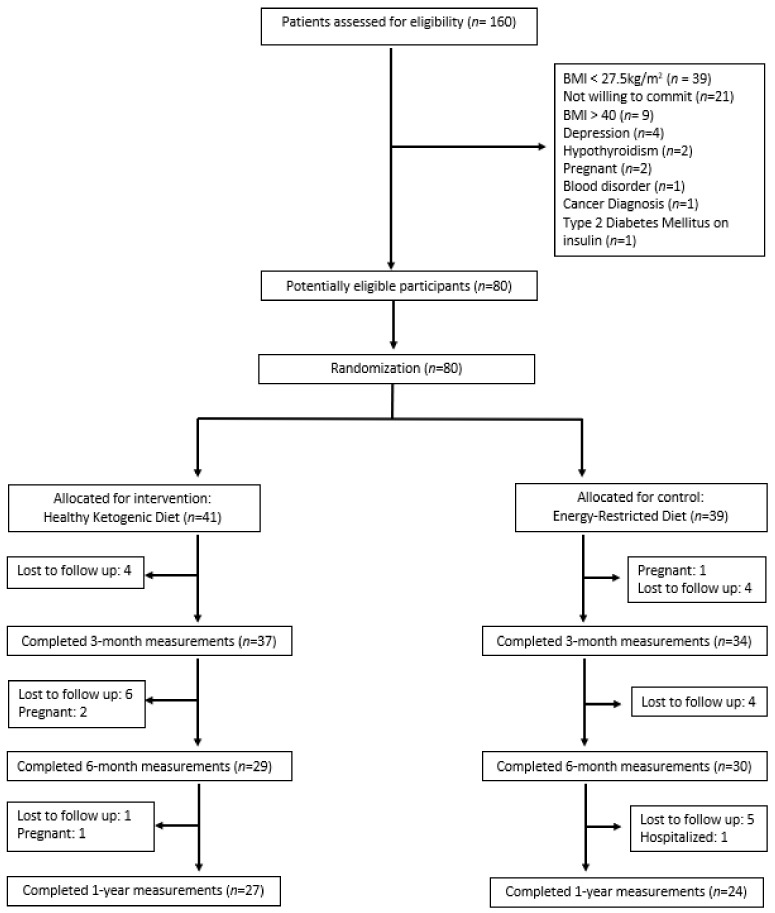
Introduction: The ketogenic diet (KD) is widely used for weight management by reducing appetite, enhancing fat oxidation, and facilitating weight loss. However, the high content of total and saturated fats in a conventional KD may elevate low-density lipoprotein (LDL)-cholesterol levels, a known risk factor for cardiovascular diseases, highlighting the need for healthier alternatives. This study aimed to investigate the effect of a newly developed Healthy Ketogenic Diet (HKD) versus an Energy-Restricted Diet (ERD) on weight loss and metabolic outcomes among adults with obesity. Methods: Multi-ethnic Asian adults (n = 80) with body mass index ≥ 27.5 kg/m2 were randomized either to HKD (n = 41) or ERD (n = 39) for 6 months. Both groups followed an energy-restricted healthy diet, emphasizing on reducing saturated and trans fats. The HKD group additionally limited net carbohydrate intake to no more than 50 g per day. Dietary adherence was supported via the Nutritionist Buddy app with dietitian coaching. The primary outcome was weight change from baseline at 6 months. Secondary outcomes included weight change at 3 months and 1 year, along with changes in metabolic profiles. Data were analyzed using linear regression with an intention-to-treat approach. Results: The HKD group achieved significantly greater mean weight loss at 6 months than the ERD group (-7.8 ± 5.2 kg vs. -4.2 ± 5.6 kg, p = 0.01). The mean weight loss percentage at 6 months was 9.3 ± 5.9% and 4.9 ± 5.8% for the HKD and ERD groups, respectively (p = 0.004). Improvements in metabolic profiles were also significantly better in the HKD group [glycated hemoglobin (-0.3 ± 0.3% vs. -0.1 ± 0.2%, p = 0.008), systolic blood pressure (-7.7 ± 8.9 mmHg vs. -2.6 ± 12.2 mmHg, p = 0.005), and aspartate transaminase (-7.6 ± 15.5 IU/L vs. 0.6 ± 11.5 IU/L, p = 0.01)], with no increase in LDL-cholesterol (-0.12 ± 0.60 mmol/L vs. -0.04 ± 0.56 mmol/L, p = 0.97) observed in either group. Conclusions: The HKD was more effective than the ERD in promoting weight loss and improving cardiometabolic outcomes without elevation in LDL-cholesterol. It can be recommended for therapeutic intervention in patients with obesity.
Keywords: Asian; adults; energy-restricted diet; healthy ketogenic diet; metabolic outcomes; obesity; weight loss.
Conflict of interest statement
The authors declare no conflicts of interest.
Figures
References
-
- Elsahoryi N.A., Alkurd R.A., Subih H., Musharbash R. Effect of Low-Calorie Ketogenic vs. Low-Carbohydrate Diets on Body Composition and Other Biomarkers of Overweight/Obese Women: An 8 Weeks Randomised Controlled Trial. Obes. Med. 2023;41:100496. doi: 10.1016/j.obmed.2023.100496. - DOI
-
- Kirkpatrick C.F., Bolick J.P., Kris-Etherton P.M., Sikand G., Aspry K.E., Soffer D.E., Willard K.E., Maki K.C. Review of Current Evidence and Clinical Recommendations on the Effects of Low-Carbohydrate and Very-Low-Carbohydrate (Including Ketogenic) Diets for the Management of Body Weight and Other Cardiometabolic Risk Factors: A Scientific Statement from the National Lipid Association Nutrition and Lifestyle Task Force. J. Clin. Lipidol. 2019;13:689–711.e1. - PubMed
-
- Mohorko N., Cernelic-Bizjak M., Poklar-Vatovec T., Grom G., Kenig S., Petelin A., Jenko-Praznikar Z. Weight Loss, Improved Physical Performance, Cognitive Function, Eating Behavior, and Metabolic Profile in a 12-Week Ketogenic Diet in Obese Adults. Nutr. Res. 2019;62:64–77. doi: 10.1016/j.nutres.2018.11.007. - DOI - PubMed
-
- Hall K.D., Guo J., Courville A.B., Boring J., Brychta R., Chen K.Y., Darcey V., Forde C.G., Gharib A.M., Gallagher I., et al. Effect of a Plant-Based, Low-Fat Diet Versus an Animal-Based, Ketogenic Diet on Ad Libitum Energy Intake. Nat. Med. 2021;27:344–353. doi: 10.1038/s41591-020-01209-1. - DOI - PubMed
Publication types
MeSH terms
Grants and funding
LinkOut - more resources
Full Text Sources
Medical
