


Short-term estradiol administration does not restore endothelin-B receptor-mediated vasodilation in postmenopausal women
- PMID: 39773019
- PMCID: PMC12175985
- DOI: 10.1152/ajpheart.00815.2024
Short-term estradiol administration does not restore endothelin-B receptor-mediated vasodilation in postmenopausal women
Abstract
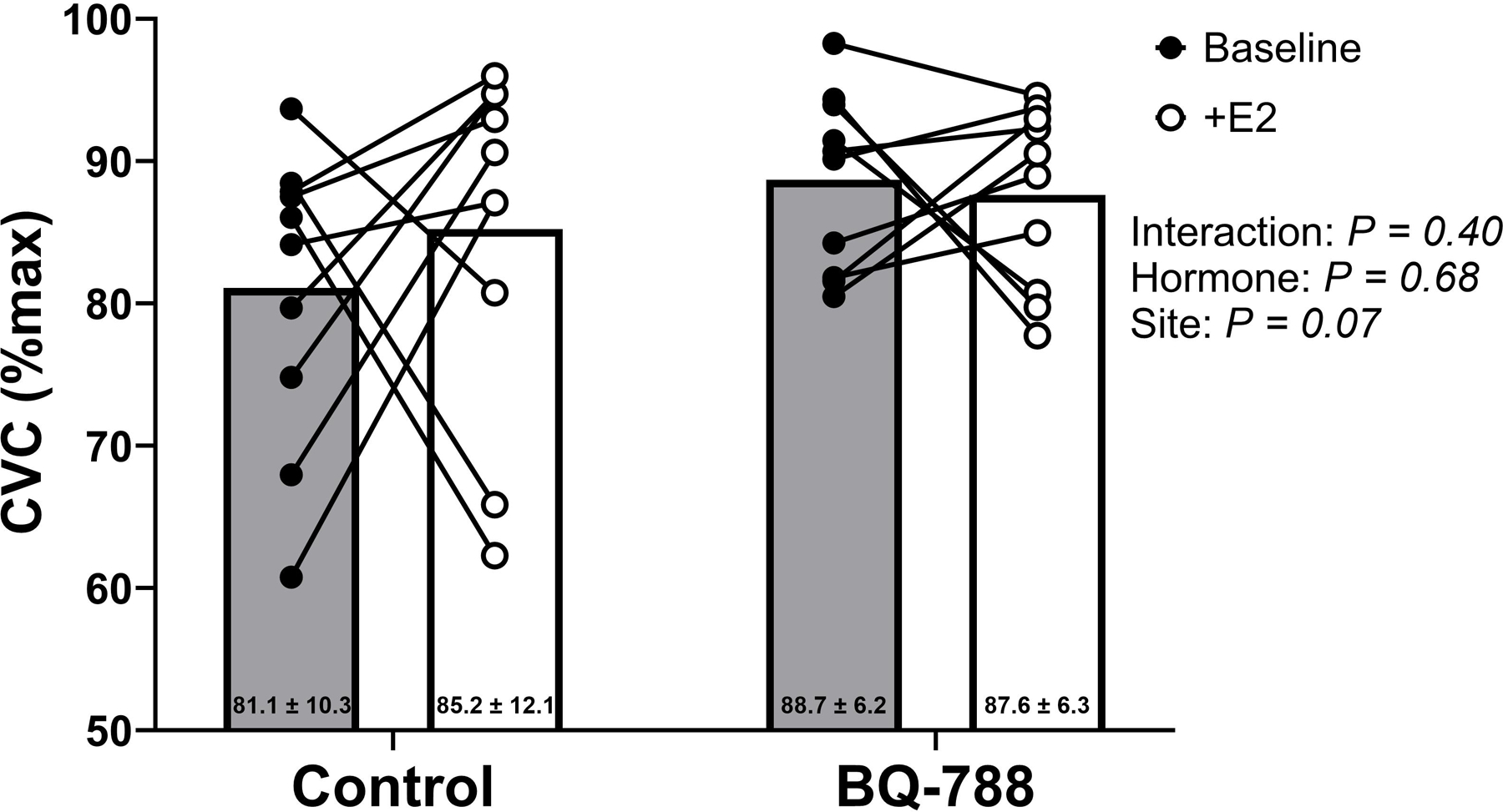
The endothelin-B receptor (ETBR) mediates vasodilation in young women, an effect that is absent in postmenopausal women. We have previously demonstrated that ETBR-mediated vasodilation is regulated by estradiol (E2) in young women; however, the impact of E2 on ETBR function in postmenopausal women remains unknown. Accordingly, the objective of this study was to test the hypothesis that E2 exposure restores ETBR-mediated dilation in postmenopausal women. Ten healthy postmenopausal women (55 ± 2 yr of age, 5 ± 3 years since menopause) completed the study. E2 was administered by transdermal patch for 7 days (0.1 mg/day, Vivelle-Dot patch). Vasodilation in the cutaneous microcirculation (microvascular endothelial function) was measured via local heating (42°C) using laser Doppler flowmetry combined with intradermal microdialysis perfusions of lactated Ringer's (control) and ETBR antagonist (BQ-788, 300 nM) at baseline and after E2 administration. There was no effect of E2 on ETBR function [hormone × site, F(1,9) = 0.77, P = 0.40]. These data demonstrate that in contrast to findings in premenopausal women, E2 administration does not restore ETBR function in postmenopausal women.NEW & NOTEWORTHY The vascular endothelial endothelin-B receptor (ETBR) mediates vasodilation in premenopausal women, an effect modulated by estradiol. ETBR-mediated vasodilation is lost in postmenopausal women, but the effect of exogenous estradiol administration on ETBR function in postmenopausal women is not known. During estradiol administration, ETBR blockade did not affect cutaneous microvascular vasodilatory response to local heating. We demonstrate that exogenous estradiol administration does not restore ETBR-mediated vasodilation in postmenopausal women.
Keywords: endothelial function; endothelin; estrogen; menopause; skin blood flow.
Copyright © 2025 The Authors.
Figures
References
-
- El Khoudary SR, Aggarwal B, Beckie TM, Hodis HN, Johnson AE, Langer RD, Limacher MC, Manson JE, Stefanick ML, and Allison MA. Menopause transition and cardiovascular disease risk: implications for timing of early prevention: a scientific statement from the American Heart Association. Circulation 142: e506–e532, 2020. - PubMed
-
- Ras RT, Streppel MT, Draijer R, and Zock PL. Flow-mediated dilation and cardiovascular risk prediction: a systematic review with meta-analysis. International journal of cardiology 168: 344–351, 2013. - PubMed
MeSH terms
Substances
Grants and funding
LinkOut - more resources
Full Text Sources
