


Comparative analysis of qPCR and metagenomics for detecting antimicrobial resistance in wastewater: a case study
- PMID: 39773654
- PMCID: PMC11705827
- DOI: 10.1186/s13104-024-07027-9
Comparative analysis of qPCR and metagenomics for detecting antimicrobial resistance in wastewater: a case study
Abstract
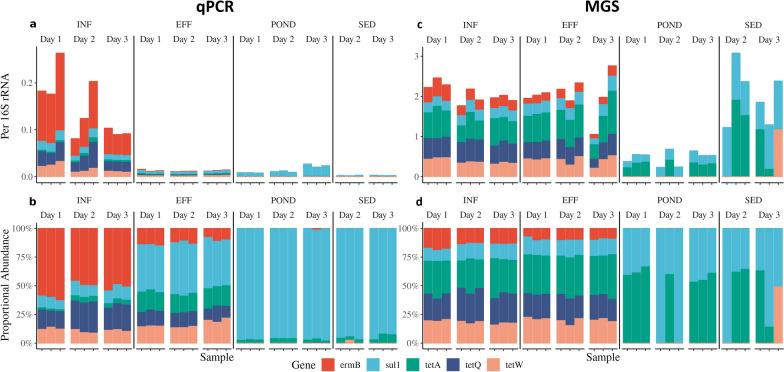
Objective: The World Health Organization (WHO) has declared antimicrobial resistance (AMR) as one of the top threats to global public health. While AMR surveillance of human clinical isolates is well-established in many countries, the increasing threat of AMR has intensified efforts to detect antibiotic resistance genes (ARGs) accurately and sensitively in environmental samples, wastewater, animals, and food. Using five ARGs and the 16S rRNA gene, we compared quantitative PCR (qPCR) and metagenomic sequencing (MGS), two commonly used methods to uncover the wastewater resistome. We compared both methods by evaluating ARG detection through a municipal wastewater treatment chain.
Results: Our results demonstrate that qPCR was more sensitive than MGS, particularly in diluted samples with low ARG concentrations such as oxidation pond water. However, MGS was potentially more specific and has less risk of off-target binding in concentrated samples such as raw sewage. MGS analysis revealed multiple subtypes of each gene which could not be distinguished by qPCR; these subtypes varied across different sample types. Our findings affect the conclusions that can be drawn when comparing different sample types, particularly in terms of inferring removal rates or origins of genes. We conclude that both methods appear suitable to profile the resistome of wastewater and other environmental samples, depending on the research question and type of sample.
Keywords: AMR; Antimicrobial resistance; Metagenomics; QPCR; Wastewater; Wastewater surveillance; Wastewater-based epidemiology..
© 2024. The Author(s).
Conflict of interest statement
Declarations. Ethics approval and consent to participate: An application to the NZ Health and Disability Ethics Committee (HDEC) indicated that the study research plan using human sewerage was out of the scope of HDEC review. We obtained permission from Christchurch City Council to access the wastewater treatment plant for sampling and to publish the findings in the current manuscript. Consent for publication: Not applicable. Competing interests: The authors declare no competing interests.
Figures

References
-
- WHO. Global action plan on Antimicrobial Resistance. Geneva, Switzerland: World Health Organization; 2015.
-
- WHO. Global antimicrobial resistance and use surveillance system (GLASS) report 2022. Geneva: World Health Organization;; 2022.
-
- Londong J, Barth M, Söbke H. 2023. Reducing antimicrobial resistances by source separation of domestic wastewater. Front Environ Health 2:1151898 - DOI
Publication types
MeSH terms
Substances
LinkOut - more resources
Full Text Sources
