


Whole-exome sequencing uncovers the genetic basis of hereditary concomitant exotropia in ten Chinese pedigrees
- PMID: 39773702
- PMCID: PMC11705921
- DOI: 10.1186/s12920-024-02078-0
Whole-exome sequencing uncovers the genetic basis of hereditary concomitant exotropia in ten Chinese pedigrees
Abstract
Purpose: To explore possible pathogenic genes for concomitant exotropia using whole-exome sequencing.
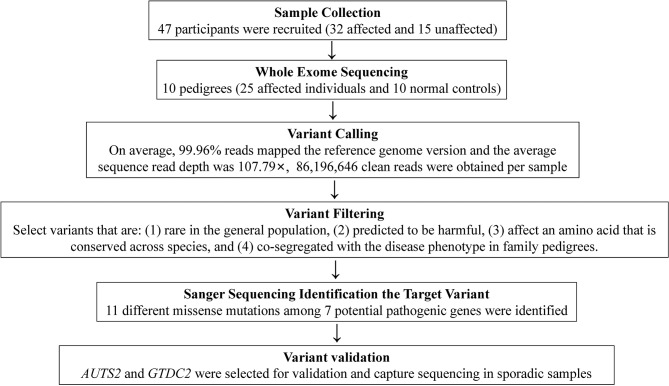
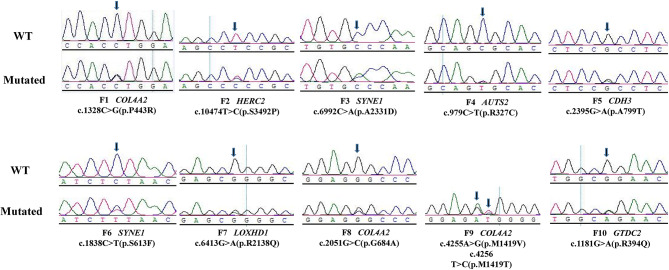
Methods: In this study, 47 individuals from 10 concomitant exotropia (including intermittent exotropia and constant exotropia) pedigrees were enrolled. Whole-exome sequencing was used to screen mutational profiles in 25 affected individuals and 10 unaffected individuals. Sanger sequencing and in silico analysis were performed for all participants. Two target genes were used to capture the sequences of 220 sporadic samples.
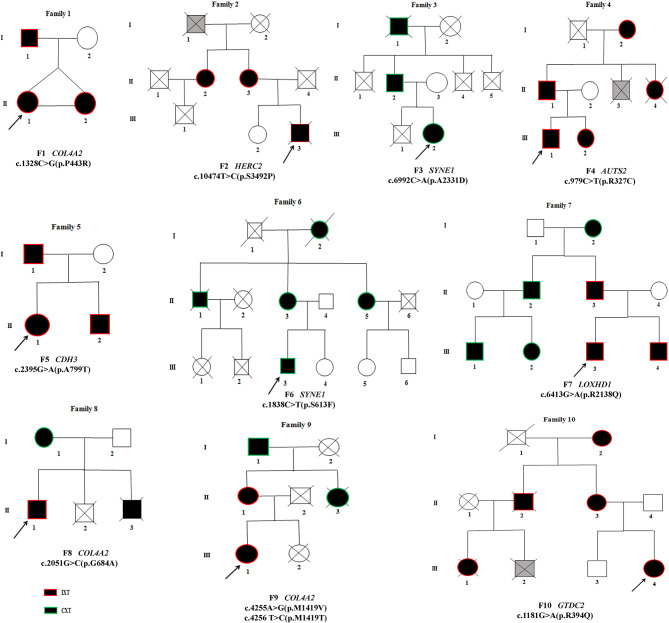
Results: All 10 concomitant exotropia pedigrees presented autosomal dominant inheritance with childhood onset (3.35 ± 1.51 years old). Eleven different missense variants were identified among seven potential pathogenic genes (COL4A2, SYNE1, LOXHD1, AUTS2, GTDC2, HERC2 and CDH3) that cosegregated with pedigree members. All variants were predicted to be deleterious and had low frequencies in the general population. Distinct variants of COL4A2 were present in three pedigrees, and distinct variants of SYNE1 were present in two pedigrees. Fifteen variants in AUTS2 and four variants in GTDC2 were identified in 220 patients with sporadic concomitant exotropia using a target-capture sequencing approach.
Conclusion: This is the first study to explore the genetic mechanism of concomitant exotropia and identify seven associated genes (COL4A2, SYNE1, LOXHD1, AUTS2, GTDC2, HERC2 and CDH3) that may be candidate genes causing concomitant exotropia. More samples and in-depth studies are needed to verify these findings.
Keywords: Concomitant exotropia; Genetics; Strabismus.
© 2024. The Author(s).
Conflict of interest statement
Declarations. Ethics approval and consent to participate: This study was performed in accordance with the Declaration of Helsinki. It was reviewed by the research unit’s professional ethics committee, and informed consent was obtained and signed by the investigator. Our study was approved by the Ethics Committee of The Affiliated Hospital of Yunnan University (The Second People’s Hospital of Yunnan Province), No. 20180774. Informed written consent was obtained from all the participants and the legal guardians of the children. Consent for publication: Written informed consent was obtained from the patients or their guardians (parents), and they consented to the publication of their medical information. Competing interests: The authors declare no competing interests.
Figures

References
-
- McKean-Cowdin R, Cotter SA, Tarczy-Hornoch K, Wen G, Kim J, Borchert M, Varma R. Multi-ethnic Pediatric Eye Disease Study G: prevalence of amblyopia or strabismus in Asian and non-hispanic white preschool children: multi-ethnic pediatric eye disease study[J]. Ophthalmology. 2013;120(10):2117–24. - PMC - PubMed
-
- Pan CW, Zhu H, Yu JJ, Ding H, Bai J, Chen J, Yu RB, Liu H. Epidemiology of intermittent Exotropia in Preschool Children in China[J]. Optom Vis Sci. 2016;93(1):57–62. - PubMed
-
- Wang Y, Zhao A, Zhang X, Huang D, Zhu H, Sun Q, Yu J, Chen J, Zhao X, Li R, Han S, Dong W, Ma F, Chen X, Liu H. Prevalence of strabismus among preschool children in eastern China and comparison at a 5-year interval: a population-based cross-sectional study[J]. BMJ Open. 2021;11(10):e055112. - PMC - PubMed
MeSH terms
Grants and funding
- 2024-KHRCBZ-B06/Science and Technology plan project of the First People's Hospital of Yunnan Province
- KUST-KH2022036Y/Kunming University of Science and Technology medical joint project
- L-2018018/the Leading the Charge of Yunnan Province Health System
- CY22624106/Yunnan University "Double first-class" construction - Children Low Vision Prevention and Control Innovation Team
LinkOut - more resources
Full Text Sources
