


Elucidation of peptide screen for targeted identification of Yersinia pestis by nano-liquid chromatography tandem mass spectrometry
- PMID: 39774652
- PMCID: PMC11707332
- DOI: 10.1038/s41598-024-81906-w
Elucidation of peptide screen for targeted identification of Yersinia pestis by nano-liquid chromatography tandem mass spectrometry
Abstract
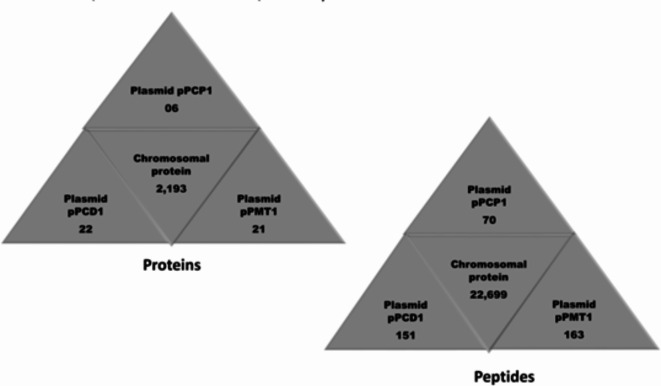
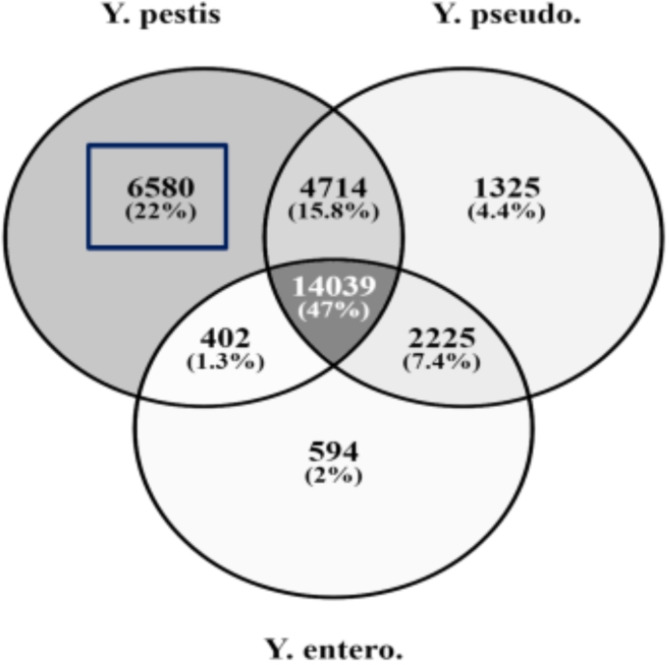
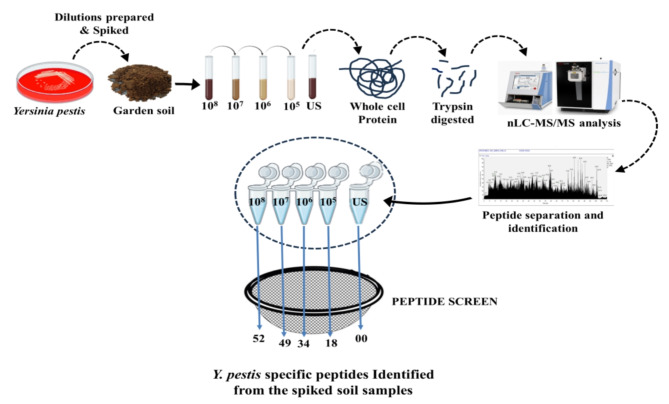
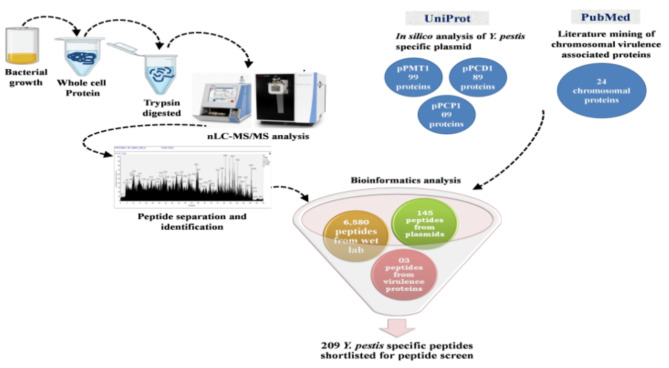
Yersinia pestis, a Gram-negative bacterium is the causative agent of the fatal communicable disease plague. The disease had a profound impact on human history. Plague bacteria are usually transmitted to humans through the bite of an infected rat flea. Earlier studies have indicated that Y. pestis can survive in environmental matrices e.g. water and soil. This study aimed to generate a peptide-based screen for identification of Y. pestis particularly from environmental matrices. We employed a shotgun proteomic approach using nano-liquid chromatography-tandem mass spectrometry (nLC-MS/MS) to discover Y. pestis-specific peptides. The pure cultures of Y. pestis and related species were grown, their proteome were delineated and analyzed by in silico tools to discover 61 Y. pestis specific peptides. Additionally, 148 peptides were discovered from proteins of Y. pestis-specific plasmids and chromosomal-associated virulence markers. To validate this screen of 209 peptides, various concentrations of Y. pestis (ranging from 1.3 × 10⁸ to 1.3 × 10⁵ cfu) were spiked into garden soil. Y. pestis could be identified in all samples except un-spiked negative control soil sample. This study offers a valuable method for the identification of Y. pestis, by tandem mass spectrometry which may be used in environmental and clinical matrices.
Keywords: Yersinia pestis; Peptide-based screen; nLC-MS/MS.
© 2025. The Author(s).
Conflict of interest statement
Declarations. Competing interests: The authors declare no competing interests.
Figures
References
MeSH terms
Substances
LinkOut - more resources
Full Text Sources
Molecular Biology Databases
