


A genome-wide scan of non-coding RNAs and enhancers for refractive error and myopia
- PMID: 39774722
- PMCID: PMC11754329
- DOI: 10.1007/s00439-024-02721-x
A genome-wide scan of non-coding RNAs and enhancers for refractive error and myopia
Abstract
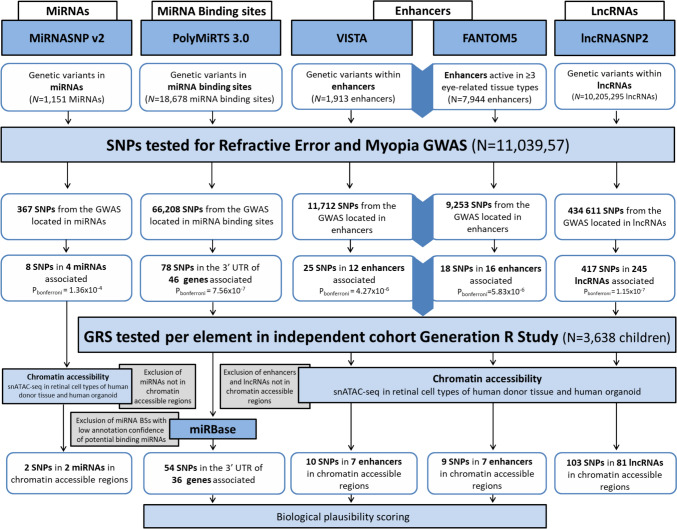
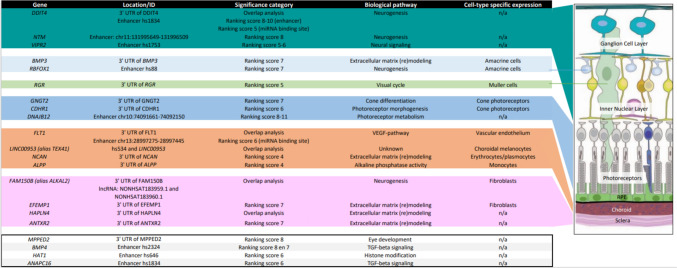
Refractive error (RE) and myopia are complex polygenic conditions with the majority of genome-wide associated genetic variants in non-exonic regions. Given this, and the onset during childhood, gene-regulation is expected to play an important role in its pathogenesis. This prompted us to explore beyond traditional gene finding approaches. We performed a genetic association study between variants in non-coding RNAs and enhancers, and RE and myopia. We obtained single-nucleotide polymorphisms (SNPs) in microRNA (miRNA) genes, miRNA-binding sites, long non-coding RNAs genes (lncRNAs) and enhancers from publicly available databases: miRNASNPv2, PolymiRTS, VISTA Enhancer Browser, FANTOM5 and lncRNASNP2. We investigated whether SNPs overlapping these elements were associated with RE and myopia leveraged from a large GWAS meta-analysis (N = 160,420). With genetic risk scores (GRSs) per element, we investigated the joint effect of associated variants on RE, axial length (AL)/corneal radius (CR), and AL progression in an independent child cohort, the Generation R Study (N = 3638 children). We constructed a score for biological plausibility per SNP in highly confident miRNA-binding sites and enhancers in chromatin accessible regions. We found that SNPs in two miRNA genes, 14 enhancers and 81 lncRNA genes in chromatin accessible regions and 54 highly confident miRNA-binding sites, were in RE and myopia-associated loci. GRSs from SNPs in enhancers were significantly associated with RE, AL/CR and AL progression. GRSs from lncRNAs were significantly associated with all AL/CR and AL progression. GRSs from miRNAs were not associated with any ocular biometric measurement. GRSs from miRNA-binding sites showed suggestive but inconsistent significance. We prioritized candidate miRNA binding sites and candidate enhancers for future functional validation. Pathways of target and host genes of highly ranked variants included eye development (BMP4, MPPED2), neurogenesis (DDIT4, NTM), extracellular matrix (ANTXR2, BMP3), photoreceptor metabolism (DNAJB12), photoreceptor morphogenesis (CHDR1), neural signaling (VIPR2) and TGF-beta signaling (ANAPC16). This is the first large-scale study of non-coding RNAs and enhancers for RE and myopia. Enhancers and lncRNAs could be of large importance as they are associated with childhood myopia. We provide a confident blueprint for future functional validation by prioritizing candidate miRNA binding sites and candidate enhancers.
© 2025. The Author(s).
Conflict of interest statement
Declarations. Conflict of interest: The authors declare no competing interests.
Figures


References
-
- Balay L, Totten E, Okada L, Zell S, Ticho B, Israel J et al (2016) A familial pericentric inversion of chromosome 11 associated with a microdeletion of 163 kb and microduplication of 288 kb at 11p13 and 11q22.3 without aniridia or eye anomalies. Am J Med Genet A 170A:202–209 - PubMed
MeSH terms
Substances
Grants and funding
LinkOut - more resources
Full Text Sources
Medical
Research Materials
