


The Bimanual Observation of The Hands (BOTH): Development, reliability, and validity for stroke rehabilitation
- PMID: 39775261
- PMCID: PMC11706489
- DOI: 10.1371/journal.pone.0316356
The Bimanual Observation of The Hands (BOTH): Development, reliability, and validity for stroke rehabilitation
Abstract
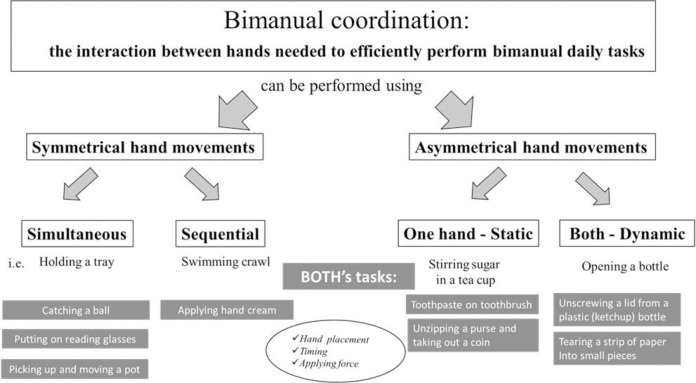
Importance: To efficiently perform bimanual daily tasks, bimanual coordination is needed. Bimanual coordination is the interaction between an individual's hands, which may be impaired post-stroke, however clinical and functional assessments are lacking and research is limited.
Objectives: To develop a valid and reliable observation tool to assess bimanual coordination of individuals post-stroke.
Design: A cross-sectional study.
Setting: Rehabilitation settings.
Participants: Occupational therapists (OTs) with stroke rehabilitation experience and individuals post stroke.
Outcomes and measures: The development and content validity of BOTH included a literature review, review of existing tools and followed a 10-step process. The conceptual and operational definitions of bimanual coordination were defined as well as scoring criteria. Then multiple rounds of feedback from expert OTs were performed. OTs reviewed BOTH using the 'Template for assessing content validity through expert judgement' questionnaire. Then, BOTH was administered to 51 participants post-stroke. Cronbach's alpha was used to verify internal reliability of BOTH and construct validity of BOTH was assessed by correlating it to the bimanual subtests of The Purdue Pegboard Test.
Results: Expert validity was established in two-rounds with 11 OTs. Cronbach's alpha was α = 0.923 for the asymmetrical items, 0.897 for the symmetrical items and 0.949 for all eight items. The item-total correlations of BOTH were also strong and significant. The total score of BOTH was strongly significantly correlated with The Purdue-Both hands placement (r = .787, p < .001) and Assembly (r = .730, p < .001) subtests.
Conclusions and relevance: BOTH is a new observation tool to assess bimanual coordination post-stroke. Expert validity of BOTH was established, excellent internal reliability and construct validity were demonstrated. Further research is needed, so in the future, BOTH can be used for clinical and research purposes to address bimanual coordination post-stroke.
Copyright: © 2025 Rand et al. This is an open access article distributed under the terms of the Creative Commons Attribution License, which permits unrestricted use, distribution, and reproduction in any medium, provided the original author and source are credited.
Conflict of interest statement
The authors have declared that no competing interests exist.
Figures
References
-
- Van Gils A, Meyer S, Van Dijk M, Thijs L, Michielsen M, Lafosse C, et al.. The adult assisting hand assessment stroke: psychometric properties of an observation-based bimanual upper limb performance measurement. Archives of physical medicine and rehabilitation. 2018. Dec 1;99(12):2513–22. doi: 10.1016/j.apmr.2018.04.025 - DOI - PubMed
MeSH terms
LinkOut - more resources
Full Text Sources
Medical
