


Moderating effects of demographic characteristics on the relationship between parenting practices and energy balance related behaviors of Chinese preschoolers
- PMID: 39776485
- PMCID: PMC11704617
- DOI: 10.3389/fpubh.2024.1476733
Moderating effects of demographic characteristics on the relationship between parenting practices and energy balance related behaviors of Chinese preschoolers
Abstract
Background: Early establishment of energy balance related behaviors (EBRBs) may be effective in combating unhealthy lifestyle in preschoolers. Parents are responsible for cultivating preschoolers' EBRBs directly through parenting practices. Although investigating the impact of various parenting practices on preschoolers' EBRBs is crucial to determine which practices should be recommended to parents to help reverse childhood unhealthy lifestyle, it is important to assess whether these effects of parenting practices on preschoolers' EBRBs would be similar across different groups of preschoolers, necessitating research into the moderating effects of demographic characteristics.
Methods: Baseline dataset was utilized from an electronic health intervention study of Chinese 3-6-year-old preschoolers. Preschoolers' PA and sleep duration and quality were objectively examined using wGT3X ActiGraph accelerometer. Data related to parents and preschoolers' eating behaviors and sleep problems were subjectively assessed using parent-reported questionnaires. The PROCESS macro version 4.2 was used to perform moderation analysis. When the interaction revealed a p-value of less than 0.05 and the 95% confidence interval did not include 0, the conditional effects of the focal predictor at various levels of the moderator were further examined (p < 0.05) to investigate how the relationship between parenting practices and preschoolers' EBRBs varied with different moderator levels.
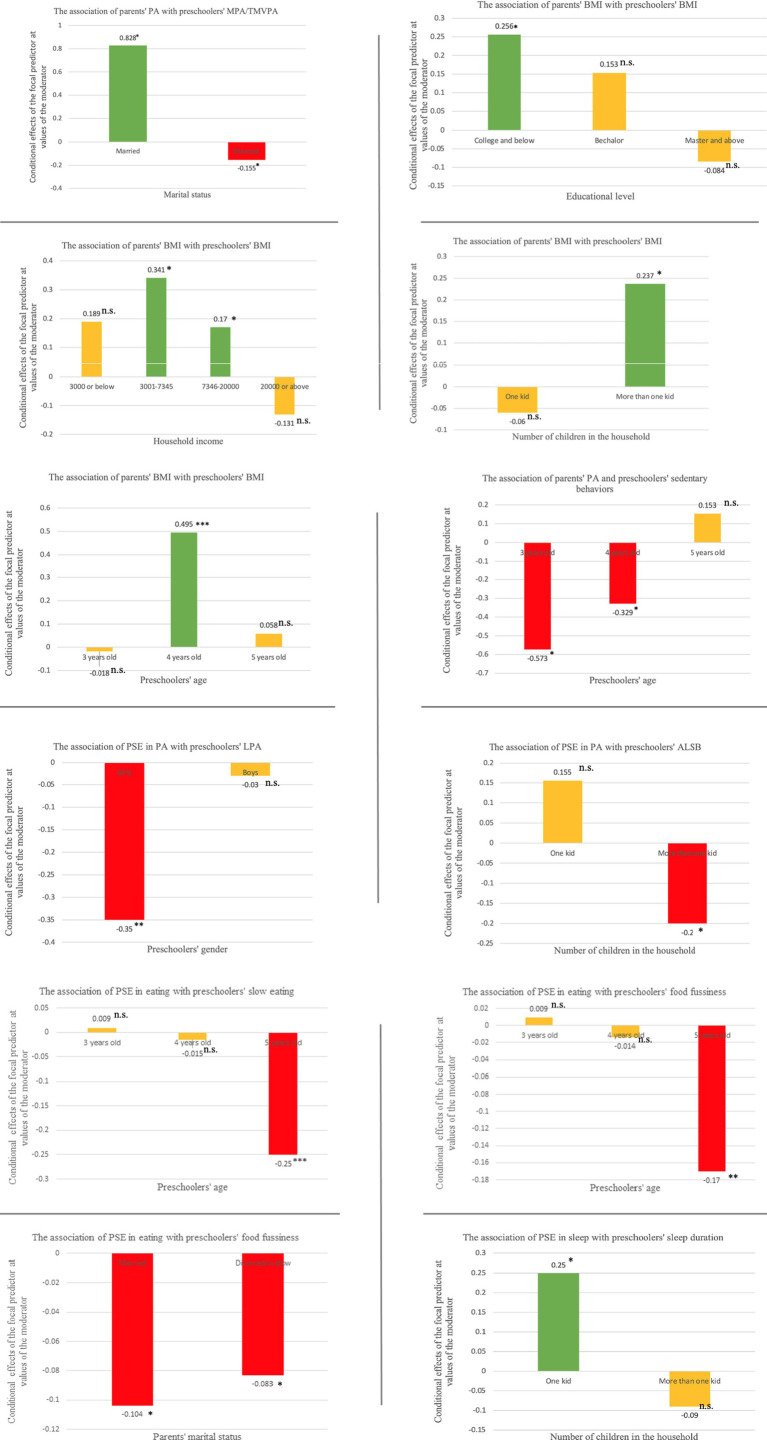
Results: Married parents exhibited the desired outcomes in the relationship between parenting practices and their preschoolers' EBRBs. In contrast, divorced/separated parents showed unfavorable results in this relationship. The association between the parents' and preschoolers' BMI varied depending on parents' socioeconomic status, the preschoolers' age, and the number of children in the household. The preschoolers' age showed different moderating trend on the relationship between parents' PA and preschoolers' sedentary behaviors as well as the association of eating-related PSE with preschoolers' eating behaviors. The mechanisms linking the parents' PSE to the preschoolers' PA, sedentary behaviors, and sleep duration were influenced by the preschoolers' gender and the number of children in the household.
Conclusion: The potential parental influence warrants further investigation with the consideration that the relationship between parenting practices and preschoolers' EBRBs varied across different group of children.
Clinical trial registration: NCT06025019.
Keywords: child-rearing behaviors; diet; physical activity; preschool-age children; screen time; sleep.
Copyright © 2024 Peng, Lau and Wen.
Conflict of interest statement
The authors declare that the research was conducted in the absence of any commercial or financial relationships that could be construed as a potential conflict of interest.
Figures
References
-
- Cerin E, Barnett A, Baranowski T, Lee RE, Mellecker RR, Suen YN, et al. . Parent-perceived neighbourhood environment, parenting practices and preschool-aged children physical activity and screen time: a cross-sectional study of two culturally and geographically diverse cities. BMC Pediatr. (2022) 22:309. doi: 10.1186/s12887-022-03377-0, PMID: - DOI - PMC - PubMed
MeSH terms
Associated data
LinkOut - more resources
Full Text Sources
Medical
