


Interleukin-6 and Interleukin-8 Gene Expressions Differ Between Male and Female Patients at Time of Hip Arthroscopy for Femoroacetabular Impingement Syndrome
- PMID: 39776506
- PMCID: PMC11701993
- DOI: 10.1016/j.asmr.2024.100985
Interleukin-6 and Interleukin-8 Gene Expressions Differ Between Male and Female Patients at Time of Hip Arthroscopy for Femoroacetabular Impingement Syndrome
Abstract
Purpose: To identify key molecular components within the femoroacetabular impingement hip and compare the findings between male and female patients across varying age groups.
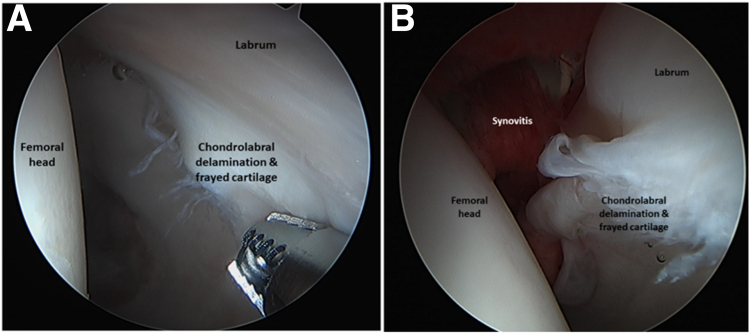
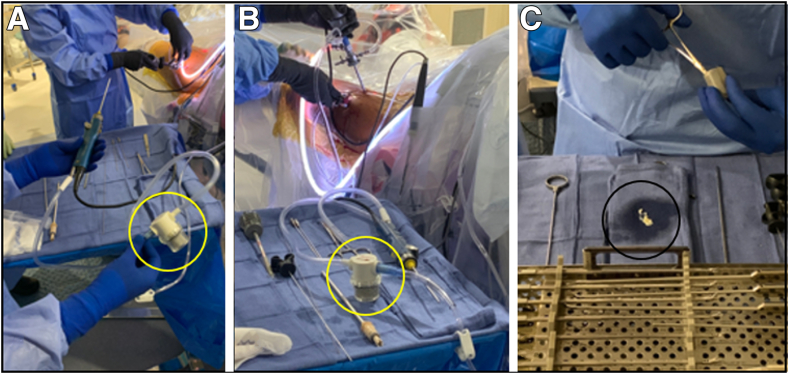
Methods: All patients undergoing hip arthroscopy for femoroacetabular impingement syndrome (FAIS) without hip dysplasia were included. During hip arthroscopy, performed at University of Wisconsin Health, loose articular cartilage, excess synovium, damaged labral tissue, and minimal adipose tissue were debrided only as needed for visualization and tissue repair purposes and collected. Tissue was processed and used for quantitative polymerase chain reaction (qPCR). Genes were selected for qPCR on the basis of their associated function in inflammation and/or extracellular matrix remodeling during the progression of osteoarthritis.
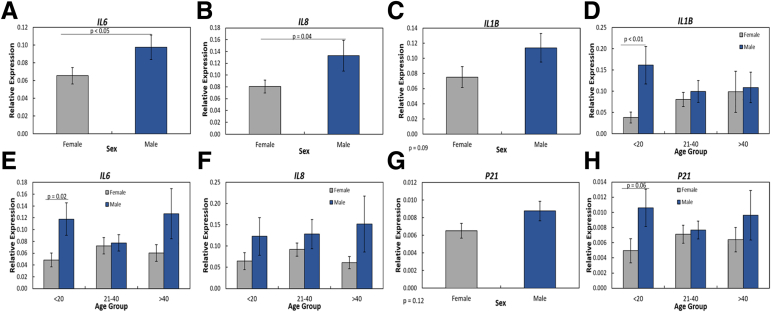
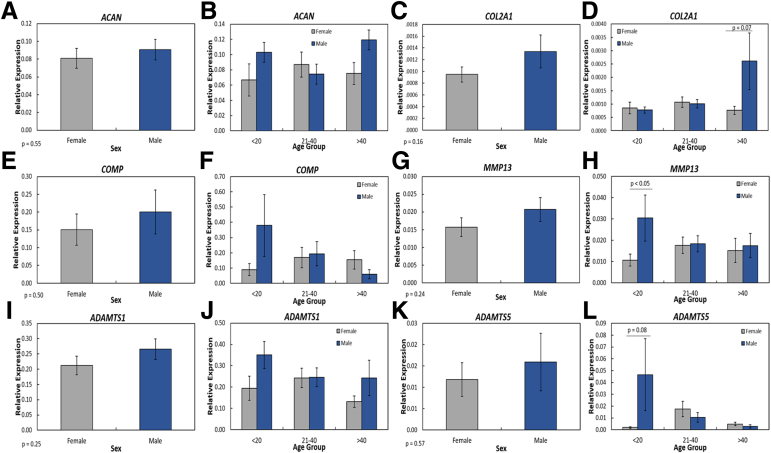
Results: A total of 91 male (M) and female (F) patients 15 to 58 years old were included in the study. qPCR results indicated that Interleukin-6 (P < .05, 95% confidence interval [CI] 0.047-0.083 F, 0.070-0.12 M) and Interleukin-8 (P = .04, 95% CI 0.059-0.10 F, 0.082-0.18 M) were significantly greater in male patients compared with female patients regardless of age, and IL6 (P = .02, 95% CI [0.026-0.070] F, [0.067-0.17] M), Interleukin-1ß (P < .01 95% CI [0.013-0.063] F, [0.073-0.25] M), and Matrix metalloproteinase-13 (P = .047, 95% CI [0.0051-0.017] F, [0.0084-0.052] M) were significantly greater in male patients younger than 20 years old compared with female patients younger than 20 years old.
Conclusions: In patients with FAIS, there are significant differences between male and female patients in the biomarkers present in the affected hip at the time of surgery. Male patients have greater levels of IL6 and IL8 and male patients younger than 20 years of age have greater levels of IL1β, IL6, and MMP13 compared with age-matched female patients.
Clinical relevance: A better understanding of the molecular markers present during varying stages of FAIS and in patients of different ages will help characterize the pathologic process behind FAIS. This may also help define future methods of targeted treatment and prevention of disease progression.
© 2024 The Authors.
Conflict of interest statement
The authors report the following potential conflicts of interest or sources of funding: This work was supported by the University of Wisconsin Department of Orthopedics and Rehabilitation, Wisconsin Foundation, and Alumni Association Freedom of Movement Fund and a grant provided by the University of Wisconsin Institute for Clinical and Translational Research Shapiro Research Foundation. A.M.S. reports grants from University of Wisconsin, during the conduct of the study; and personal fees from Stryker, consultant, outside the submitted work. All authors (A.M.S., J.A.C., E.H.G.T., R.V., W.L.M., C.S.C.) declare that they have no known competing financial interests or personal relationships that could have appeared to influence the work reported in this paper. Full ICMJE author disclosure forms are available for this article online, as supplementary material.
Figures
References
-
- Griffin D.R., Dickenson E.J., O’Donnell J., et al. The Warwick Agreement on femoroacetabular impingement syndrome (FAI syndrome): An international consensus statement. Br J Sports Med. 2016;50:1169–1176. - PubMed
LinkOut - more resources
Full Text Sources
