


Precision medicine using molecular-target drugs in psoriatic arthritis
- PMID: 39776828
- PMCID: PMC11701904
- DOI: 10.1177/1759720X241311462
Precision medicine using molecular-target drugs in psoriatic arthritis
Abstract
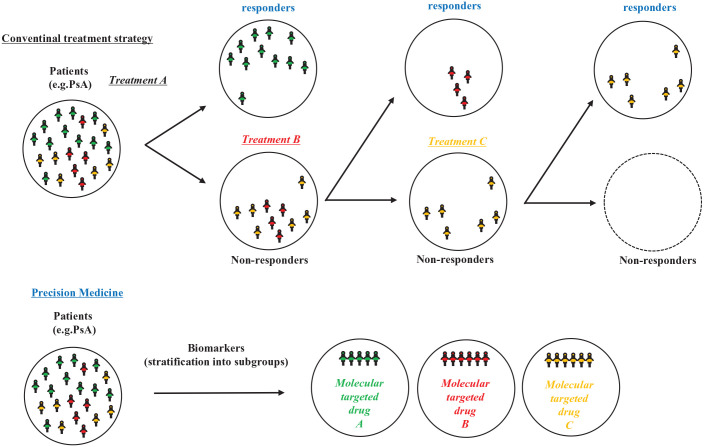
Psoriatic arthritis (PsA) presents various clinical manifestations, including skin lesions, peripheral arthritis, axial involvement, enthesitis, nail involvement, dactylitis, and uveitis. In addition, it causes a high incidence of lifestyle-related diseases and an increase in cerebrovascular and cardiovascular events. As the pathology of PsA has been clarified, molecular-targeted drugs targeting tumor necrosis factor-α, interleukin (IL)-17A, IL-17A/F, IL-17 receptor, IL-12/23(p40), IL-23p19, Cytotoxic T-lymphocyte Antigen-4 (CTLA-4), Janus kinase, and phosphodiesterase-4 have been developed and are widely used in clinical practice. PsA is clinically and molecularly heterogeneous, and it is necessary to improve various clinical symptoms with limited treatment options simultaneously; therefore, rheumatologists sometimes encounter difficult situations in clinical practice. Hence, the development of precision medicine may improve treatment outcomes. Recently, the strategic use of molecular-targeted drugs based on the stratification of patients with PsA by peripheral blood lymphocyte phenotyping and serum cytokine concentrations has been reported to possibly lead to a higher therapeutic response. A randomized controlled trial was initiated to verify the efficacy of this treatment strategy. However, to make precision medicine in PsA feasible, shifting from conventional clinical trials to clinical trials based on biomarker profiles and accumulating further data are necessary.
Keywords: precision medicine; psoriatic arthritis; treatment.
Plain language summary
Precision medicine in psoriatic arthritis Psoriatic arthritis (PsA) can cause a wide range of muscle-skeletal manifestations due to tendons, fingers, toes, joints, and spine inflammation. These findings may be associated with other health manifestations, such as gastrointestinal and eye inflammation, and an increased risk of cardiovascular and dysmetabolic diseases. Scientists have figured out the underlying issues in PsA, leading to the development of drugs that target specific molecules in the body, such as tumor necrosis factor-α, interleukins, and enzymes. Currently, these drugs are commonly prescribed by physicians. However, treating PsA is challenging because it greatly varies individually, and treatment options are limited. Therefore, physicians occasionally struggle to determine the optimal approach. Nevertheless, precision medicine, which tailors treatment for each individual, may be beneficial. Some studies have suggested that matching patients with PsA to the right drugs based on their blood and cytokine levels might be effective. Large-scale trials are currently underway to test the effectiveness of this approach. However, making precision medicine work for PsA requires a shift from traditional clinical trials to trials that focus on individuals’ specific characteristics and gathering more data.
© The Author(s), 2025.
Conflict of interest statement
Y.T. has received consulting fees, speaking fees, and honoraria from Behringer-Ingelheim, Eli Lilly, Abbvie, Gilead, AstraZeneca, Bristol-Myers, Chugai, Daiichi-Sankyo, Eisai, Pfizer, Mitsubishi-Tanabe, and GlaxoSmithKline and research grants from Asahi-Kasei, Abbvie, Chugai, Eisai, Takeda, Daiichi-Sankyo, and Behringer-Ingelheim. I.M.: None.
Figures
References
-
- FitzGerald O, Ogdie A, Chandran V, et al.. Psoriatic arthritis. Nat Rev Dis Primers 2021; 7: 59. - PubMed
-
- Schett G, Lories RJ, D’Agostino MA, et al.. Enthesitis: from pathophysiology to treatment. Nat Rev Rheumatol 2017; 13: 731–741. - PubMed
-
- Roubille C, Richer V, Starnino T, et al.. The effects of tumour necrosis factor inhibitors, methotrexate, non-steroidal anti-inflammatory drugs and corticosteroids on cardiovascular events in rheumatoid arthritis, psoriasis and psoriatic arthritis: a systematic review and meta-analysis. Ann Rheum Dis 2015; 74: 480–489. - PMC - PubMed
-
- Antoni CE, Kavanaugh A, van der Heijde D, et al.. Two-year efficacy and safety of infliximab treatment in patients with active psoriatic arthritis: findings of the Infliximab Multinational Psoriatic Arthritis Controlled Trial (IMPACT). J Rheumatol 200; 35: 869–876. - PubMed
Publication types
LinkOut - more resources
Full Text Sources
Research Materials
Miscellaneous
