


Comparison of smoking behaviors and associated factors between HIV-infected and uninfected men in Guilin, China: a case-control study
- PMID: 39776966
- PMCID: PMC11705868
- DOI: 10.3389/fpsyg.2024.1422144
Comparison of smoking behaviors and associated factors between HIV-infected and uninfected men in Guilin, China: a case-control study
Abstract
Background: Smoking is highly prevalent among HIV-infected individuals and is associated with high morbidity and mortality. Studies on smoking among HIV-infected individuals in China, especially compared to uninfected individuals, are scarce.
Purpose: This study aimed to investigate and compare the prevalence and factors associated with smoking between HIV-infected and uninfected men in Guilin, China.
Methods: A survey was conducted among 1,395 HIV-infected men at Guilin Third People's Hospital from June to December 2022, with a 1:2 age (±1 year) and education-matched control group of 2,790 HIV-uninfected men, whose data were collected from March to August 2023. Both groups completed an online questionnaire on smoking behaviors and relevant characteristics, with a comparative analysis of associated factors conducted using chi-square tests and multivariable logistic regressions.
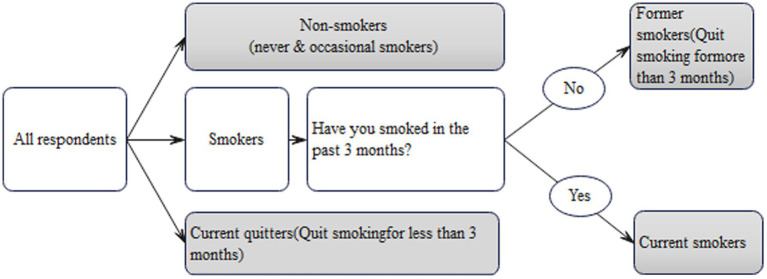
Results: The rates of former smokers were comparable between HIV-infected and uninfected men [12.3% (95% CI: 10.7-13.9%) vs. 12.0% (95% CI: 10.9-13.1%)], but the current smoking rate was significantly higher in the infected group than in the uninfected group [37.6% (95% CI: 35.2-40.0%) vs. 27.6% (95% CI: 25.9-29.3%), p < 0.05]. In both groups, the following factors were significantly associated with smoking: higher income, presence of chronic diseases, negative coping styles, lower social support, and having depression, anxiety, and suicidal ideation. Additionally, in HIV-infected men, the following factors were exclusively associated with smoking: heterosexual HIV transmission route, lower CD4+ T cell count, longer duration of antiretroviral therapy (ART), and drug use.
Conclusion: HIV-infected men had higher smoking rates than their uninfected counterparts, indicating that HIV diagnosis may be a critical timing to initiate behavioral changes and deliver smoking cessation interventions. Furthermore, multiple demographic, clinical, and psychosocial factors were associated with smoking, indicating the need to develop and implement comprehensive smoking cessation prevention and intervention programs.
Keywords: China; HIV infection; case–control study; men; smoking.
Copyright © 2024 Yu, Xiao, Xia, Huang, Liu, Tang and Gong.
Conflict of interest statement
MX, XL, WT, and XG were employed by the company Guilin Tobacco Company of Guangxi Zhuang Autonomous Region. The authors declare that this study received funding from Guangxi Zhuang Autonomous Region Tobacco Company. The funder had the following involvement in the study: study design, data collection, manuscript preparation, and decision to publish. The remaining authors declare that the research was conducted in the absence of any commercial or financial relationships that could be construed as a potential conflict of interest.
Figures
References
-
- Ale B. M., Amahowe F., Nganda M. M., Danwang C., Wakaba N. N., Almuwallad A., et al. (2021). Global burden of active smoking among people living with HIV on antiretroviral therapy: a systematic review and meta-analysis. Infect. Dis. Poverty 10:12. doi: 10.1186/s40249-021-00799-3, PMID: - DOI - PMC - PubMed
-
- Amato A. T., Émond G. (2023). A systematic review of psychosocial challenges for MSM living with HIV among diverse and intersecting minorities. Can. J. Hum. Sex. 32, 340–354. doi: 10.3138/cjhs.2022-0048 - DOI
-
- Brandt C. P., Bakhshaie J., Jardin C., Lemaire C., Kauffman B. Y., Sharp C., et al. (2017). The moderating effect of smoking status on the relation between anxiety sensitivity, sexual compulsivity, and suicidality among people with HIV/AIDS. Int. J. Behav. Med. 24, 92–100. doi: 10.1007/s12529-016-9568-5, PMID: - DOI - PMC - PubMed
LinkOut - more resources
Full Text Sources
Research Materials
