


What is it like to be a lizard? Directed attention and the flow of sensory experience in lizards and birds
- PMID: 39776975
- PMCID: PMC11704812
- DOI: 10.3389/fpsyg.2024.1424329
What is it like to be a lizard? Directed attention and the flow of sensory experience in lizards and birds
Abstract
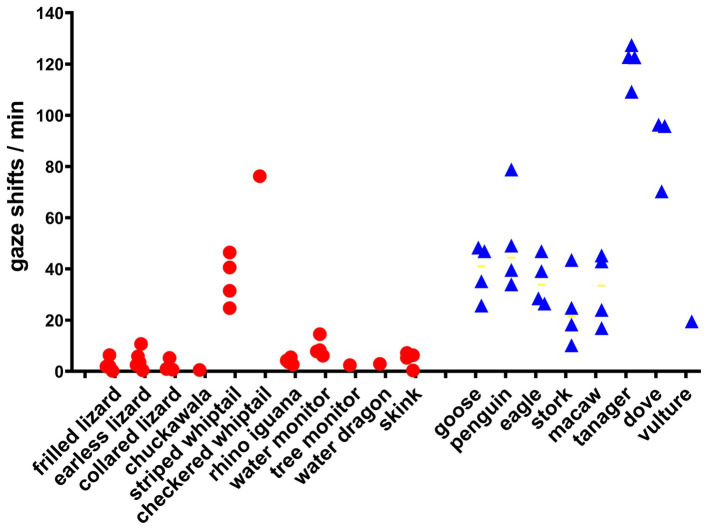
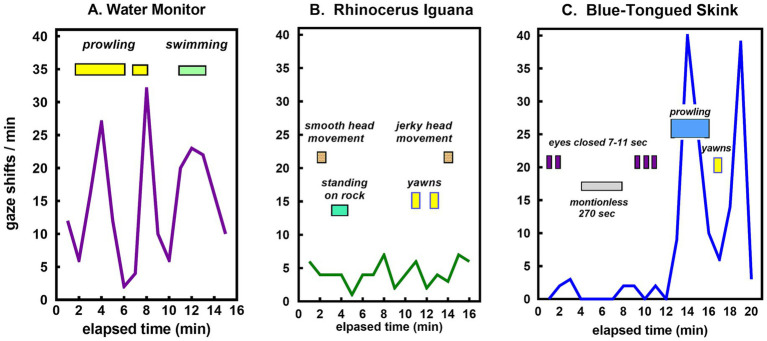
While the content of subjective (personal) experience is inaccessible to external observers, behavioral proxies can frame the nature of that experience and suggest its cognitive requirements. Directed attention is widely recognized as a feature of animal awareness. This descriptive study used the frequency of gaze shifts in lizards and birds as an indicator of the rate at which the animals change the perceptual segmentation of their ongoing experience. Most lizards are solitary, with social interactions limited to territorial defense and mating. Many are sit-and-wait insectivores that intersperse active foraging with long periods of sedentary activity. Others actively seek encounters with prey, either randomly (teiids) or through strategies indicative of intelligent planning (varanids). Birds typically change the direction of their attention five times faster than lizards while displaying more behavioral complexity and variety. A number of interspecies differences among both lizards and birds were observed in this study, consistent with the view that subjective experience varies uniquely across lifestyles, ecology, and phylogeny. These differences constitute variations in the structure of perceptual experience and could serve as probes for investigating neural correlates of animal consciousness.
Keywords: awareness; consciousness; ethology; gaze duration; perception; phenomenology; proxy behavior.
Copyright © 2024 Irwin.
Conflict of interest statement
The author declares that the research was conducted in the absence of any commercial or financial relationships that could be construed as a potential conflict of interest.
Figures




References
-
- Baird T. A., Acree M. A., Sloan C. L. (1996). Age and gender-related differences in the social behavior and mating success of free-living collared lizards, Crotaphytus collaris. Copeia 1996, 336–347. doi: 10.2307/1446849 - DOI
-
- Bayne T. (2004). Closing the gap? Some questions for neurophenomenology. Phenomenol. Cogn. Sci. 3, 349–364. doi: 10.1023/B:PHEN.0000048934.34397.ca - DOI
-
- Beritashvili I. (1971). Vertebrate memory: Characteristics and origin. New York: Plenum Press.
-
- Birdfact . (2023). Steller's Sea eagle: range and habitat. Available at: (https://birdfact.com/birds/stellers-sea-eagle/range-and-habitat)
LinkOut - more resources
Full Text Sources
