Are oligodendrocytes bystanders or drivers of Parkinson's disease pathology?
- PMID: 39777410
- PMCID: PMC11709285
- DOI: 10.1371/journal.pbio.3002977
Are oligodendrocytes bystanders or drivers of Parkinson's disease pathology?
Abstract
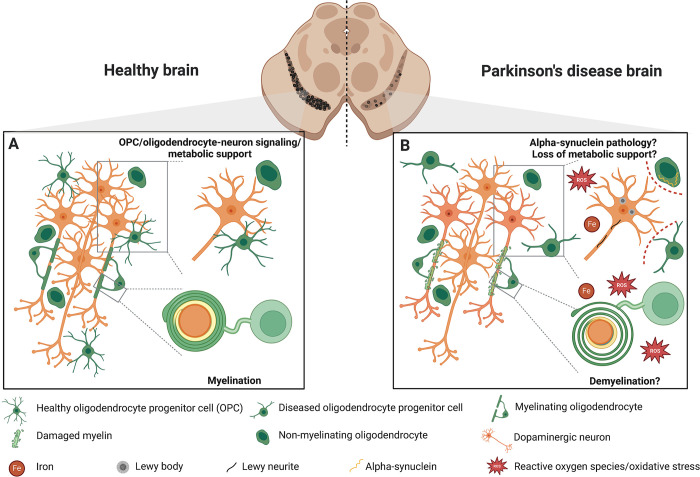
The major pathological feature of Parkinson 's disease (PD), the second most common neurodegenerative disease and most common movement disorder, is the predominant degeneration of dopaminergic neurons in the substantia nigra, a part of the midbrain. Despite decades of research, the molecular mechanisms of the origin of the disease remain unknown. While the disease was initially viewed as a purely neuronal disorder, results from single-cell transcriptomics have suggested that oligodendrocytes may play an important role in the early stages of Parkinson's. Although these findings are of high relevance, particularly to the search for effective disease-modifying therapies, the actual functional role of oligodendrocytes in Parkinson's disease remains highly speculative and requires a concerted scientific effort to be better understood. This Unsolved Mystery discusses the limited understanding of oligodendrocytes in PD, highlighting unresolved questions regarding functional changes in oligodendroglia, the role of myelin in nigral dopaminergic neurons, the impact of the toxic environment, and the aggregation of alpha-synuclein within oligodendrocytes.
Copyright: © 2025 Salazar Campos et al. This is an open access article distributed under the terms of the Creative Commons Attribution License, which permits unrestricted use, distribution, and reproduction in any medium, provided the original author and source are credited.
Conflict of interest statement
The authors have declared that no competing interests exist.
Figures

References
MeSH terms
Substances
LinkOut - more resources
Full Text Sources
Medical