


In vitro Antibacterial and Antifungal Activity of a Skin Ointment and Its Active Pharmaceutical Ingredients Larch Turpentine, Turpentine Oil, and Eucalyptus Oil
- PMID: 39778547
- PMCID: PMC12136597
- DOI: 10.1159/000543158
In vitro Antibacterial and Antifungal Activity of a Skin Ointment and Its Active Pharmaceutical Ingredients Larch Turpentine, Turpentine Oil, and Eucalyptus Oil
Abstract
Introduction: Turpentine derivatives and eucalyptus oil are herbal substances traditionally used to treat various skin infections. Limited non-clinical data suggest they exert an immunological activity, but only scant information exists on their antibiotic effects. This in vitro study has been carried out to investigate the antibacterial and antifungal activity of a marketed skin ointment; its active pharmaceutical ingredients larch turpentine, eucalyptus oil, and turpentine oil; and their mixture, against bacteria and yeasts commonly present on the skin and causing skin infections.
Methods: The antibiotic activity was tested using the drop dilution assay on the Gram-positive bacteria Staphylococcus aureus (wild type), a methicillin-resistant S. aureus strain, S. epidermidis, S. haemolyticus, Streptococcus pyogenes, the Gram-negative Pseudomonas aeruginosa, and the yeasts Candida albicans and C. tropicalis.
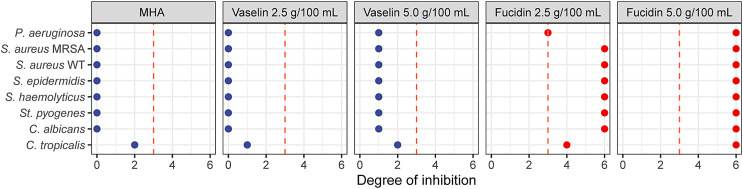
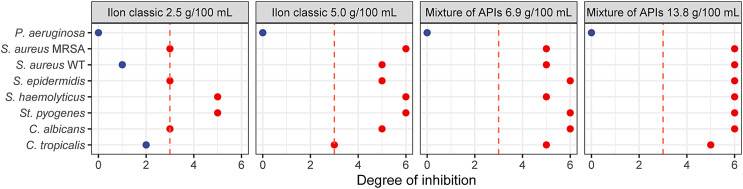
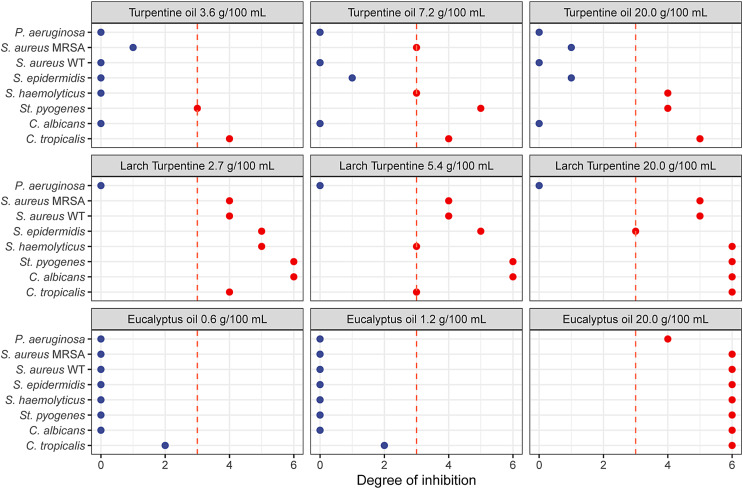
Results: The ointment exerts a strong inhibitory effect on all Gram-positive bacteria at a concentration of 5 g/100 mL in the Müller-Hinton medium. It also has inhibiting effect on both Candida species but does not inhibit P. aeruginosa growth. As for the single active pharmaceutical ingredients, larch turpentine was the most active substance. The mixture of the three ingredients, in the concentrations used in the ointment, had a higher antibiotic effect than any of the individual ingredients studied, suggesting at least an additive activity.
Conclusions: Our study has shown that the herbal ingredients and their combination exert antimicrobial activities, especially against Gram-positive bacteria, that justify their use in the treatment of skin infections.
Keywords: Antibiotic susceptibility testing; Drop test; Essential oils; Methicillin-resistant Staphylococcus aureus; Pull ointment; Turpentine.
© 2025 The Author(s). Published by S. Karger AG, Basel.
Conflict of interest statement
E.P. and C.F.-C. received a grant from Cesra Arzneimittel GmbH & Co. KG. O.P. is a consultant to Cesra. C.Z. and N.G. are employees of Cesra.
Figures
References
-
- Dryden MS. Skin and soft tissue infection: microbiology and epidemiology. Int J Antimicrob Agents. 2009;34(Suppl 1):S2–7. - PubMed
-
- Chiller K, Selkin BA, Murakawa GJ. Skin microflora and bacterial infections of the skin. J Investig Dermatol Symp Proc. 2001;6(3):170–4. - PubMed
-
- Clebak KT, Malone MA. Skin infections. Prim Care. 2018;45(3):433–54. - PubMed
-
- Stulberg DL, Penrod MA, Blatny RA. Common bacterial skin infections. Am Fam Physician. 2002;66(1):119–24. - PubMed
-
- Halverstam C, Cohen SR. Cutaneous candidiasis and chronic mucocutaneous candidiasis. In: Lebwohl MG, Heymann WR, Berth-Jones J, Coulson IH, editors. Treatment of skin disease. 5th ed. London: Elsevier; 2018. p. 171–4.
MeSH terms
Substances
LinkOut - more resources
Full Text Sources
Medical
Research Materials
