


Prospective association of tobacco retailer density and neighbourhood walkability with youth vaping initiation in California, USA
- PMID: 39779327
- PMCID: PMC12234799
- DOI: 10.1136/tc-2024-058974
Prospective association of tobacco retailer density and neighbourhood walkability with youth vaping initiation in California, USA
Abstract
Background: Tobacco retailer density might influence youth e-cigarette use due to increased access and exposure to point-of-sale marketing. There is a need for longitudinal investigations on the association of tobacco retailer density with youth e-cigarette use, with consideration of contextual factors such as neighbourhood walkability that could enhance retailer exposure.
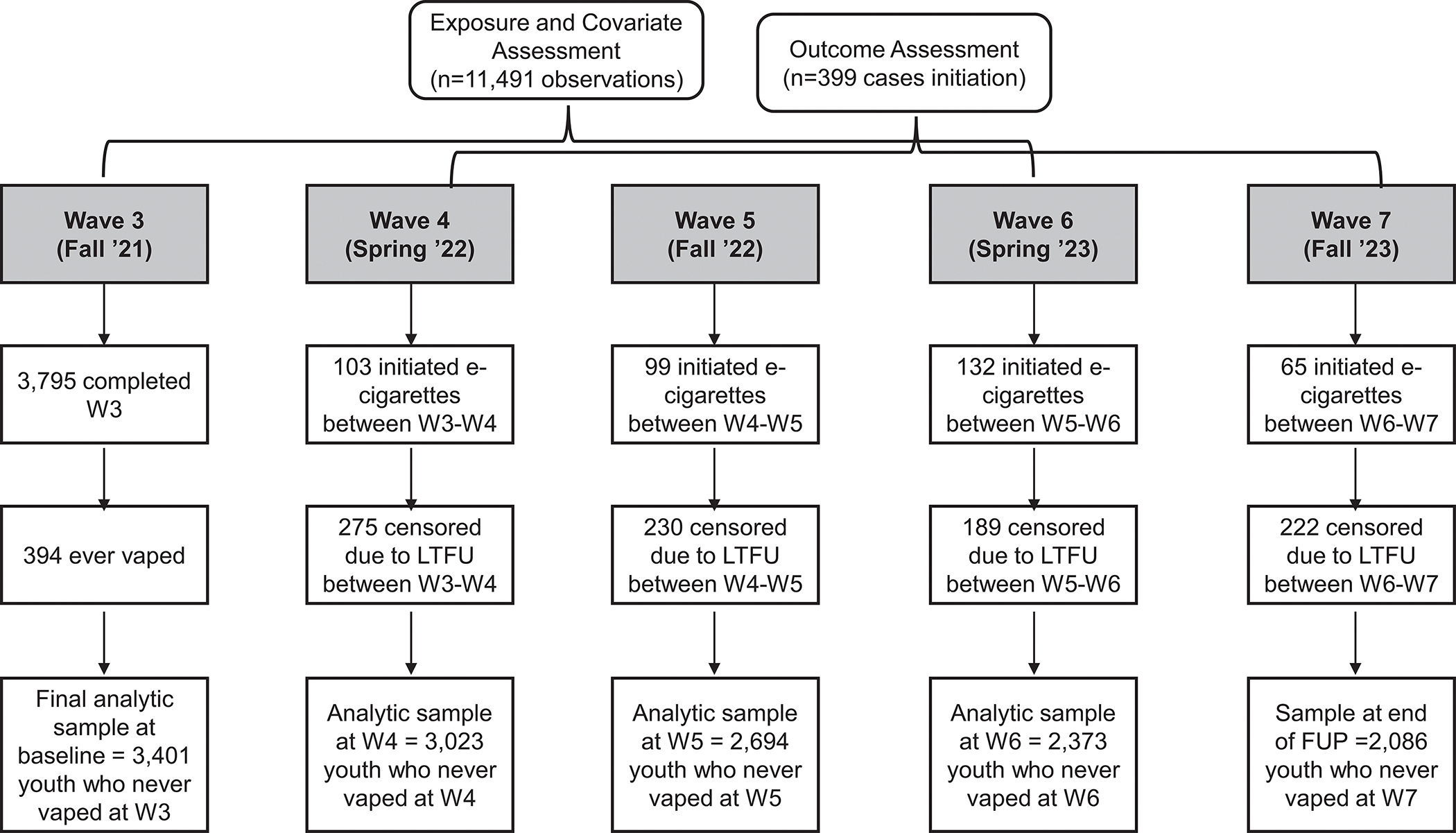
Methods: Five semi-annual waves (Fall 2021-Fall 2023) of a Southern California school-based cohort of youth who never vaped at baseline (n=3401; mean baseline age=15 years [range=12-17]) were merged with spatial data on tobacco retailers corresponding to each school year. Time-varying measures of retailer exposures included count of retailers within circular home buffers (800 m/1600 m buffers) and retailer density/km2 within home census tracts. Discrete-time survival analyses estimated associations of time-lagged and time-varying retailer exposures with vaping initiation at each 6-month follow-up, adjusting for race/ethnicity, parental education, neighbourhood walkability and an Area Deprivation Index. Secondary analyses examined moderation by neighbourhood walkability based on a National Walkability Index.
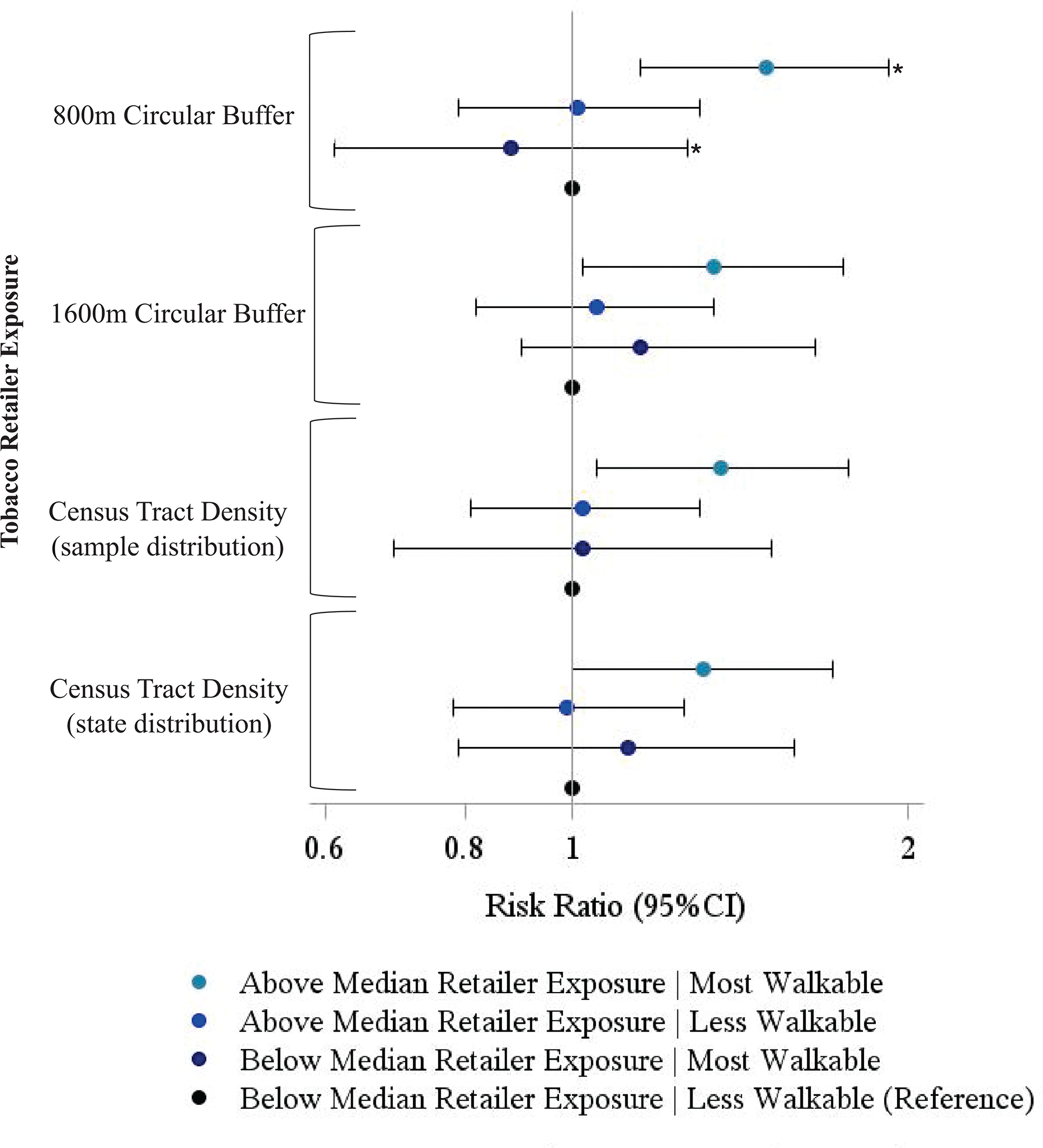
Results: The incident rate of vaping initiation was 3.8% per 6-month follow-up. After covariate adjustment, only associations with census tract retail density were statistically significant (risk ratio (RR) highest vs lowest quartile=1.36, 95% CI=1.01 to 1.84). In moderation analyses, count of retailers within 800 m home buffers was positively associated with vaping initiation for youth who lived in the most walkable neighbourhoods (RR=1.08, 95% CI: 1.01 to 1.16), with no association for youth in less walkable neighbourhoods (RR=1.00, 95% CI:0.95 to 1.05; interaction p-value=0.0238).
Conclusion: Findings highlight the potential role of restricting retailer density in preventing youth vaping, particularly in areas characterised by both greater walkability and tobacco retailer density.
Keywords: Electronic nicotine delivery devices; Environment; Nicotine; Non-cigarette tobacco products.
© Author(s) (or their employer(s)) 2025. No commercial re-use. See rights and permissions. Published by BMJ Group.
Conflict of interest statement
Competing interests: No, there are no competing interests.
Figures
References
-
- US Food and Drug Administration Center for Tobacco Products. Results from the Annual National Youth Tobacco Survey. Published online June 3, 2024. Accessed June 11, 2024. https://www.fda.gov/tobacco-products/youth-and-tobacco/results-annual-na...
-
- Mantey D, Barroso C, Kelder B, Kelder S. Retail Access to E-cigarettes and Frequency of E-cigarette Use in High School Students. Tobacco Regulatory Science. 2019;5:280–290. doi: 10.18001/TRS.5.3.6 - DOI
Grants and funding
LinkOut - more resources
Full Text Sources