


The analysis of dance teaching system in deep residual network fusing gated recurrent unit based on artificial intelligence
- PMID: 39779733
- PMCID: PMC11711383
- DOI: 10.1038/s41598-025-85407-2
The analysis of dance teaching system in deep residual network fusing gated recurrent unit based on artificial intelligence
Abstract
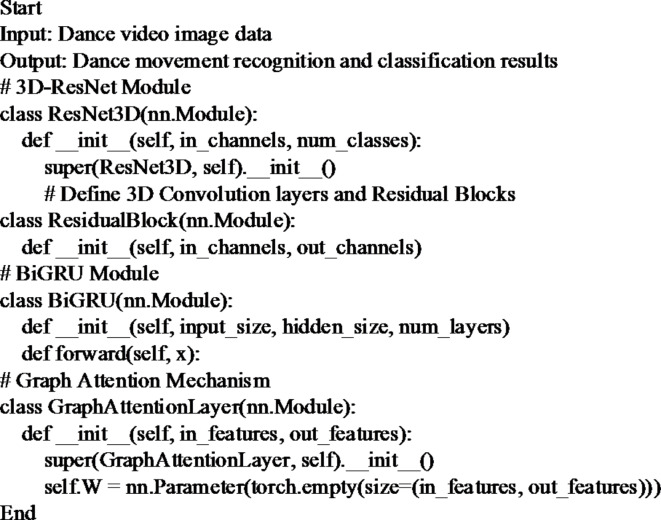
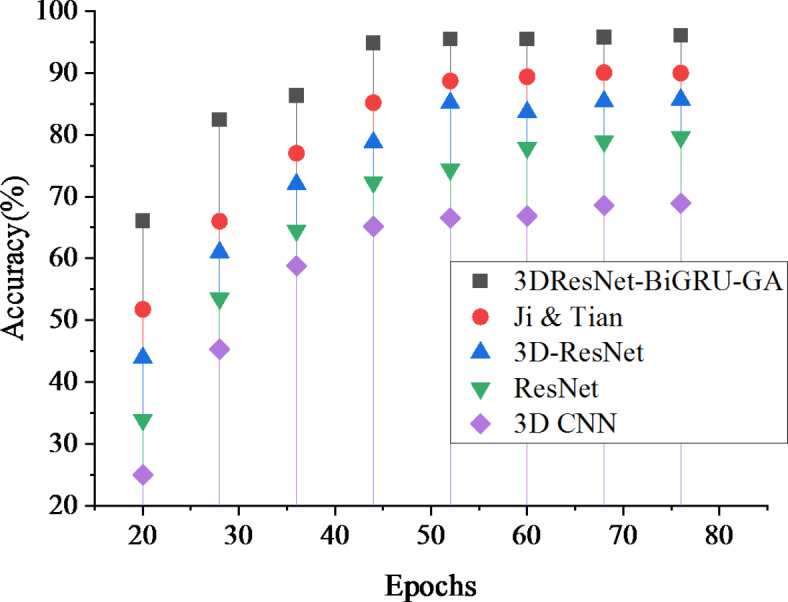
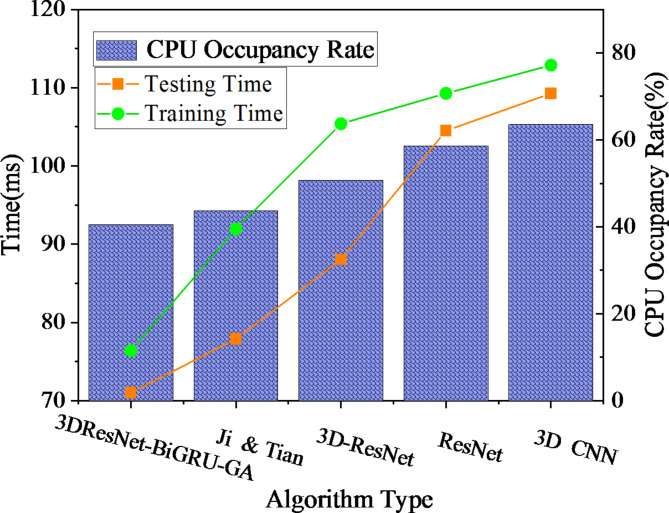
The purpose of this study is to investigate how deep learning and other artificial intelligence (AI) technologies can be used to enhance the intelligent level of dance instruction. The study develops a dance action recognition and feedback model based on the Graph Attention Mechanism (GA) and Bidirectional Gated Recurrent Unit (3D-Resnet-BigRu). In this model, time series features are captured using BiGRU after 3D-ResNet is inserted to extract video features. Lastly, GA dynamically modifies the node weights to maximize action recognition performance. According to the experimental results, this model's F1 score is 85.34%, and its maximum accuracy on the NTU-RGBD60 datasets is more than 5% greater than that of the current 3D Convolutional Neural Network (3D-CNN) baseline algorithm. In addition, the model shows high efficiency and resource utilization in test time, training time and CPU occupancy. The research shows that this model has strong competitiveness in dealing with complex dance action recognition tasks, and provides efficient and personalized technical support for future dance teaching. Meanwhile, the model provides a powerful tool for dance educators to support their teaching activities and enhance students' learning experience.
Keywords: 3D-ResNet; Action recognition; Artificial intelligence; Dance teaching; Deep learning.
© 2025. The Author(s).
Conflict of interest statement
Competing interests: The authors declare no competing interests. Ethics statement: The studies involving human participants were reviewed and approved by Academy of Music, Suihua University Ethics Committee (Approval Number: 2022.54510023). The participants provided their written informed consent to participate in this study. All methods were performed in accordance with relevant guidelines and regulations.
Figures




References
-
- Zhang, Y. et al. High-precision detection for sandalwood trees via improved YOLOv5s and StyleGAN. Agriculture14(3), 452 (2024).
-
- Li, N. & Boers, S. Human motion recognition in dance video images based on attitude estimation. Wirel. Commun. Mob. Comput.2023(1), 4687465 (2023).
-
- Tomescu, G., Stănescu, M. I. & Aivaz, K. A. The contribution of dance to Optimizing Motor skills and improving the Educational process in Institutionalized Children. BRAIN Broad Res. Artif. Intell. Neurosci.15(2), 362–377 (2024).
-
- Cob-Parro, A. C., Losada-Gutiérrez, C., Marrón-Romera, M., Gardel-Vicente, A. & Bravo-Muñoz, I. A new framework for deep learning video based Human Action Recognition on the edge. Expert Syst. Appl.238, 122220 (2024).
Publication types
MeSH terms
LinkOut - more resources
Full Text Sources
Miscellaneous
