


The effect of mortality salience and early-life maternal care on neuroendocrine, autonomic, and psychological stress responses
- PMID: 39779773
- PMCID: PMC11711282
- DOI: 10.1038/s41598-025-85380-w
The effect of mortality salience and early-life maternal care on neuroendocrine, autonomic, and psychological stress responses
Abstract
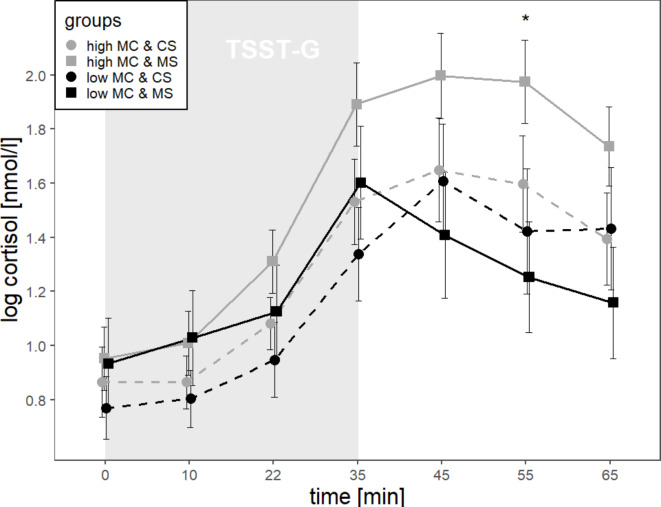
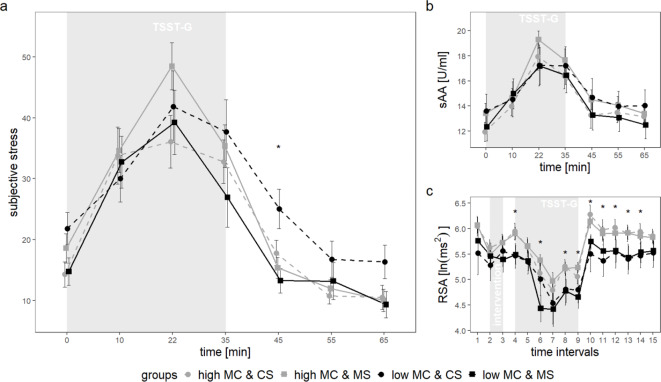
Adverse early-life experiences alter the regulation of major stress systems such as the hypothalamic-pituitary-adrenal (HPA) axis. Low early-life maternal care (MC) has repeatedly been related to blunted cortisol stress responses. Likewise, an acutely increased awareness of mortality (mortality salience [MS]) also has been shown to blunt cortisol responses. In this study we investigated the effects of early-life MC and a potential interaction with MS on HPA axis responsivity, as well as autonomic and subjective stress responses. Seventy-three women (Mage=21.56, SDage=2.85) with self-reported low (n = 30) or high (n = 43) early-life MC, underwent the Trier Social Stress Test for groups. Before, they were asked to briefly contemplate either death (mortality condition, n = 38) or sleep (control condition, n = 35). Salivary cortisol and alpha amylase, heart rate variability and subjective stress levels were assessed repeatedly. Multilevel mixed models confirmed an effect of MC on stress system regulation, indicated by blunted cortisol responses and overall reduced heart rate variability in low versus high MC individuals. Moreover, we found an interaction between MS and MC concerning subjective stress and autonomic measures. Specifically, low MC individuals in the control compared to the mortality condition showed both overall higher subjective stress levels, and less increase in heart rate variability following stress. These findings demonstrate the enduring impact of low early-life MC and the potential role of acute mortality primes on the regulation of stress systems in healthy women.
Keywords: Early-life adversity; HPA axis; Maternal care; Mortality salience; Stress; TSST.
© 2025. The Author(s).
Conflict of interest statement
Competing interests: The authors declare no competing interests.
Figures

References
-
- Leistner, C. & Menke, A. Hypothalamic-pituitary-adrenal axis and stress. Handb. Clin. Neurol.175, 55–64 (2020). - PubMed
-
- Phillips, A. C., Ginty, A. T. & Hughes, B. M. The other side of the coin: Blunted cardiovascular and cortisol reactivity are associated with negative health outcomes. Int. J. Psychophysiol.90, 1–7 (2013). - PubMed
-
- Zorn, J. V. et al. Cortisol stress reactivity across psychiatric disorders: A systematic review and meta-analysis. Psychoneuroendocrinology77, 25–36 (2017). - PubMed
Publication types
MeSH terms
Substances
LinkOut - more resources
Full Text Sources
Medical
