


Perceiving inter-leg speed differences while walking on a split-belt treadmill
- PMID: 39779829
- PMCID: PMC11711748
- DOI: 10.1038/s41598-024-85091-8
Perceiving inter-leg speed differences while walking on a split-belt treadmill
Abstract
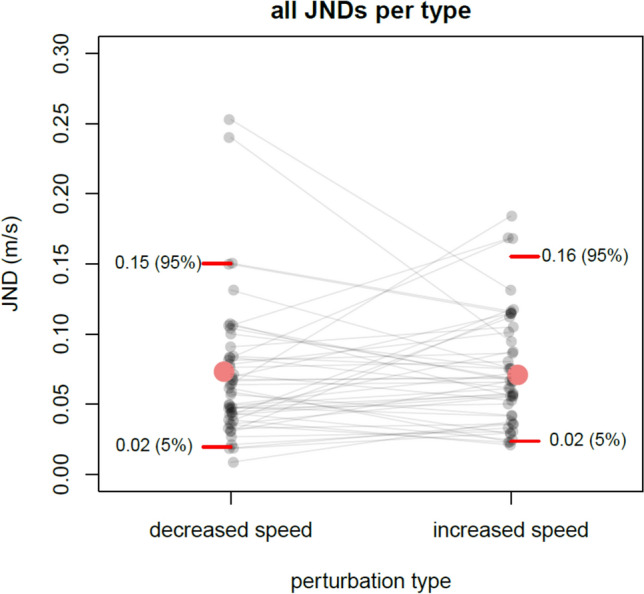
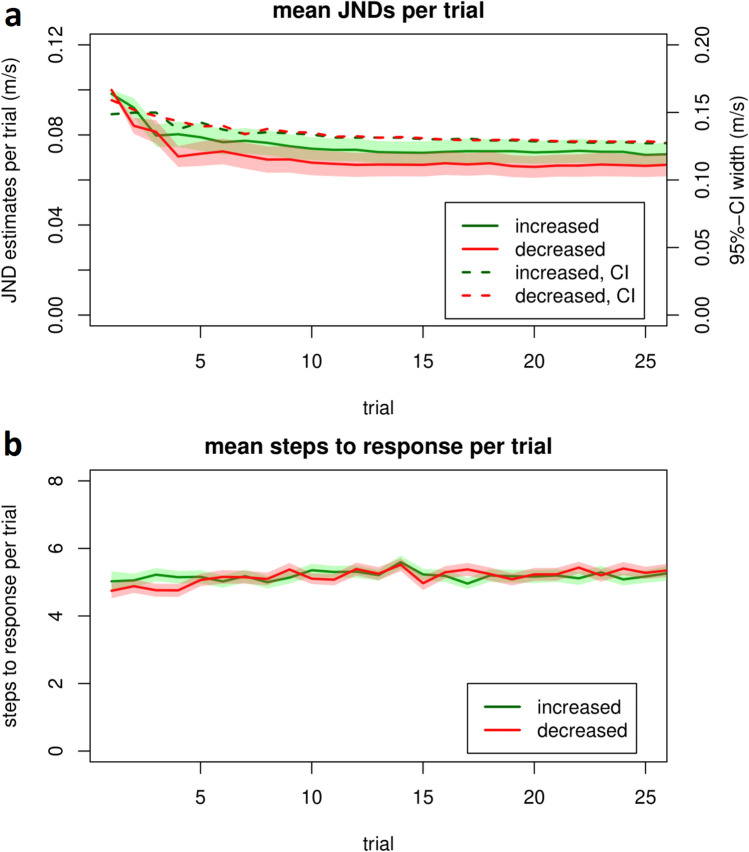
Walking is one of the most common forms of self-motion in humans. Most humans can walk effortlessly over flat uniform terrain, but also a variety of more challenging surfaces, as they adjust their gait to the demands of the terrain. In this, they rely in part on the perception of their own gait and of when it needs to be adjusted. Here, we investigated how well N = 48 participants detected speed differences between two belts of a split-belt treadmill. As participants walked at a constant speed, we either accelerated or decelerated one of the belts at quasi-random intervals and asked participants to judge their relative speeds in a two-alternative forced-choice task. Using an adaptive psychophysical procedure, we obtained precise perception-threshold estimates for inter-leg speed differences after accelerating or decelerating one belt. We found that most participants could detect even very small speed differences, with mean threshold estimates of just over 7% for both perturbation types. These were relatively stable within, but highly variable across participants. Increased-speed and decreased-speed thresholds were highly correlated, indicating that despite different biomechanics, the detection mechanisms might be similar. This sheds light on how perceiving their own motion helps humans manage interlimb coordination in perturbed walking.
Keywords: Just-noticeable differences; Perception and action; Self-motion; Sensorimotor adaptation; Walking.
© 2025. The Author(s).
Conflict of interest statement
Competing interests: On behalf of all authors, the corresponding author states that there are no competing interests.
Figures


References
-
- Gibson, J. J. Visually controlled locomotion and visual orientation in animals. Br. J. Psychol.49, 182–194 (1958). - PubMed
-
- Marigold, D. S. & Patla, A. E. Strategies for Dynamic Stability During Locomotion on a Slippery Surface: Effects of Prior Experience and Knowledge. J. Neurophysiol.88, 339–353 (2002). - PubMed
-
- Weerdesteyn, V., Nienhuis, B., Hampsink, B. & Duysens, J. Gait adjustments in response to an obstacle are faster than voluntary reactions. Hum. Mov. Sci.23, 351–363 (2004). - PubMed
-
- Luukinen, H. et al. Fracture Risk Associated with a Fall According to Type of Fall Among the Elderly. Osteoporos. Int.11, 631–634 (2000). - PubMed
-
- Oliver, D. Risk factors and risk assessment tools for falls in hospital in-patients: a systematic review. Age Ageing33, 122–130 (2004). - PubMed
Publication types
MeSH terms
LinkOut - more resources
Full Text Sources
Research Materials
