


Flood-driven survival and growth of dominant C4 grasses helps set their distributions along tallgrass prairie moisture gradients
- PMID: 39780373
- PMCID: PMC11744443
- DOI: 10.1002/ajb2.16457
Flood-driven survival and growth of dominant C4 grasses helps set their distributions along tallgrass prairie moisture gradients
Abstract
Premise: Five C4 grasses (Bouteloua curtipendula, Schizachyrium scoparium, Andropogon gerardii, Sorghastrum nutans, Spartina pectinata) dominate different portions of a moisture gradient from dry to wet tallgrass prairies in the Upper Midwest of the United States. We hypothesized that their distributions may partly reflect differences in flooding tolerance and context-specific growth relative to each other.
Methods: We tested these ideas with greenhouse flooding and drought experiments, outdoor mesocosm experiments, and a natural experiment involving a month-long flood in two wet-mesic prairies.
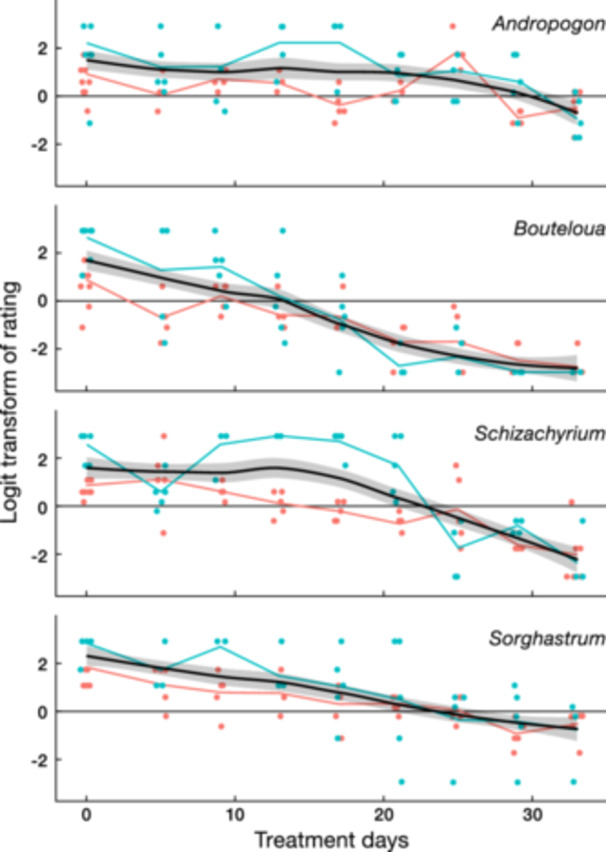
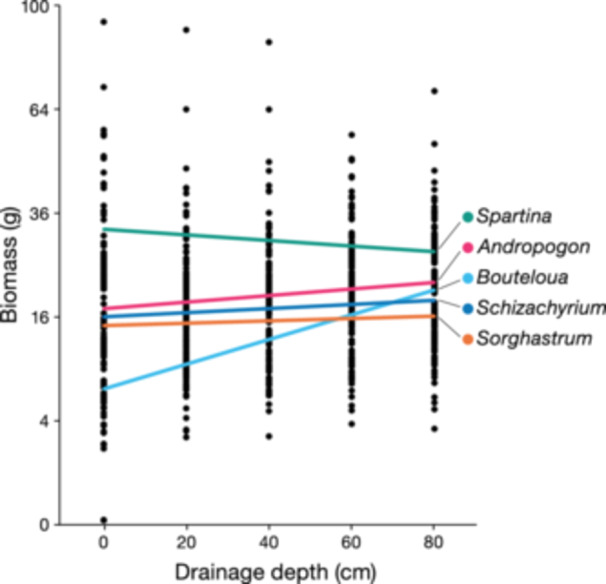
Results: Bouteloua promptly succumbed to inundation, so flooding intolerance likely excludes it from wet and wet-mesic prairies. Competition is likely to exclude short-statured Bouteloua from productive mesic sites. Schizachyrium is excluded from wet prairies by low flooding tolerance, demonstrated by all experiments. Sorghastrum had low flooding tolerance in both greenhouse and natural experiments, suggesting that physiological intolerance excludes it from wet prairies. Spartina had by far the greatest growth under the wettest mesocosm conditions; this and comparisons of species growth in monocultures vs. mixtures suggests that competition helps it dominate wet prairies. Indeed, quadrat presence of Spartina increased by 57% two years after flooding of two prairies, while that of upland grasses declined by 44%. The high flooding tolerance, lack of significant differences from other species in drought tolerance, and tall stature of Andropogon suggest that broad physiological tolerance combined with competitive ability allows it to thrive across the prairie moisture gradient.
Conclusions: Flooding helps shape the distributions of dominant prairie grasses, and its effects may become more important as extreme rain events continue to increase.
Keywords: LD50; ecological distributions; flooding tolerance; logit analysis; species sorting; water table depth.
© 2025 The Author(s). American Journal of Botany published by Wiley Periodicals LLC on behalf of Botanical Society of America.
Figures
References
-
- Bachle, S. , Griffith D. M., and Nippert J. B.. 2018. Intraspecific trait variability in Andropogon gerardii, a dominant grass species in the US Great Plains. Frontiers in Ecology and Evolution 6: 217.
-
- Bonin, C. L. , and Zedler J. B.. 2008. Southern California salt marsh dominance relates to plant traits and plasticity. Estuaries and Coasts 31: 682‐693.
-
- Bowles, M. , and Jones M.. 2007. The prairie‐wetland vegetation continuum in the Chicago region of northeastern Illinois. Ecological Restoration 25: 29–42.
-
- Bowles, M. L. , Kelsey P. D., and McBride J. L.. 2005. Relationships among environmental factors, vegetation zones, and species richness in a North American calcareous prairie fen. Wetlands 25: 685–696.
MeSH terms
Substances
LinkOut - more resources
Full Text Sources
Other Literature Sources
Medical
Miscellaneous
