


Emerging Roles of Dermal Fibroblasts in Hyperpigmentation and Hypopigmentation: A Review
- PMID: 39780507
- PMCID: PMC11711935
- DOI: 10.1111/jocd.16790
Emerging Roles of Dermal Fibroblasts in Hyperpigmentation and Hypopigmentation: A Review
Abstract
Background: Skin pigmentation disorders may increase patients' psychological burdens. Consequently, they are increasingly attracting attention. Dermal fibroblasts have been shown to regulate pigmentation by secreting soluble factors.
Aim: This study aimed to summarize recent findings on the effects of dermal fibroblasts on hyperpigmentation and hypopigmentation, enabling the discovery of new therapeutic targets.
Methods: PubMed was searched for literature on fibroblast factors, hyperpigmentation, and hypopigmentation, and a comprehensive summary and analysis were performed.
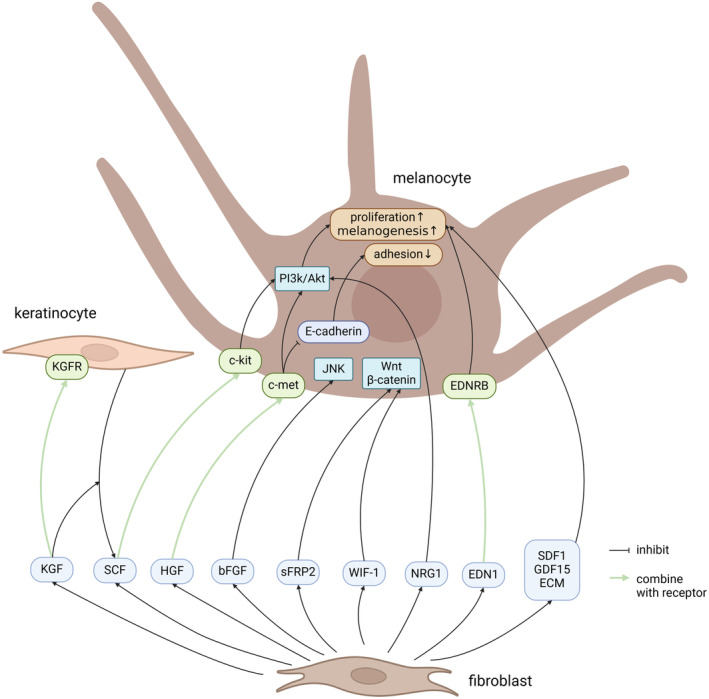
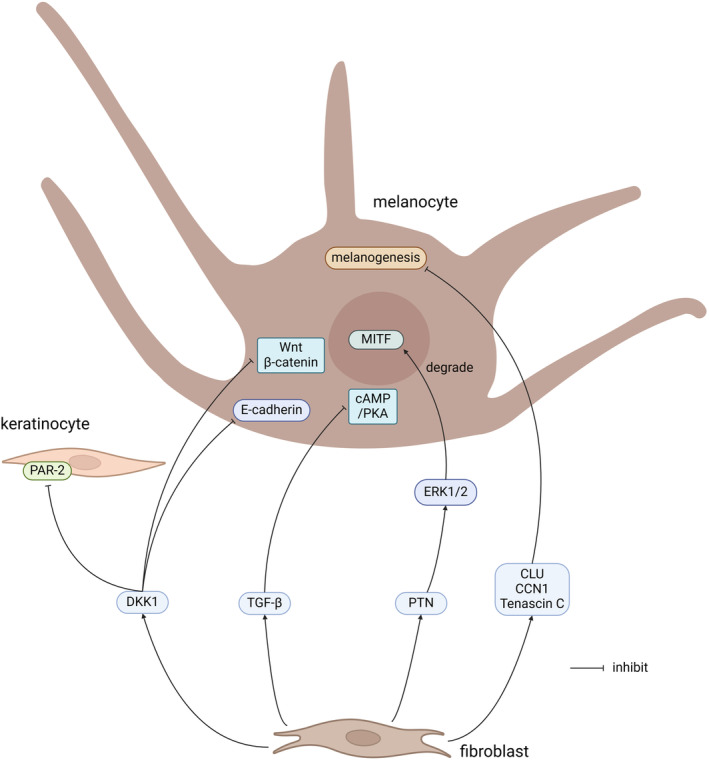
Results: Fibroblasts secrete both cytokines that promote pigmentation, including stem cell factor (SCF) and keratinocyte growth factor (KGF), and small amounts of those that inhibit pigmentation, such as Dickkopf1 (DKK1) and transforming growth factor (TGF)-β. Fibroblast-derived extracellular matrix (ECM) can also affect melanocyte tyrosinase activity and the transfer of melanosomes. In hyperpigmentation disorders, such as melasma and solar lentigines, the secretion of pigmentation-promoting factors increases, and the activity of key enzymes in melanin production is elevated. In hypopigmentation disorders, including vitiligo, the secretion of melanogenic factors decreases while the factors that inhibit pigmentation increase. Fibroblasts may serve as a new therapeutic target, providing new insights to precisely treat pigmentary disorders.
Conclusions: Fibroblasts synthesize and secrete various cytokines and proteins that modify melanin synthesis and transfer through different signaling pathways, playing prominent roles in pigmentary skin disorders, such as photoaging, melasma, solar lentigo, and vitiligo.
Keywords: cytokine; fibroblasts; melanocytes; pigmentation.
© 2025 The Author(s). Journal of Cosmetic Dermatology published by Wiley Periodicals LLC.
Conflict of interest statement
The authors declare no conflicts of interest.
Figures
References
-
- Wu Y., Yang Y., Lin Y., et al., “Emerging Role of Fibroblasts in Vitiligo: A Formerly Underestimated Rising Star,” Journal of Investigative Dermatology 144, no. 8 (2024): 1696–1706. - PubMed
-
- Sarkar R., Bansal A., and Ailawadi P., “Future Therapies in Melasma: What Lies Ahead?,” Indian Journal of Dermatology, Venereology and Leprology 86, no. 1 (2020): 8–17. - PubMed
-
- Mohd Nor N. H., Berahim Z., Azlina A., Mokhtar K. I., and Kannan T. P., “Identification and Characterization of Intraoral and Dermal Fibroblasts Revisited,” Current Stem Cell Research & Therapy 12, no. 8 (2017): 675–681. - PubMed
-
- Bellei B. and Picardo M., “Premature Cell Senescence in Human Skin: Dual Face in Chronic Acquired Pigmentary Disorders,” Ageing Research Reviews 57 (2020): 100981. - PubMed
Publication types
MeSH terms
Substances
LinkOut - more resources
Full Text Sources
