" Trying to Grab Pieces of Hope " : Exploring the Experiences of Black and Hispanic Parents following a Congenital Heart Disease Diagnosis
- PMID: 39780940
- PMCID: PMC11706635
- DOI: 10.1055/a-2504-1813
" Trying to Grab Pieces of Hope " : Exploring the Experiences of Black and Hispanic Parents following a Congenital Heart Disease Diagnosis
Abstract
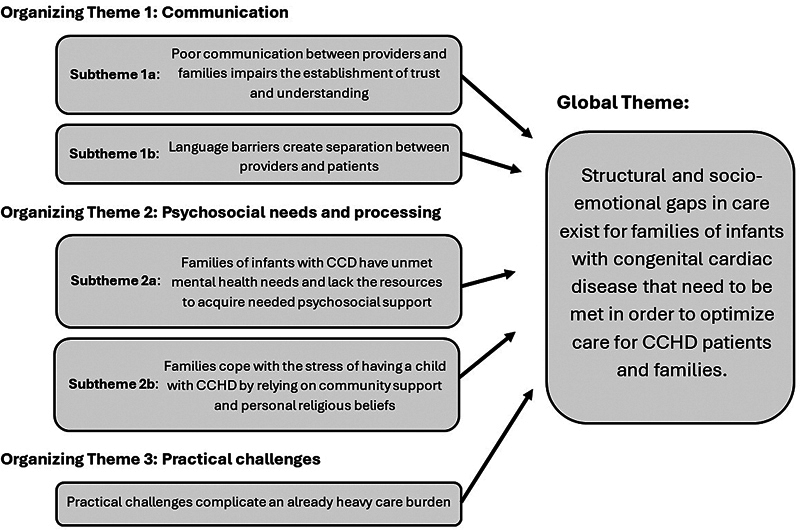
Objective Congenital heart disease (CHD) is an important contributor to pediatric morbidity and mortality. Unfortunately, disparities in the diagnosis and treatment of CHD exist across racial and ethnic groups. The objective of this study was to share the experiences of Hispanic and Black families with CHD to better understand their needs. Study Design This was a descriptive qualitative study involving two 2-part focus groups, one conducted in English and one in Spanish, consisting of parents of infants with CHD. Focus groups were audio recorded, transcribed, and analyzed via a conventional content analysis approach. Results Six family members participated, representing a range of cardiac diagnoses. Two participants cited their identity as non-Hispanic Black and four as Hispanic. Three organizing themes emerged related to (1) communication, (2) psychosocial needs and processing, and (3) practical challenges associated with having a child with CHD. Together, these organizing themes supported a singular global theme: structural and socioemotional gaps in care exist for families of infants with CHD that need to be met in order to optimize care for patients and families. Conclusion Societal and systems-level factors, including structural inequities, contribute to the care gaps experienced by racial and ethnic minority families of children with CHD. Key Points Poor communication around CHD diagnosis impairs provider-patient trust.Language barriers hinder accurate communication about CHD diagnosis and treatment.Parents of children with CHD have unmet mental health needs.Perinatal providers should champion health equity for CHD patients and their families.
Keywords: communication; complex congenital heart disease; congenital heart disease; health disparities; health equity; neonatal intensive care; parental mental health.
The Author(s). This is an open access article published by Thieme under the terms of the Creative Commons Attribution-NonDerivative-NonCommercial License, permitting copying and reproduction so long as the original work is given appropriate credit. Contents may not be used for commercial purposes, or adapted, remixed, transformed or built upon. ( https://creativecommons.org/licenses/by-nc-nd/4.0/ ).
Conflict of interest statement
Conflict of Interest M.S.M. reports support from the National Heart, Lung, and Blood Institute of the National Institutes of Health (NIH) under award for Postdoctoral Training in Cardiovascular Clinical Research (5T32HL069749); J.C.R. and K.H. report support from the Duke Children's Health and Discovery Institute; M.E.L. reports grants from the NIH; BAND Foundation; Child Neurology Society.
References
-
- Hoffman J I, Kaplan S. The incidence of congenital heart disease. J Am Coll Cardiol. 2002;39(12):1890–1900. - PubMed
-
- Botto L D, Correa A, Erickson J D. Racial and temporal variations in the prevalence of heart defects. Pediatrics. 2001;107(03):E32. - PubMed
-
- American Heart Association Adults With Congenital Heart Disease Joint Committee of the Council on Cardiovascular Disease in the Young and Council on Clinical Cardiology, Council on Cardiovascular Surgery and Anesthesia, and Council on Cardiovascular and Stroke Nursing . Donofrio M T, Moon-Grady A J, Hornberger L K et al.Diagnosis and treatment of fetal cardiac disease: a scientific statement from the American Heart Association. Circulation. 2014;129(21):2183–2242. - PubMed
LinkOut - more resources
Full Text Sources
Miscellaneous