


Menopausal hormone therapy is associated with worse levels of Alzheimer's disease biomarkers in APOE ε4-carrying women: An observational study
- PMID: 39783876
- PMCID: PMC11848176
- DOI: 10.1002/alz.14456
Menopausal hormone therapy is associated with worse levels of Alzheimer's disease biomarkers in APOE ε4-carrying women: An observational study
Abstract
Introduction: Menopausal hormone therapy (MHT), along with the apolipoprotein E (APOE) ε4 allele, has been suggested as a possible risk factor for Alzheimer's disease (AD). However, the relationship between MHT and cerebrospinal fluid (CSF) biomarkers is unknown: we investigated this association, and whether APOE ε4 carrier status moderates it.
Methods: In an observational study of 136 cognitively unimpaired female participants (Mage = 66.0; standard deviation = 6.3), we examined whether MHT use alone or in interaction with APOE ε4 carrier status was associated with CSF levels of phosphorylated tau (p-tau), amyloid beta (Aβ)40, Aβ42, p-tau/Aβ42, and Aβ42/40 ratios.
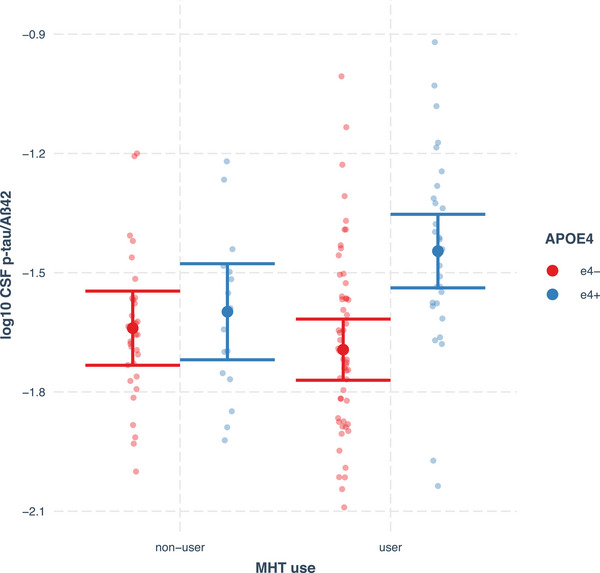
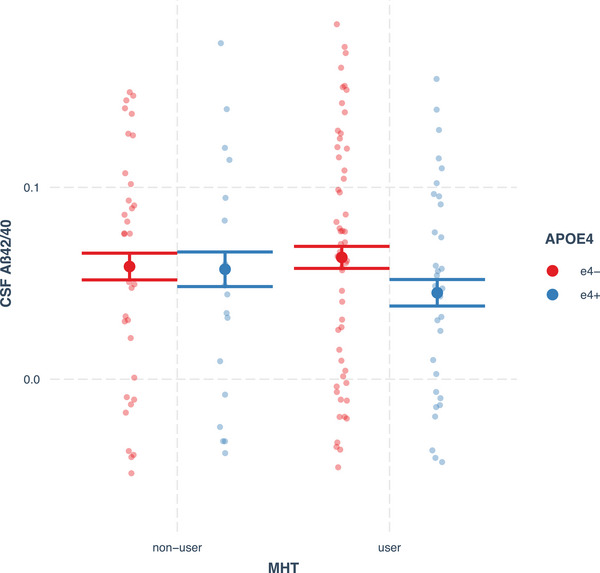
Results: Significant interactions were found between APOE ε4 and MHT use for CSF biomarkers. APOE ε4 carriers who were MHT users showed worse levels of CSF p-tau/Aβ42 and Aβ42/40 ratios than all other users and non-users.
Discussion: The presence of both APOE ε4 and MHT may be associated with elevated amyloid deposition and AD pathology in this sample of participants who demonstrated high familial AD risk.
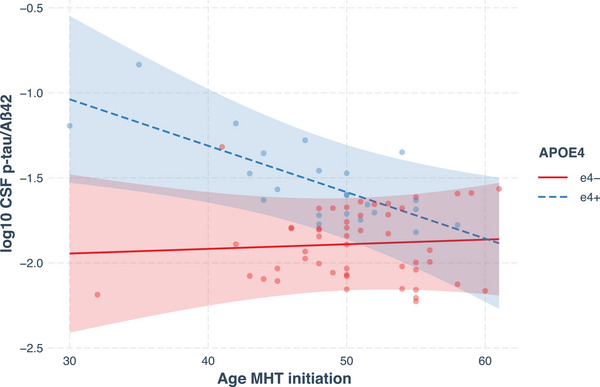
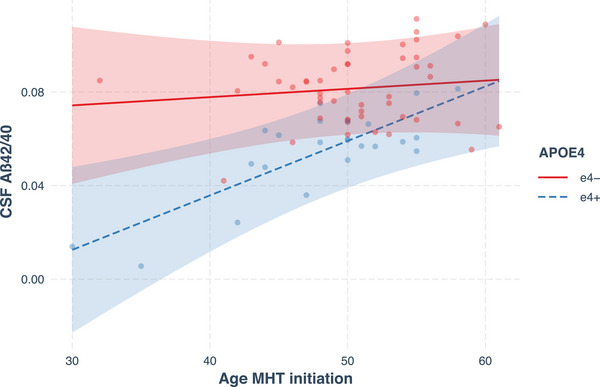
Highlights: Significant interactions were found between apolipoprotein E (APOE) ε4 and menopausal hormone therapy (MHT) use for cerebrospinal fluid (CSF) phosphorylated tau (p-tau)/amyloid beta (Aβ)42 and Aβ42/40 ratios. APOE ε4 carriers who were MHT users showed worse levels of CSF biomarkers than non-users and non-carriers, both users and non-users. Younger age at MHT initiation was associated with worse levels of the p-tau/Aβ42 and Aβ42/40 ratios in carriers only. The presence of both APOE ε4 carriage and MHT use may be associated with elevated amyloid deposition and AD pathology. Further studies with larger sample sizes are necessary to confirm the differences observed in the current study.
Keywords: Alzheimer's disease; apolipoprotein E ε4 allele; biomarker; cerebrospinal fluid; hormone therapy; menopause.
© 2025 The Author(s). Alzheimer's & Dementia published by Wiley Periodicals LLC on behalf of Alzheimer's Association.
Conflict of interest statement
H.Z. has served on scientific advisory boards and/or as a consultant for Abbvie, Acumen, Alector, Alzinova, ALZPath, Annexon, Apellis, Artery Therapeutics, AZTherapies, CogRx, Denali, Eisai, Nervgen, Novo Nordisk, Optoceutics, Passage Bio, Pinteon Therapeutics, Prothena, Red Abbey Labs, reMYND, Roche, Samumed, Siemens Healthineers, Triplet Therapeutics, and Wave; has given lectures in symposia sponsored by Cellectricon, Fujirebio, Alzecure, Biogen, and Roche; and is a co‐founder of Brain Biomarker Solutions in Gothenburg AB (BBS), which is a part of the GU Ventures Incubator Program (outside submitted work). No other author reports any conflicts of interest or disclosures. Author disclosures are available in the supporting information.
Figures
References
-
- Hogervorst E, Temple S, O'Donnell E. Sex differences in dementia. In: Sex Differences in Brain Function and Dysfunction. Springer Nature; 2023:309‐331. - PubMed
Publication types
MeSH terms
Substances
Grants and funding
LinkOut - more resources
Full Text Sources
Medical
Miscellaneous
