


Six-Month Outcomes from the Prospective, Multi-Center, Non-Randomized Clinical Study of the COVERA(™) Arterio VeNous (AV) Stent Graft in the Treatment of Stenosis in the VEnous OutfloW of AV Fistula Access Circuits (AVeNEW PAS)
- PMID: 39789255
- PMCID: PMC11958458
- DOI: 10.1007/s00270-024-03930-7
Six-Month Outcomes from the Prospective, Multi-Center, Non-Randomized Clinical Study of the COVERA(™) Arterio VeNous (AV) Stent Graft in the Treatment of Stenosis in the VEnous OutfloW of AV Fistula Access Circuits (AVeNEW PAS)
Erratum in
-
Correction to: Six-Month Outcomes from the Prospective, Multi-Center, Non-Randomized Clinical Study of the COVERA(™) Arterio VeNous (AV) Stent Graft in the Treatment of Stenosis in the VEnous OutfloW of AV Fistula Access Circuits (AVeNEW PAS).Cardiovasc Intervent Radiol. 2025 Mar;48(3):422. doi: 10.1007/s00270-025-03980-5. Cardiovasc Intervent Radiol. 2025. PMID: 39915326 Free PMC article. No abstract available.
Abstract
Purpose: The AVeNEW Post-Approval Study (AVeNEW PAS) follows upon results from the AVeNEW IDE clinical trial and was designed to provide additional clinical evidence of safety and effectiveness using the Covera™ Vascular Covered Stent to treat arteriovenous fistula (AVF) stenoses in a real-world hemodialysis patient population.
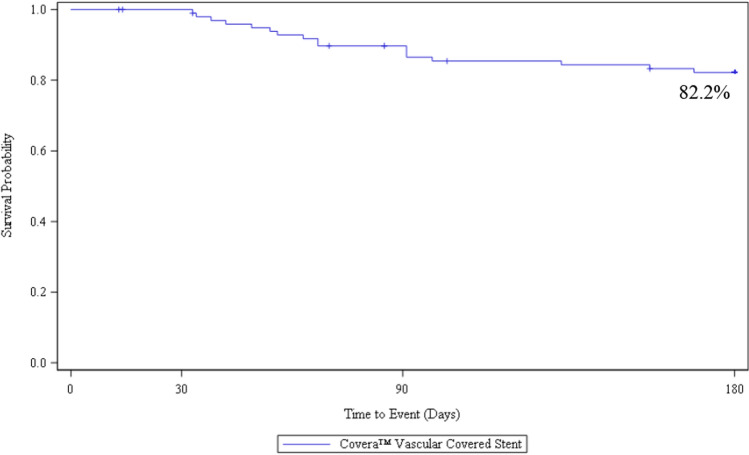
Materials and methods: One hundred AVF patients were prospectively enrolled at 11 clinical trial sites in the USA and treated with the covered stent after angioplasty of a clinically significant target stenosis. The primary safety outcome was freedom from any adverse event that suggests the involvement of the AV access circuit evaluated at 30 days. The primary efficacy outcome was Target Lesion Primary Patency (TLPP) at six months, determined by an independent core laboratory. Secondary outcome measures included technical success defined as successful deployment to the intended location and access circuit primary patency (ACPP).
Results: Safety was 94.9% with no device-related deaths nor in-patient hospitalization. Technical success was 100%. TLPP rates at 1, 3, and 6 months were 100, 89.7, and 82.2%. ACPP rates at 1, 3, and 6 months were 98, 76.3, and 60.0%. Target stenoses were 81% restenotic, and 75% located in the cephalic vein arch. There were 35% non-target stenoses treated with angioplasty during the index procedure.
Conclusion: The 6-month results of the AVeNEW PAS confirm results from the AVeNEW IDE clinical trial and demonstrate safety and efficacy using the Covera(™) Covered Stent in a real-world US hemodialysis patient population.
Trial registration: NCT04261686.
Level of evidence: 3 - prospective, multicenter.
Keywords: Angioplasty; Arteriovenous fistula; Dialysis; Hemodialysis; Stent.
© 2025. The Author(s).
Conflict of interest statement
Declarations. Conflict of interest: BD reports receiving speaker and consulting fees from Becton Dickinson and Company; Medtronic; and Merit Medical Systems. TS and MU are employees and shareholders in Becton, Dickinson and Company. Ethical approval: All procedures were in accordance with the ethical standards of the institution(s) and with the 1964 Helsinki Declaration and its later amendments or comparable ethical standards. Investigators followed a standard protocol approved by their institutional reviews boards (IRB), and all patients provided written informed consent prior to completing any procedure. Consent for publication: For this type of study, consent for publication is not required.
Figures

References
-
- Jose MD, et al. Fatal dialysis vascular access hemorrhage. Am J Kidney Dis. 2017;70(4):570–5. - PubMed
-
- Inston N, et al. Aneurysms in vascular access: state of the art and future developments. J Vasc Access. 2017;18(6):464–72. - PubMed
-
- Lok CE, et al. KDOQI clinical practice guideline for vascular access: 2019 update. Am J Kidney Dis. 2020;75(4 Suppl 2):S1–164. - PubMed
-
- Rajput A, et al. Venous aneurysms in autogenous hemodialysis fistulas: is there an association with venous outflow stenosis. J Vasc Access. 2013;14(2):126–30. - PubMed
Publication types
MeSH terms
Associated data
LinkOut - more resources
Full Text Sources
Medical
Research Materials
