


The activity of a herbal medicinal product of Phyllanthus niruri and Silybum marianum powdered extracts (Heptex®) in patients with apparent risk factors for nonalcoholic steatohepatitis: a phase II, multicentered, randomized, double-blind, placebo-controlled clinical trial
- PMID: 39789561
- PMCID: PMC11715200
- DOI: 10.1186/s12906-024-04692-y
The activity of a herbal medicinal product of Phyllanthus niruri and Silybum marianum powdered extracts (Heptex®) in patients with apparent risk factors for nonalcoholic steatohepatitis: a phase II, multicentered, randomized, double-blind, placebo-controlled clinical trial
Abstract
Background: Nonalcoholic steatohepatitis (NASH) is a severe form of nonalcoholic fatty liver disease (NAFLD) characterized by damage and inflammation of hepatocytes. Some medicinal plants have shown antioxidant and anti-inflammatory effects on liver cells. We aimed to investigate the hepatoprotective effect of Heptex® capsules containing 200 mg of Dukung Anak (a powdered extract from aerial parts of Phyllanthus niruri) and 100 mg of Milk Thistle (a powdered extract from fruits of Silybum marianum) in patients with an apparent risk factor for NASH.
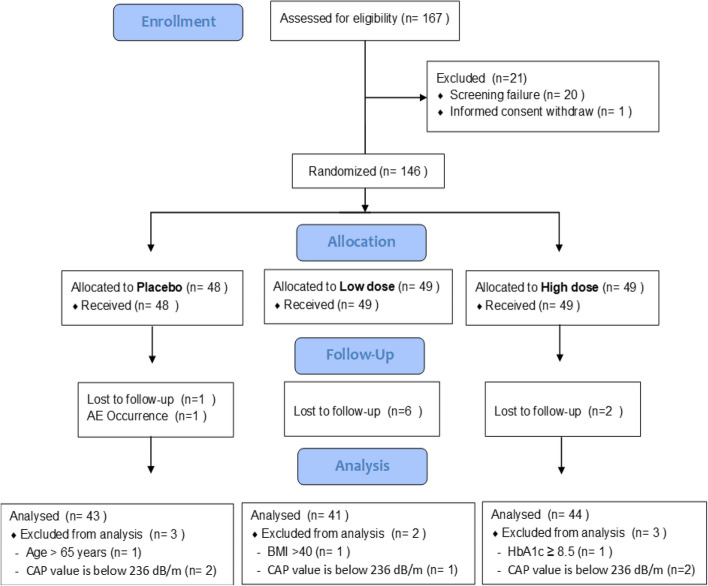
Methods: This was a phase II, randomized, double-blind, placebo-controlled, three-arm, interventional clinical trial. Patients were randomized in a 1:1:1 ratio to receive placebo, low dose (one capsule) of Heptex®, or high dose (two capsules) of Heptex®. After 36 weeks, liver enzymes, Fib-4 score, lipid profile, CAP score, and kPa score were evaluated. Patients were monitored for safety throughout the treatment duration.
Results: A total of 146 patients were enrolled in the study. A significant decrease was observed in ALT levels in the low-dose group (57 IU/L to 40 IU/L, p = 0.026) and the high-dose group (61 IU/L to 47.5 IU/L, p < 0.0001) and in AST levels in the high-dose group (43.5 IU/L to 32 IU/L, p = 0.001), with no significant difference between the relative percent change in ALT (p = 0.465) or AST (p = 0.632) between the three groups. No significant difference was revealed between the three groups regarding the median change in Fib-4 score at the end of treatment (p = 0.985). No significant change in the lipid profile was observed in any of the three groups except for the total cholesterol level, which significantly decreased from 210 IU/L to 187 IU/L, p = 0.031 in the low-dose group.
Conclusion: Heptex® capsules were safe and well tolerated over a treatment period of 36 weeks. However, the hepatoprotective effect in patients at risk of NASH still needs further assessment using more accurate investigation tools, a larger sample size, and/ or higher doses of the combination.
Trial registration: Retrospectively registered (registration date: 25/04/2022; trial registration number: NCT05343780).
Keywords: Hepatoprotection; NAFLD; NASH; Phyllanthus niruri; Silybum marianum; Silymarin.
© 2025. The Author(s).
Conflict of interest statement
Declarations. Ethics approval and consent to participate: All experiments were performed in accordance with relevant international and local guidelines and regulations. The study protocol was approved by the Egyptian Ministry of Health and Population (MoHP) Research Ethics Committee (code: 3-2020/13), the National Hepatology and Tropical Medicine Research Institute (NHTMRI) Research Ethics Committee (code: ITH00001), and Ain Shams University Research Ethics Committee (code: P02c/2019-2022). Informed consent was obtained from all participants prior to conducting any study-related procedures. Consent for publication: Not applicable. Competing interests: Shahnaz Mohamed is an employee of Natural Wellness. The rest of the authors declare no conflicts of interest.
References
-
- Chalasani N, Younossi Z, Lavine JE, Charlton M, Cusi K, Rinella M, Harrison SA, Brunt EM, Sanyal AJ. The diagnosis and management of nonalcoholic fatty liver disease: practice guidance from the American Association for the Study of Liver Diseases. Hepatology. 2018;67(1):328–57. - PubMed
-
- Fouad Y, Waked I, Bollipo S, Gomaa A, Ajlouni Y, Attia D. What’s in a name? Renaming ‘NAFLD’to ‘MAFLD.’ Liver Int. 2020;40(6):1254–61. - PubMed
Publication types
MeSH terms
Substances
Associated data
LinkOut - more resources
Full Text Sources
Medical
Miscellaneous
