


Batch and semi-continuous fermentation with Parageobacillus thermoglucosidasius DSM 6285 for H2 production
- PMID: 39789593
- PMCID: PMC11715973
- DOI: 10.1186/s13068-024-02597-z
Batch and semi-continuous fermentation with Parageobacillus thermoglucosidasius DSM 6285 for H2 production
Abstract
Background: Parageobacillus thermoglucosidasius is a facultatively anaerobic thermophile that is able to produce hydrogen (H2) gas from the oxidation of carbon monoxide through the water-gas shift reaction when grown under anaerobic conditions. The water-gas shift (WGS) reaction is driven by a carbon monoxide dehydrogenase-hydrogenase enzyme complex. Previous experiments exploring hydrogenogenesis with P. thermoglucosidasius have relied on batch fermentations comprising defined media compositions and gas atmospheres. This study evaluated the effects of a semi-continuous feeding strategy on hydrogenogenesis.
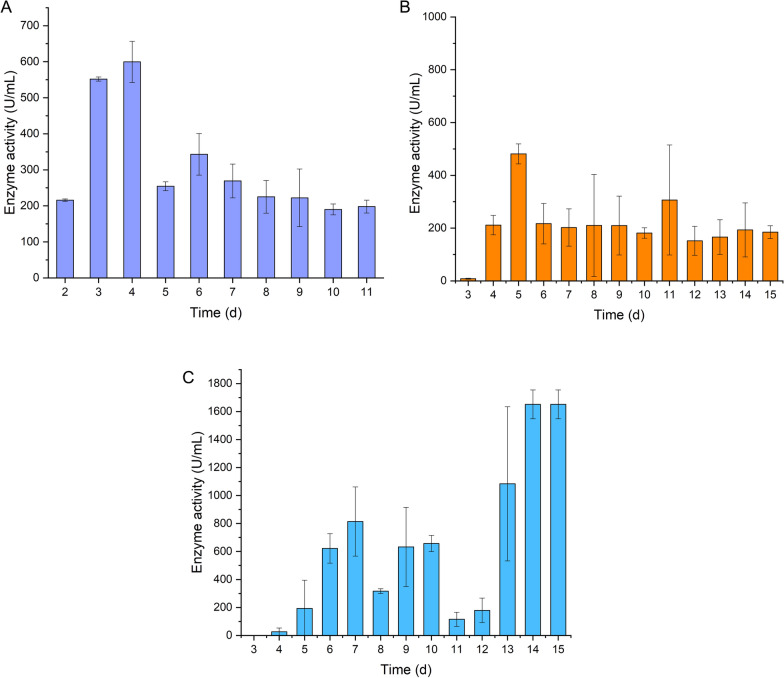
Results: A batch and two semi-continuous fermentations, with feeding of the latter fresh media (with glucose) in either 24 h or 48 h intervals were undertaken and H2 production, carbon monoxide dehydrogenase (CODH) activity, and metabolite consumption/production were monitored throughout. Maximum H2 production rates (HPR) of 0.14 and 0.3 mmol min-1, were observed for the batch and the semi-continuous fermentations, respectively. Daily feeding attained stable H2 production for 7 days, while feeding every 48 h resulted in high variations in H2 production. CODH enzyme activity correlated with H2 production, with a maximum of 1651 U mL-1 on day 14 with the 48 h feeding strategy, while CODH activity remained relatively constant throughout the fermentation process with the 24 h feeding strategy.
Conclusions: The results emphasize the significance of a semi-continuous glucose-containing feed for attaining stable hydrogen production with P. thermoglucosidasius. The semi-continuous fermentations achieved a 46% higher HPR than the batch fermentation. The higher HPRs achieved with both semi-continuous fermentations imply that this approach could enhance the biohydrogen platform. However, optimizing the feeding interval is pivotal to ensuring stable hydrogen production.
Keywords: Parageobacillus thermoglucosidasius; Carbon monoxide dehydrogenase; Hydrogen; Semi-continuous fermentation; Water gas shift reaction.
© 2025. The Author(s).
Conflict of interest statement
Declarations. Ethics approval and consent to participate: Not applicable. Consent for publication: Not applicable. Competing interests: The authors declare no competing interests.
Figures


References
-
- Sivaramakrishnan R, Shanmugam S, Sekar M, Mathimani T, Incharoensakdi A, Kim S-H, et al. Insights on biological hydrogen production routes and potential microorganisms for high hydrogen yield. Fuel. 2021;291: 120136.
-
- Cabrol L, Marone A, Tapia-Venegas E, Steyer J-P, Ruiz-Filippi G, Trably E. Microbial ecology of fermentative hydrogen producing bioprocesses: useful insights for driving the ecosystem function. FEMS Microbiol Rev. 2017;41:158–81. - PubMed
-
- Sherif SA, Barbir F, Veziroglu TN. Wind energy and the hydrogen economy—review of the technology. Sol Energy. 2005;78:647–60.
-
- da Silva Veras T, Mozer TS, da Costa Rubim Messeder dos Santos D, da Silva César A. Hydrogen: Trends, production and characterization of the main process worldwide. Int J Hydrogen Energy. 2017; 42:2018–33.
-
- Nikolaidis P, Poullikkas A. A comparative overview of hydrogen production processes. Renew Sustain Energy Rev. 2017;67:597–611.
Grants and funding
LinkOut - more resources
Full Text Sources
Molecular Biology Databases
Miscellaneous